

Why Digital Growth Strategy Matters More Than Ever
A digital growth strategy is your systematic plan to increase customer lifetime value while reducing acquisition costs through online channels. In 2025, it’s no longer optional—90% of companies worldwide have adopted digital transformation, and those that execute well are capturing $3.9 trillion in value by 2027.
Key components of an effective digital growth strategy:
- AI-powered customer intelligence – Predictive analytics and personalization that drives 53% efficiency improvements
- Omnichannel optimization – Unified experiences across all digital touchpoints
- Data-driven content – Content marketing that generates 3x more leads at 62% lower cost
- Advanced attribution – Tracking that connects marketing to revenue (currently only 27% of businesses measure ROI effectively)
- Agile testing – Continuous optimization based on real performance data
The stakes are high. Companies that integrate mature digital capabilities with AI-driven operating models grow EBITDA five times faster than digital laggards. Yet 73% of businesses still can’t measure their digital marketing ROI effectively—leaving massive growth potential on the table.
What makes 2025 different? The game has shifted from simply having an online presence to building intelligent, automated systems. Email marketing now delivers $40 for every $1 spent. Organic search drives 53% of website traffic. But these channels only work when they’re part of a cohesive strategy, not random tactics.
The challenge for small business owners is clear: your competitors are already investing heavily in digital. 87% of senior business leaders say digitalization is a priority. Without a structured approach, you’re not just missing opportunities—you’re falling behind.
I’m Brian Butrym, and I’ve helped countless businesses in Queens and across NYC transform their digital presence into predictable revenue engines through strategic digital growth strategy implementation. Let me show you exactly how to build yours.
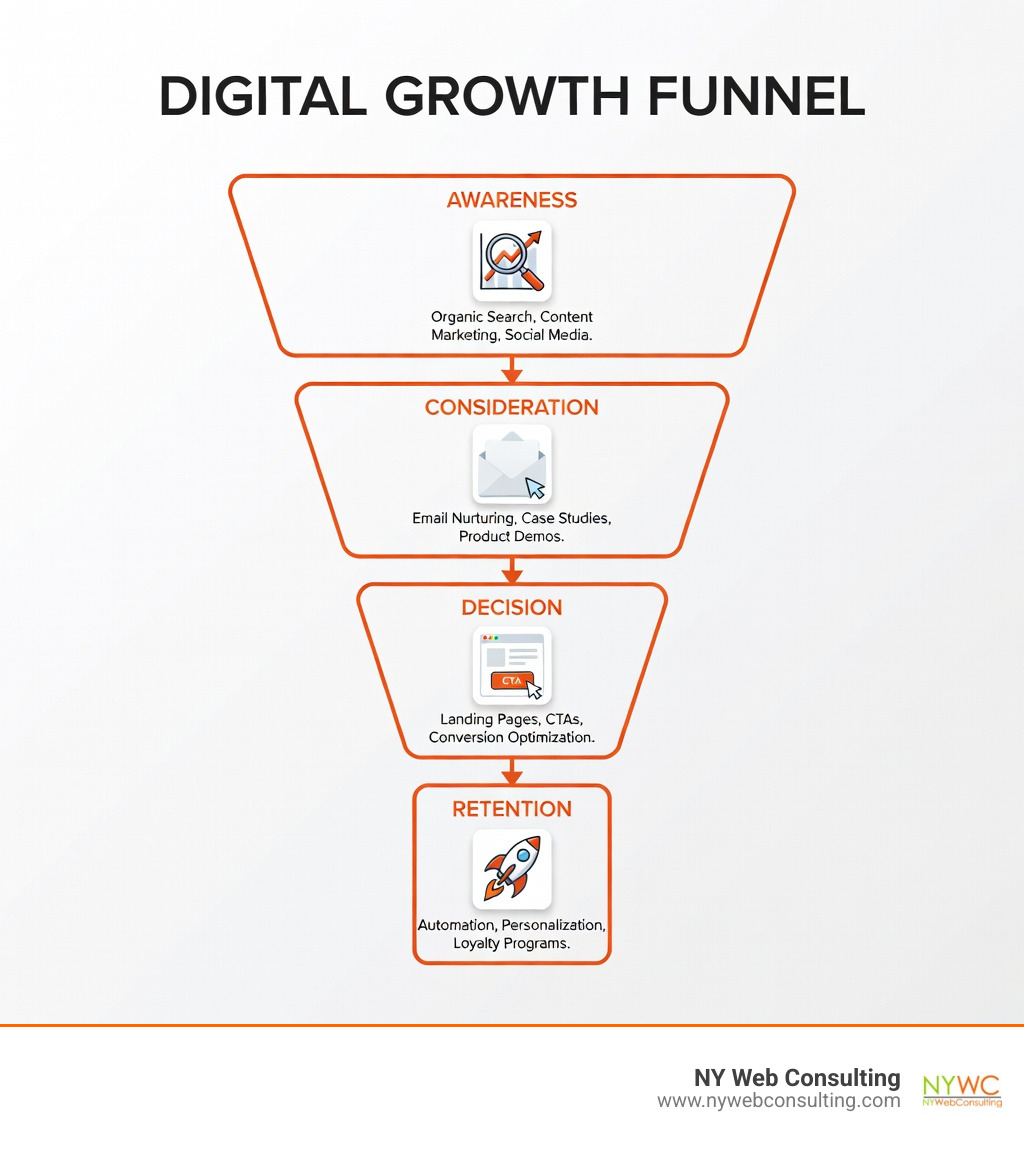
Simple guide to digital growth strategy:
Defining the Modern Digital Growth Strategy in 2025
To understand a digital growth strategy in 2025, we have to look beyond simple social media posts or having a “pretty” website. Modern growth is about digital transformation—the process of using technology to fundamentally change how you provide value to your customers. It isn’t a one-time project; it’s an ongoing optimization process.
The landscape has evolved significantly. According to Gartner, 91% of businesses are engaged in some form of digital initiative, and 87% of senior business leaders say digitalisation is a priority. However, the “new growth game” is now played at a hyper-granular level. It involves spotting opportunities in the data that your competitors are ignoring. For our neighbors in Glendale and across NYC, this means moving away from “spray and pray” marketing and moving toward marketing for small businesses that is precise, agile, and scalable.
The 5 Pillars of a Successful Digital Growth Strategy
We’ve identified five core pillars that sustain any high-performing growth engine today:
- AI Intelligence: This isn’t just about chatbots. It’s about using AI-driven personalization to produce content 50% faster and improve team efficiency by 53%. It’s about predictive scoring to find your best leads before they even fill out a form.
- Omnichannel Experience: Customers expect a seamless transition from your Instagram ad to your mobile site to their email inbox. Deloitte’s 2025 US Retail Outlook lists omnichannel experience enhancement as a top-three growth lever—outranking even store expansion.
- Data-Driven Content: Content is the backbone of your strategy. By using advanced SEO strategies, we ensure your content isn’t just “good,” but specifically engineered to answer the questions your target audience is asking in Google.
- Advanced Attribution: You need to know exactly which dollar is making you five more. In 2025, we use server-side tracking and sophisticated models to overcome the privacy hurdles introduced by iOS 14.5.
- Agile Testing: The fastest-growing companies treat their digital presence as a continuous experiment. DocuSign achieved a 35 % mobile-conversion lift simply by removing non-essential form fields. We apply this same “test-and-learn” mindset to every campaign.
Digital Growth vs. Traditional Marketing
Traditional marketing often asks, “How can we get more traffic?” A digital growth strategy asks, “How can we systematically increase customer lifetime value while reducing acquisition costs?”
Traditional marketing relies on broad reach and intuition. Digital growth relies on targeted data and adaptability. Scientific research on digital acceleration shows that the ability to reallocate resources at “digital speed”—moving budget from a failing ad to a winning one in hours, not months—is what separates market leaders from laggards. We don’t just want to be seen; we want to be measured.
High-ROI Channels: Building Your Growth Mix
Choosing the right channels is like picking the right ingredients for a recipe. If you use the wrong ones, the whole thing falls flat. In 2025, the “right mix” usually starts with a foundation of high-ROI channels.

Leveraging Content and Social Media
Content marketing is the gift that keeps on giving. Content marketing delivers 3x more leads than traditional advertising at 62% lower cost. But in 2025, the “type” of content matters. Video marketing is now non-negotiable, with 92% of video marketers reporting a positive ROI.
For local NYC businesses, social media isn’t just for “likes.” A staggering 92% of marketers rely on social media ads for building awareness. When you combine social media with our SEO services NYC, you can see up to a 50% higher ROI because you’re attacking growth from both the “discovery” and “search” sides. To maintain quality, many teams now use tools like an Attrock AI content detector to ensure their AI-assisted writing still feels human and authoritative.
The Power of Email and Automation
If you think email is dead, you’re missing out on the highest-performing channel in existence. Email marketing delivers an average ROI of $40 for every $1 spent.
The secret in 2025 is automation and personalization. We don’t send “blasts”; we send triggers based on user behavior. However, with great power comes great responsibility. Businesses must adhere to laws like the CAN-SPAM Act, which establishes clear rules for commercial messaging. By building a high-quality, opt-in list, you create a “owned” audience that you can nurture into customers without paying for ads every time you want to talk to them. This is a core feature of the top lead generation sites we build for our clients.
Data-Driven Execution: SMART Goals and KPIs
You cannot manage what you do not measure. Most businesses fail because they focus on “vanity metrics” like follower counts instead of “North Star Metrics” like net profit or cost per qualified lead.
Identifying and Understanding Your Target Audience
The foundation of any growth strategy is understanding your customers at a granular level. We don’t guess; we use data. AI-powered analytics can process customer data 10x faster than traditional methods, revealing patterns humans might miss.
We use tools like Google Analytics and Google Search Console to see exactly what your audience is searching for and where they are dropping off on your site. For Glendale businesses, this often means implementing local SEO solutions to capture high-intent “near me” searches.
Integrating Digital Growth with Sales Efforts
Marketing shouldn’t live on an island. If your digital strategy is generating leads but your sales team isn’t closing them, the system is broken. We use CRM (Customer Relationship Management) tools to bridge this gap.
A unified approach ensures that when a lead comes in through a website built using the anatomy of a lead generation website best practices, your sales team has the full context of what that person clicked on and what their pain points are. This “warm” handoff is what drives 2-3x faster revenue growth.
Common Pitfalls in Digital Growth Implementation
Even with the best intentions, many businesses stumble. The most common mistake? Neglecting the customer experience. After one poor experience, 86% of customers would quit connecting with a brand they like.
Other pitfalls include:
- Siloed Teams: Marketing and Sales not talking to each other.
- Ignoring Data: Making decisions based on “gut feeling” rather than what key performance indicators (KPIs) are telling you.
- Trying to do Everything: Spreading a small budget across 10 channels instead of mastering two or three.
Neglecting the Customer Journey
A successful digital growth strategy considers the entire journey, from the first time someone hears your name to the moment they become a repeat customer. We use a customer journey map to identify friction points. Is your checkout process too long? Does your mobile site load slowly? In a city as as New York, a three-second delay can cost you a sale.
Overlooking Data Privacy and Transformation
Privacy isn’t just a legal hurdle; it’s a competitive advantage. Apple’s iOS 14.5 update forced marketers to develop new attribution models that don’t rely on third-party cookies. The winners in 2025 are those who focus on “first-party data”—information you collect directly from your customers through value exchanges, like offering a free guide in exchange for an email address.
Scaling and Optimization
Once you’ve found a combination of channel and message that works, it’s time to pour gasoline on the fire. This is where we transition from a “foundation” to a “growth engine.”
| Feature | Growth Hacking | Digital Growth Strategy |
|---|---|---|
| Focus | Short-term “hacks” & virality | Long-term sustainable systems |
| Primary Goal | Rapid user acquisition | Increasing Customer Lifetime Value (CLV) |
| Data Usage | Tactical A/B testing | Holistic data ecosystem & AI |
| Sustainability | Low – tricks often get patched | High – builds brand authority |
Scaling Your Digital Growth Strategy from Foundation to Engine
Scaling isn’t just about spending more money. It’s about automation and geographic expansion. McKinsey digital leader insights show that companies fusing mature digital capabilities with AI grow EBITDA five times faster. We help you identify which parts of your funnel are ready to scale using our lead generation sites ultimate guide.
Budgeting and Resourcing for Long-Term Success
How much should you spend? A good rule of thumb for growing businesses is to allocate 20-25% of your total budget to marketing. However, the real metric to watch is your LTV:CAC ratio (Lifetime Value to Customer Acquisition Cost). You want this ratio to be at least 3:1.
We recommend a “70/20/10” budget split:
- 70% on proven channels (like SEO and Email).
- 20% on optimizing existing campaigns.
- 10% on experimental “big bets” (like new AI tools or emerging social platforms).
Only 23% of marketers are confident they track the right KPIs, so investing in a solid measurement setup is the first place your budget should go.
Frequently Asked Questions about Digital Growth
What is the difference between digital growth and growth hacking?
Growth hacking is about finding short-term, “scrappy” ways to get users (like a viral referral program). A digital growth strategy is a long-term, systematic plan that builds a sustainable engine for revenue. Hacking is a tool; strategy is the blueprint.
How has AI changed digital growth strategies in 2025?
AI has moved from being a “cool tool” to the core of the operating model. It allows for hyper-personalization at scale. Instead of sending one email to 1,000 people, AI helps us send 1,000 different emails tailored to each individual’s behavior, leading to 50% faster content production.
What are the most important KPIs for measuring digital growth?
While every business is different, the “Big Three” are usually:
- Customer Acquisition Cost (CAC): How much it costs to get a new customer.
- Customer Lifetime Value (LTV): How much that customer is worth over time.
- Conversion Rate: The percentage of visitors who take a desired action.
Conclusion
At NY Web Consulting, we believe that a digital growth strategy is the only way to stay competitive in a market as crowded as New York City. We don’t just build websites; we build lead-generation machines that increase your brand’s digital value over time.
By focusing on the five pillars—AI intelligence, omnichannel optimization, data-driven content, advanced attribution, and agile testing—you can stop guessing and start growing. Whether you’re in Glendale, Queens, or Manhattan, the digital landscape of 2025 offers unprecedented opportunities for those ready to take a data-driven approach.
Ready to see how a custom strategy can transform your business? Learn more about our web design and growth services here and let’s start building your engine for sustainable success.