

Why Marketing for Small Businesses is Your Path to Growth
Marketing for small businesses is about getting your products or services in front of the right people at the right time. Here’s what you need to know:
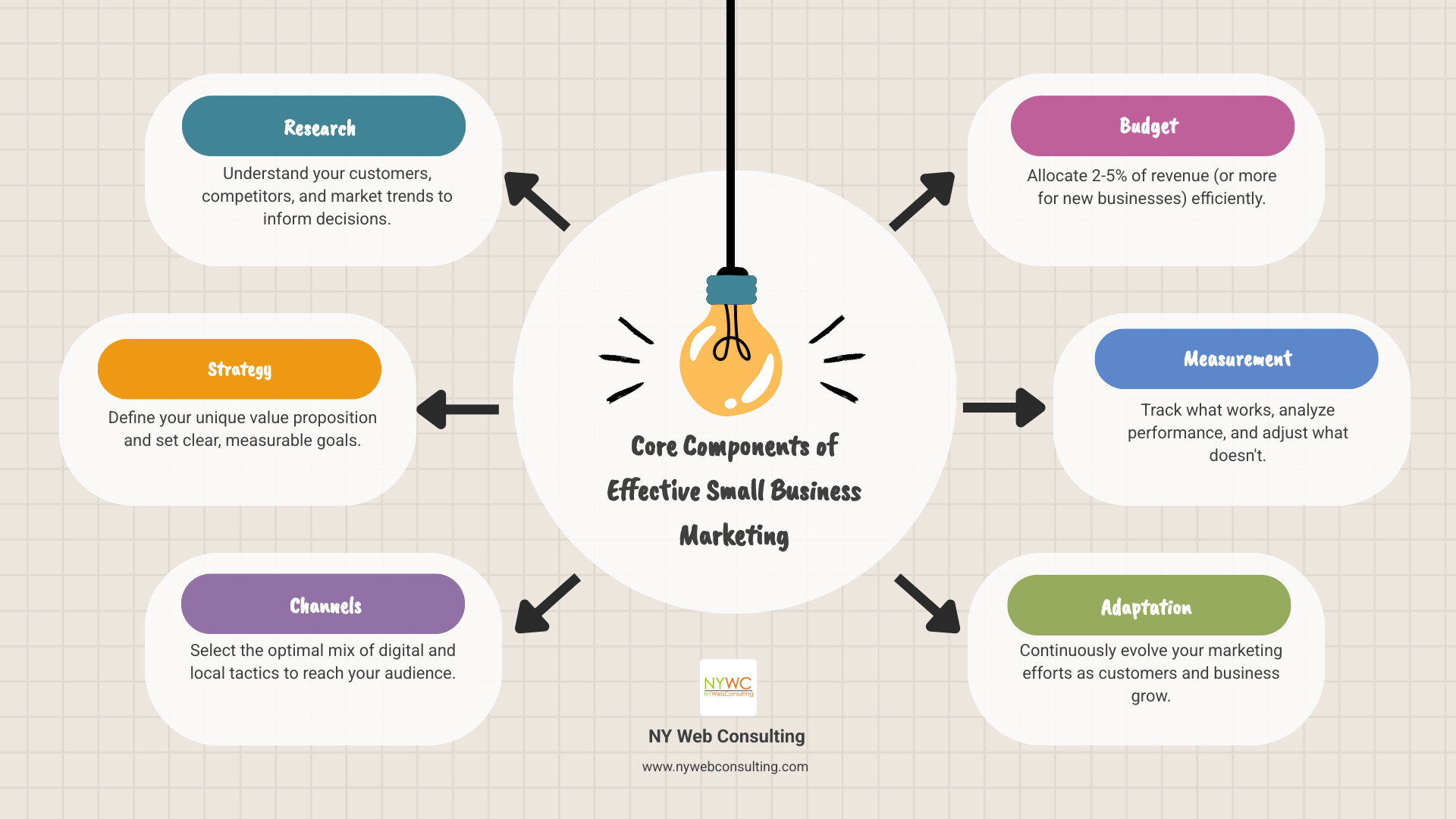
Core Components of Effective Small Business Marketing:
- Research – Understand your customers, competitors, and market trends
- Strategy – Define your unique value and set clear, measurable goals
- Channels – Choose the right mix of digital and local tactics
- Budget – Allocate 2-5% of revenue (or more for new businesses)
- Measurement – Track what works and adjust what doesn’t
Here’s the truth: you don’t need a massive budget to compete. Unlike big companies, small businesses have agility. You can test ideas quickly, pivot based on feedback, and build real customer relationships.
The digital landscape has leveled the playing field. Tools once exclusive to large corporations are now widely available. With nearly 95% of people reading reviews before a purchase and the top Google result capturing approximately 29% of all clicks, the opportunity is immense.
But marketing isn’t “set it and forget it.” It evolves as your customers change and your business grows. You need a foundation—a strategy that connects who you are with what your customers actually need.
I’m Brian Butrym, and I’ve spent years helping small businesses turn their websites into lead-generating machines through strategic web design and marketing. Throughout this guide, I’ll show you exactly how marketing for small businesses works—from building your foundation to choosing the right channels and measuring real results.
Glossary for marketing for small businesses:
Building Your Foundation: Strategy and Planning
Just as you need a blueprint for a house, you need a solid plan for your marketing for small businesses before you start executing tactics.
A marketing plan is a roadmap detailing how you’ll reach customers, persuade them to buy, and measure success. It keeps you focused and prevents wasted resources.
The first step is understanding your landscape through market research. This means learning how your customers think and behave, what your competitors are doing, and spotting market trends. The SBA offers practical guidance on market research and competitive analysis that’s worth your time.
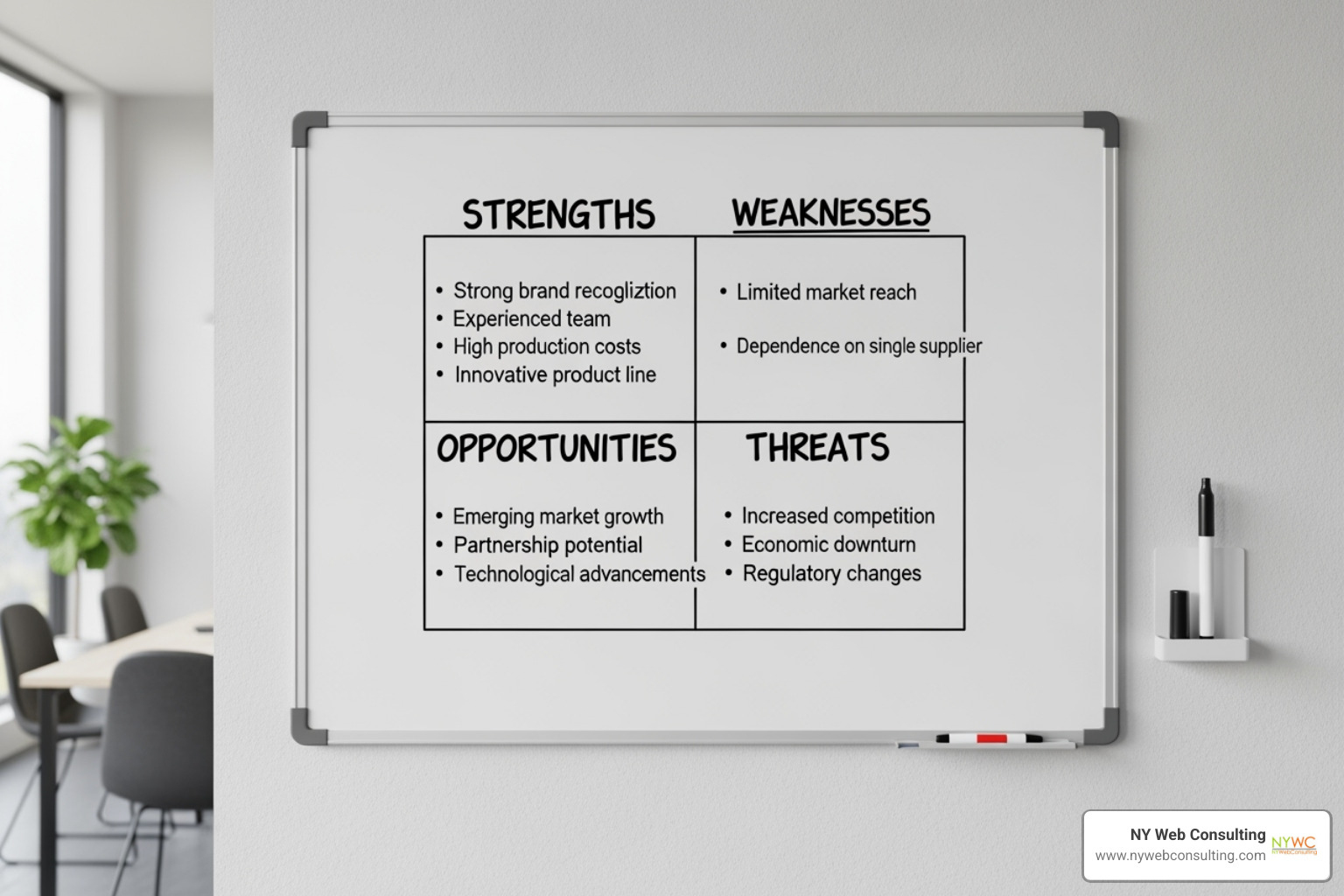
Next comes the SWOT analysis—Strengths, Weaknesses, Opportunities, and Threats. This is an honest assessment of your business that helps you position yourself against competitors and identify new market segments.
With this information, you can build your marketing plan. It should include your target market, competitive advantage, sales approach, specific goals, action steps, and budget. Marketing also informs decisions about your product, pricing, and service delivery.
Plan to revisit your strategy at least once a year, as the market is constantly changing.
To track progress, use SMART goals—Specific, Measurable, Attainable, Relevant, and Time-based. Instead of “get more customers,” a better goal is “acquire 20 new customers through SEO by June 30th.” One is a wish; the other is a target you can hit.
Identifying Your Target Audience
Marketing to “everyone” is expensive and ineffective. Instead, you need to know exactly who you’re talking to.
Segment your potential customers based on geography (where they live), demographics (age, income), behavior (how they shop), and lifestyle (what matters to them).
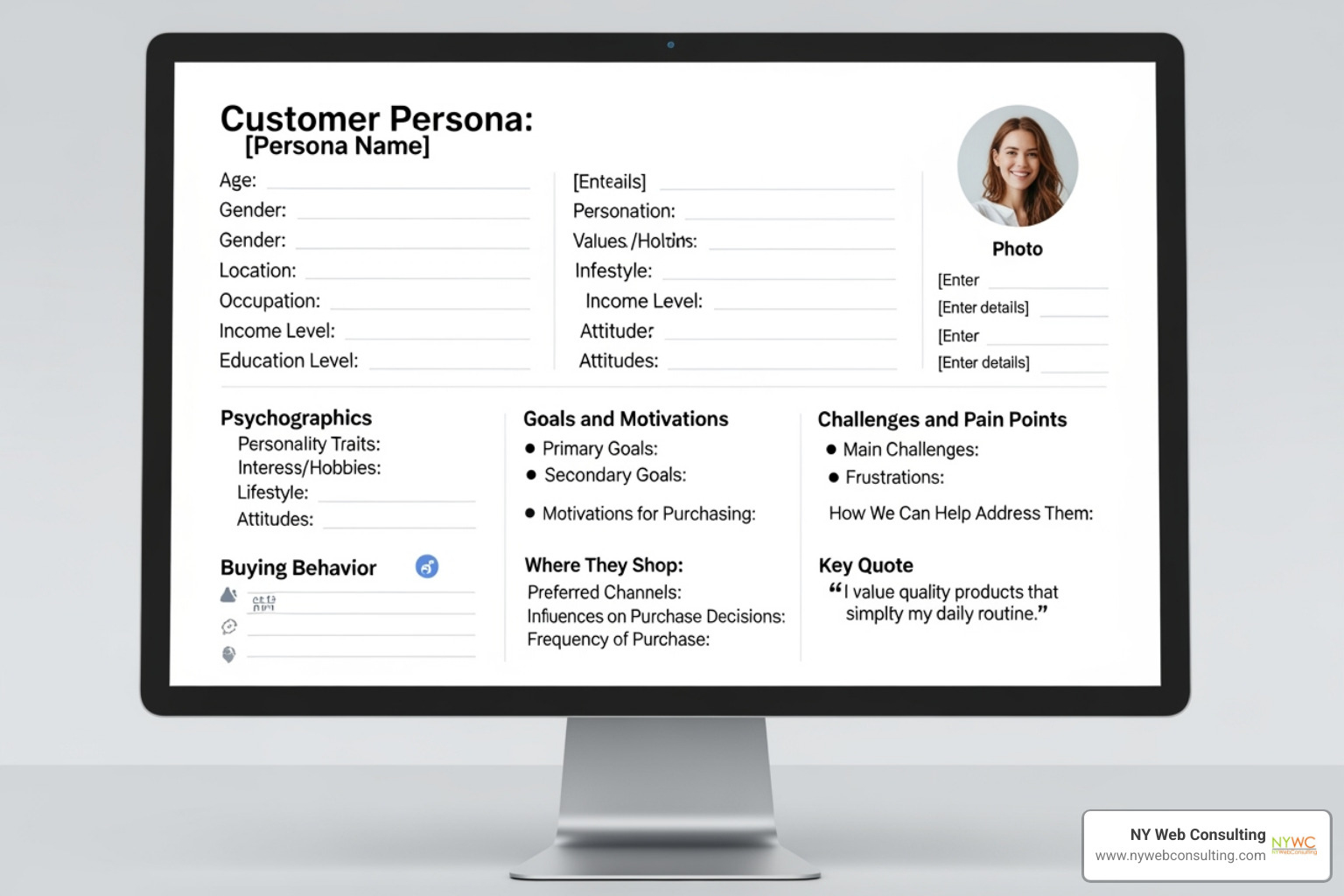
The most powerful tool for this is the customer persona—a detailed profile of your ideal customer based on real data. Personas dig into pain points, needs, and buying objections, clarifying how your solution solves their problems.
For example, a web design business might have a persona like “Frustrated Frank,” a 45-year-old business owner whose outdated website is costing him leads. He values reliability and needs to see case studies before committing. This level of detail informs your website copy, sales calls, and marketing channels.
Mapping the user’s mind and their journey helps you understand where your marketing should meet them. In fact, 66% of customers expect companies to understand their unique needs.
Crafting Your Brand and Unique Selling Proposition (USP)
Once you know who you’re talking to, you need to define what you’re saying.
Your brand identity is the emotional connection customers feel with your business. It’s the entire experience: your logo, colors, tone, and values. A cohesive brand identity makes you memorable.
Define your brand voice and tone. Whether you’re witty, authoritative, or empathetic, stay consistent across your website, social media, and all customer interactions.
Authentic storytelling matters. People connect with why you do what you do and how you make their lives better.
Your Unique Selling Proposition (USP) is your answer to the question: “Why should I choose you instead of someone else?” It’s the specific, tangible reason you’re the better choice—perhaps you’re faster, more specialized, or offer exceptional customer service. Learning to shape your unique value proposition is critical for standing out.
Focus on benefits, not features. Customers don’t care that your website “uses responsive design”; they care that they can easily browse on their phones and make a purchase.
Your competitive advantage might be quality, price, expertise, or service. Whatever it is, own it and make it obvious in all your marketing. In marketing for small businesses, clarity wins.
Essential Marketing for Small Businesses: Channels and Tactics
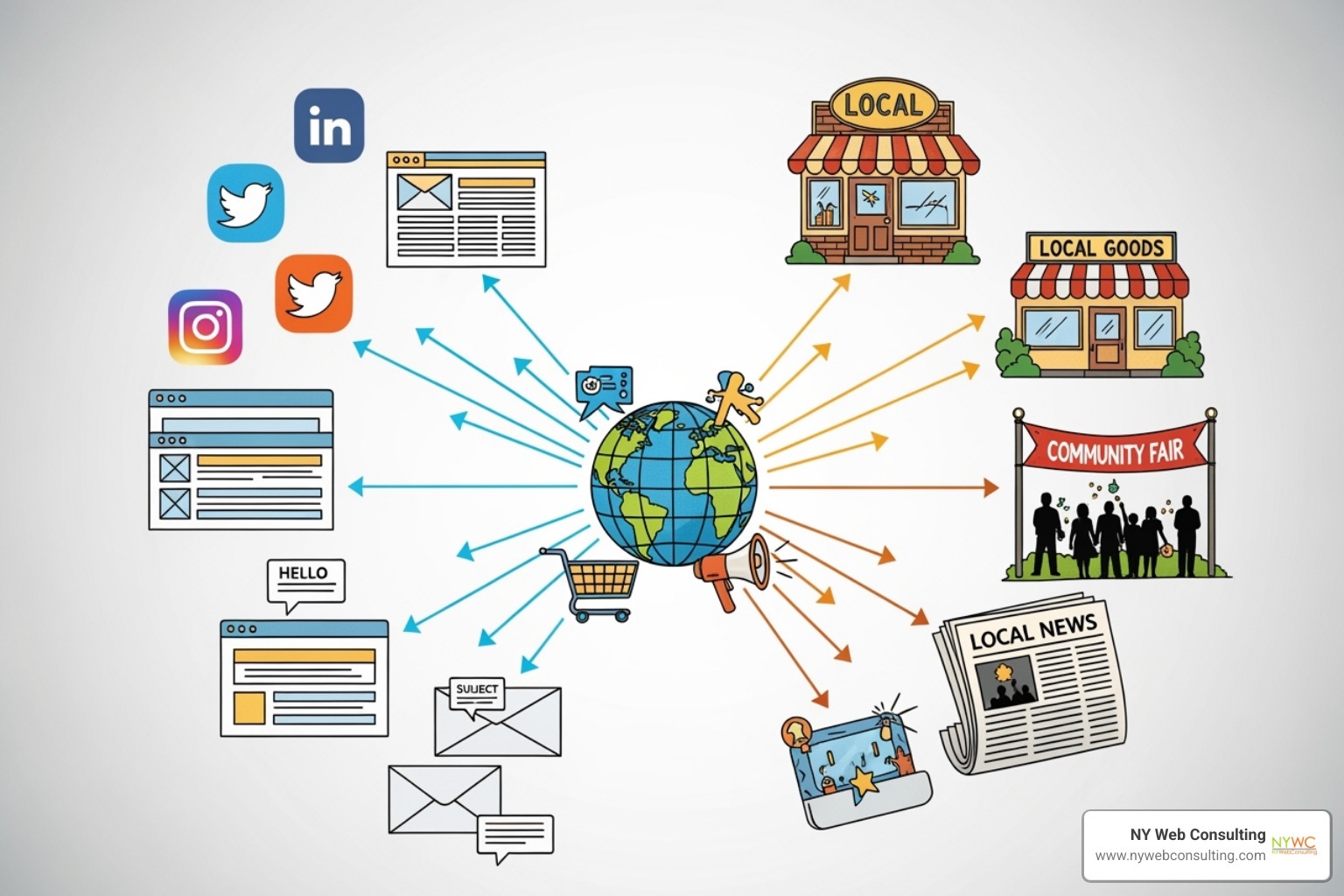
With a solid foundation, it’s time to choose your marketing channels—the doors through which customers will find you. Marketing for small businesses isn’t about doing everything; it’s about doing the right things well.
While digital channels offer great reach, traditional methods still matter. A handshake at a local event or a thank-you note builds loyalty that algorithms can’t replicate. Nurture relationships to turn first-time buyers into lifelong advocates.
Personalization is no longer optional, as 80% of adults expect a custom shopping experience. Combining smart digital tactics with authentic community engagement creates a marketing mix that feels more like a conversation than an advertisement.
Mastering Digital Marketing for Small Businesses
Digital marketing is where small businesses can be nimble, targeted, and authentic.
Search Engine Optimization (SEO) is your 24/7 workhorse. When local customers search for your services, SEO determines if they find you. The top Google spot gets roughly 29% of all clicks. SEO involves keyword research, helpful content, and backlinks to build lasting visibility. We’ve written about advanced SEO strategies and our SEO services help New York City businesses climb the rankings.
Content marketing builds trust by sharing helpful knowledge through guides, articles, and videos. This showcases your expertise, keeps you top-of-mind, and supports your SEO efforts.
Social media marketing is about conversation, not broadcasting. With 55% of users finding new brands on social media, choose the platforms your audience uses (like Facebook, Instagram, or LinkedIn) and engage authentically to build a community.
Email marketing remains a top channel for customer communication with a high ROI. Build your list by offering value, segmenting your audience for relevance, and using automation. Tools like Constant Contact can help, and SMS marketing can complement your strategy for time-sensitive offers.
Video marketing connects on a human level, with 87% of marketers reporting it directly increased sales. Use short clips or longer educational content to tell your story and build emotional connections that drive sales.
The Power of a Professional Online Presence
Your website is your hardest-working employee, always ready to serve customers.
Your website is your digital storefront, open 24/7. It’s where customers form their first impression, which influences 90% of their perception of your business. A whopping 99% of marketers use their website as a primary marketing channel.
With over 70% of internet access happening on phones, your site must be mobile-friendly. Focus on fast loading, easy navigation, and ADA compliance. While DIY website builders exist, professional web design services create sites that convert visitors into customers. Learn more about the anatomy of a lead generation website.
Your Google Business Profile is essential for local businesses. This free tool lists you on Google Maps and in local search results. Create your Google Business Profile with accurate, consistent information, add photos, and post updates. We’ve seen the power of creating a Google Business Profile in 2023.
Online reviews are critical, as nearly 95% of people read them before buying. Displaying reviews can boost conversions by 270%. Respond to all feedback—positive and negative—to show you’re engaged and care about customer experience.
Connecting with Your Community Through Local Marketing
Local marketing focuses on building goodwill in your own backyard.
Local SEO and “near me” searches are crucial, with searches for local products and services exploding. Weave local keywords (e.g., “Web Design Queens NY”) into your website content and get listed in local directories to make it clear you serve the neighborhood. Our New York SEO Consultant services specialize in this hyperlocal visibility. Google’s research on “Near Me” searches reveals just how critical this has become.
Community events and sponsorships put a face to your business. Sponsoring a local team, participating in street fairs, or hosting a workshop are investments in your community that build goodwill and brand recognition. Resources like NYC Small Business Services (SBS) can help you find local opportunities.
Local partnerships and networking expand your reach without increasing your budget. Partner with complementary businesses for cross-promotion, co-host events, or create package deals. Join local business associations like the Chamber of Commerce to build a network of referral sources and collaborators. The SBA offers practical advice on marketing in your community.

Budgeting and Measuring for Success
Success in marketing for small businesses isn’t about having the biggest budget; it’s about spending smart and measuring results.
A common guideline is to allocate 2% to 5% of your revenue to marketing, though new businesses may invest more to build awareness. This budget covers costs like digital ads, content creation, tools, and local events.
Calculating Return on Investment (ROI) shows if your marketing is profitable. Divide the revenue from a campaign by its cost. A positive ROI means your strategy is working. For example, Salesforce customers often achieve a positive ROI in just 9 months.
Here’s a quick comparison of popular digital marketing channels:
| Channel | Cost (Relative) | Time to Results | Long-Term Value |
|---|---|---|---|
| SEO | Low-Medium | Medium-Long | High (organic traffic, authority, brand awareness) |
| PPC Advertising | Medium-High | Fast | Medium (immediate visibility, but stops when budget ends) |
| Social Media Marketing (Organic) | Low | Medium-Long | High (community building, brand loyalty, direct engagement) |
| Email Marketing | Low | Medium | High (direct communication, retention, high ROI) |
For businesses needing immediate visibility, our targeted PPC Advertising services can help you get in front of customers fast while you build your organic presence.
Setting Goals and Tracking Your Marketing ROI
You can’t improve what you don’t measure. Your goals should be SMART: Specific, Measurable, Attainable, Relevant, and Time-based. For example, aim to “increase website traffic by 15% next quarter” instead of just wanting “more traffic.”
Track progress with Key Performance Indicators (KPIs) like Website traffic, Conversion rates, Customer Acquisition Cost (CAC), and Customer Lifetime Value (CLV). These metrics reveal what’s working and where to improve.
Google Analytics is a free, powerful tool for tracking visitor data and understanding customer behavior. Simply create a Google Analytics account and add the tracking code to your site to get started. There’s a helpful tutorial for assistance. You can even link Google Analytics to your Salesforce Sales Cloud account for more integrated data.
Data-driven decisions are key. Half of small and midsize companies in the U.S. now use a CRM system, showing a trend toward smarter investment of time and money.
Cost-Effective Marketing for Small Businesses on a Budget
A tight budget requires strategic and creative marketing. Many powerful tactics cost more time than money.
Leverage free tools. A Google Business Profile is essential for local search. Use social media platforms for organic engagement. Google Analytics provides free website tracking. Many email marketing platforms have free tiers, and Canva helps create professional graphics.
User-generated content is marketing gold. Encourage customers to share photos, videos, or reviews. This authentic content is free and builds more trust than traditional ads.
Referral programs turn happy customers into a sales force. Offer small incentives for referrals to amplify word-of-mouth marketing.
Focus on organic social media engagement. Join conversations and answer questions to build a genuine community. This takes time but creates loyal customers.
Building an email list should be a priority. Email marketing offers one of the highest ROIs and is a preferred communication channel for customers.
Sharing your expertise through free advice, like blog posts or workshops, positions you as an authority and builds trust.
Local collaborations with complementary businesses expand your reach without expanding your budget.
The SBA offers additional advice on getting more from your marketing budget. Whatever your budget, track your ROI to understand what’s working and adjust your strategy accordingly.
Frequently Asked Questions about Small Business Marketing
How much should a small business spend on marketing?
There’s no single magic number. A general guideline is to spend between 2% to 5% of your annual revenue on marketing. New or growth-focused businesses might invest more, around 10-12%, to gain traction.
The right amount depends on your industry, goals, and business stage. A Glendale coffee shop has different needs than a Manhattan consulting firm. The key isn’t the amount spent, but ensuring every dollar delivers a measurable return. Track what works and adjust your budget accordingly.
What is the most effective marketing for a small business with a limited budget?
With a limited budget, focus on high-impact, low-cost marketing for small businesses. Start with a free Google Business Profile for local visibility and use organic social media to build community. These relationships cost only your time.
Email marketing offers one of the highest ROIs for nurturing leads, and many platforms have free starting tiers. Create valuable content—like blog posts or videos—to establish your expertise and improve search rankings.
Leverage your existing customers through referral programs and partner with other local businesses for cross-promotion. Success hinges on clear goals, a defined audience, and a resonant brand message, especially since 80% of consumers want personalized experiences.
How can I compete with larger businesses that have bigger marketing budgets?
You can compete with larger businesses by leveraging your unique advantages: agility and personalization. While they are slow, you can pivot quickly. While they are impersonal, you can build genuine customer relationships.
Focus on a specific niche and become the go-to expert. Own your specialty, whether it’s sustainable renovations in Queens or allergen-free cakes.
Use your local advantage. Engage with your community, optimize for “near me” searches, and build partnerships with neighborhood businesses. Be the trusted local expert who shows up.
Digital marketing levels the playing field. A smart SEO strategy, engaging social media, and targeted email campaigns can outperform a large ad spend. Our web design services are built to help small businesses leverage these advantages online.
Emphasize what makes you different and better—your service, quality, or community involvement. Make that the centerpiece of your marketing message.
Conclusion: Start Growing Your Grind Today
We’ve covered the essentials of marketing for small businesses, from strategy and channels to budgeting and measurement. While it may seem overwhelming, you have the tools to succeed.
Marketing is a continuous process. As markets and customers evolve, your small business advantage—agility and the ability to build real relationships—becomes your greatest asset.
The core components—research, strategy, channels, budget, and measurement—work together to create a marketing approach that is uniquely yours.
Your digital foundation is critical. A fast, secure, and SEO-friendly website is not a luxury; it’s your 24/7 salesperson and an essential tool for converting visitors into customers.
Here at NY Web Consulting, we help small businesses in Glendale, Queens, and across New York City turn their websites into powerful lead-generating machines. We build strategic tools for your business, focusing on user experience and technology that drives growth. Our focus is simple: turning your online presence into a growth engine.
You don’t need the biggest budget. You need the right strategy, a willingness to adapt, and a strong digital foundation.
So, what’s your next step? Start with one thing: optimize your Google Business Profile, build your email list, or upgrade your website. Take that first step today. Every successful business started with one.
Ready to stop leaving money on the table? Let’s build something great together. Transform your website into a lead-generating machine with our expert Web Design Services.