

The Strategic Evolution from Basic to Advanced SEO
Advanced SEO strategies are techniques requiring a deep understanding of search algorithms, user behavior, and marketing technology to achieve a competitive edge. Here’s what sets them apart:
Key Advanced SEO Strategies:
- Technical Mastery: Core Web Vitals optimization, log file analysis, and schema markup
- Content Intelligence: Topic clusters, intent-based optimization, and content pruning
- Authority Building: Strategic link building, content alliances, and digital PR
- Data-Driven Decisions: Advanced analytics, A/B testing, and AI integration
- SERP Dominance: Featured snippets, rich results, and maximum real estate capture
The digital landscape has evolved beyond basic keyword stuffing. Today’s advanced SEO requires a holistic approach that combines technical expertise with strategic thinking.
With over 200 ranking factors and Google updating its algorithm 500-600 times per year, practitioners must master everything from JavaScript SEO and crawl budget optimization to user experience signals and E-A-T principles.
While basic SEO covers foundational elements like keyword research, advanced SEO goes deeper. It involves understanding search intent, building topical authority with content clusters, and using data for strategic decisions that compound over time.
At NY Web Consulting, we help businesses transition to advanced strategies that drive real growth. Mastering advanced SEO strategies requires the technical skill and strategic vision to create websites that don’t just rank—they dominate their markets.
Mastering Content & Intent for Topical Dominance
Search engines act like smart librarians, aiming to understand user intent beyond keywords. This is where advanced SEO strategies shine.
User intent is the secret sauce separating good content from great. Understanding if a searcher is ready to buy, browsing, or looking for reviews lets you create content that genuinely helps them.
Building topic clusters is key. A central pillar page covers a broad topic, while smaller cluster pages dive into specific aspects, all connected by internal links. For example, a fitness site’s pillar page on “Marathon Training” could link to cluster pages on nutrition, injury prevention, and gear. This creates a web of expertise that search engines reward.
Strategic internal linking is an overlooked but powerful tactic. Linking between pages with descriptive anchor text tells Google, “Hey, this page has more great info about this topic,” guiding both search engines and visitors.
Keyword cannibalization, where multiple pages compete for the same search intent, is a common trap that hurts your SEO efforts.
Cornerstone content is your foundation—your most important, comprehensive pages that showcase your expertise. Every piece of content should have a clear purpose, whether it’s ranking, converting visitors, attracting backlinks, or establishing authority.
For more details on how we implement these strategies, check out our SEO Services.
Advanced Keyword Research for 2025
Advanced keyword research goes beyond popularity to find profitable and achievable terms.
Journalist keywords are terms reporters use. Creating content with unique data, statistics, or expert quotes attracts valuable links from media outlets.
Comparison keywords capture users who are close to buying. Someone searching “iPhone vs Samsung” is making a decision, and these terms often have lower competition but higher conversion rates.
Community-driven keyword research mines platforms like Reddit and forums for conversational keywords your competitors may have missed.
Google’s “People Also Ask” section is a goldmine for content ideas, revealing exactly what users want to know next. Answering these questions can capture significant long-tail traffic.
Long-tail keywords get fewer searches but often convert better due to their specificity. A search for “best waterproof running shoes for flat feet under $150” shows clear intent.
Our most effective approaches focus on understanding intent, mining community discussions, analyzing competitor gaps, and staying ahead of trends. The goal is finding the right keywords for your business.
Elevating Content Marketing and On-Page Elements
Great content marketing makes every piece work harder for your SEO goals.
Time to value is crucial. Use the “bottom line up front” approach by providing key information immediately to satisfy user queries quickly.
Content features like interactive calculators, comparison charts, and quote boxes make articles more useful and valuable. Google’s quality guidelines emphasize the importance of supplementary content for rankings.
Repurposing content maximizes its value. Combine weaker posts into a comprehensive guide or turn a popular article into a video series to expand your reach.
Sometimes the best strategy is removing underperforming content. If a page isn’t ranking, converting, or attracting links, it may be hurting your site’s overall quality.
Visual diversity keeps users engaged. Beyond static images, animated SVGs and high-quality animated graphics can increase time on site. Original images also outperform stock photos, helping establish authenticity and expertise.
The key is making every element serve both users and SEO goals. This balance creates content that not only ranks but also converts.
The Foundation of Advanced SEO Strategies: Technical SEO & UX
Technical SEO is the foundation of your website. Without a solid technical base, even the best content will fail. That’s why advanced SEO strategies prioritize technical excellence.
Core Web Vitals are Google’s metrics for user experience, measuring load speed, interactivity, and visual stability. When we optimize site speed, we’re not just chasing rankings; we’re creating websites people enjoy using.
A one-second page load delay can reduce conversions by 7%, highlighting the financial impact of technical performance. With Google’s mobile-first indexing, your mobile-friendliness is paramount, as your mobile site is the primary version Google evaluates for ranking.
Log file analysis reveals how search bots crawl your site. This helps optimize your crawl budget, ensuring Google focuses on your most important pages. This advanced technique can uncover wasted crawl activity or identify when crucial content is being missed.
Schema markup is another game-changer. By implementing structured data following Google’s guidelines, we help search engines understand your content’s meaning—distinguishing a price from a rating, for example. This often leads to eye-catching rich results that make your listing stand out.
Maximizing SERP Real Estate
Maximizing SERP real estate is a key part of advanced SEO strategies. It’s about taking up more space on the results page to increase visibility and clicks.
Featured snippets, or “position zero,” answer a user’s question directly on the results page. We achieve this by structuring content with clear headings and providing concise answers.
Rich snippets, enabled by schema markup, improve your listings with ratings, prices, or event dates. They provide more information at a glance and attract more clicks.
Visual elements like video carousels and image packs offer more opportunities to capture attention. Repurposing content into videos and optimizing images with alt text creates multiple pathways for users to find you.
Q&A pages directly target how people search. Building pages that answer “People Also Ask” questions serves users and formats content perfectly for search engines.
For local businesses in Glendale, Queens, and NYC, an optimized Google Business Profile is critical. It ensures you appear prominently in local searches and on Google Maps. Learn more about The Power of Creating a Google Business Profile in 2023.
Maximizing SERP real estate can boost visibility and traffic without necessarily improving your ranking position.
Building Authority with Advanced Off-Page Signals

Link building is a difficult but essential part of SEO. Advanced SEO strategies for building high-quality backlinks are crucial for improving your domain authority and search rankings.
Advanced strategies for building high-quality backlinks
- Content Collaboration: Partner with other businesses on content. Sharing data or expertise creates valuable assets that naturally attract links, like a co-authored industry report.
- Resource Page Link Building: We identify resource pages on authoritative sites in your niche and propose your high-quality content as a valuable addition.
- Unlinked Brand Mentions: We monitor for online mentions of your brand that don’t include a link. Reaching out to request a link is an easy, ethical way to build backlinks.
- Guest Blogging: Advanced guest blogging involves placing high-value content on authoritative, relevant sites to earn a powerful backlink.
- Digital PR: This involves creating newsworthy content (like unique research or compelling infographics) to attract media attention and organic links from high-authority publications.
Leveraging Social Media and Paid Ads for SEO Gains
While not a direct ranking factor, social media plays a crucial supporting role in advanced SEO strategies.
- Social Sharing: Create shareable content and promote it on social channels. Integrating share buttons boosts exposure, attracts backlinks, and drives organic traffic.
- Optimizing Social Media Profiles: Fine-tuning your social media profiles with relevant keywords and a link to your website can increase visibility and traffic. An active presence builds trust and credibility.
- Using Paid Ads for Link Building: Strategically run paid ads to boost the visibility of informational content. This increased exposure can lead to more organic backlinks, a tactic especially useful for local businesses in NYC or Queens.
- Social Media SEO Tactics:
- Repurposing Content: Turn blog posts into videos for YouTube or updates for LinkedIn and X.
- Community Engagement: Use platforms like Reddit to find information gaps and low-competition keywords.
- Brand Awareness: Drive brand recognition and direct traffic to indirectly boost search visibility.
- Customer Service: Use social channels for customer support to build positive sentiment.
Measuring Success and Adapting to the Future of SEO

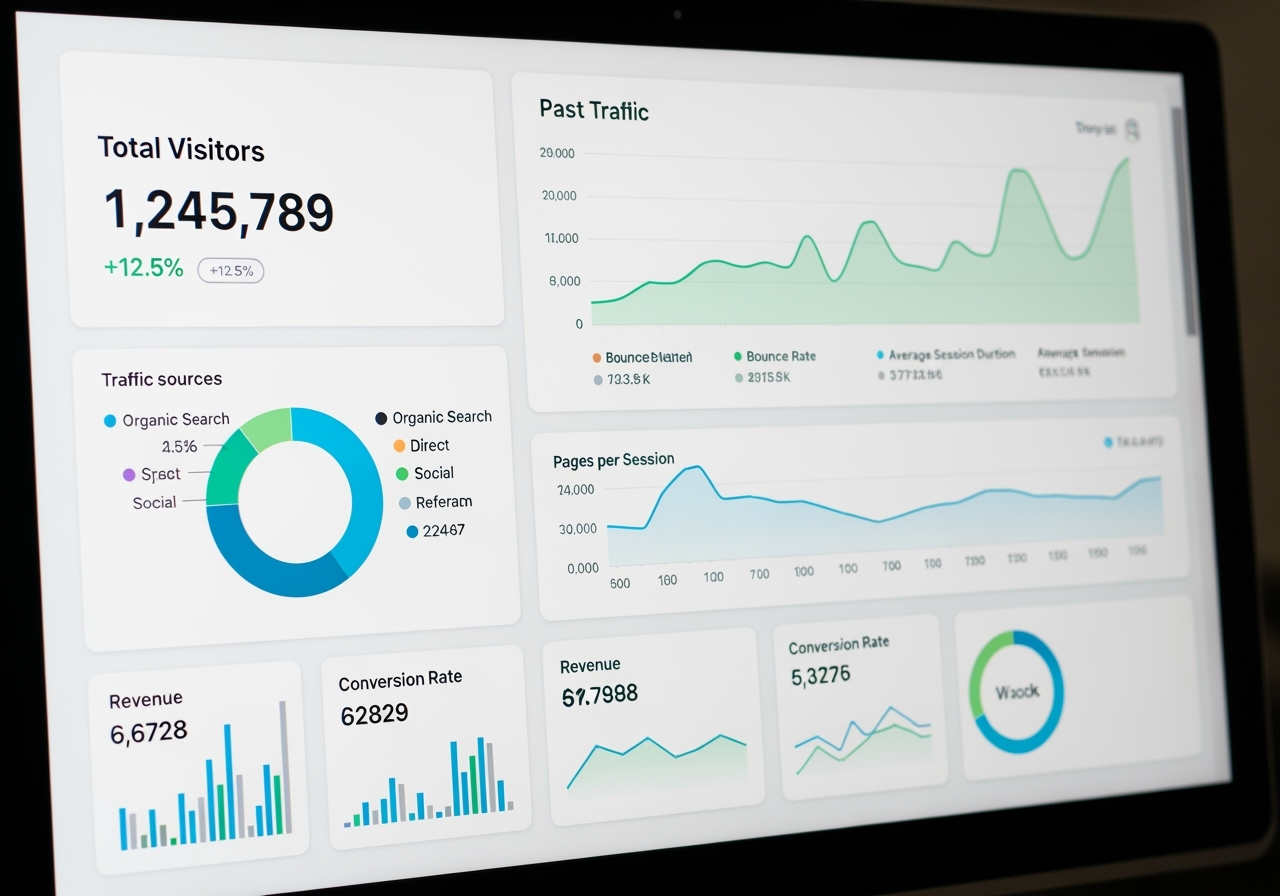
The beauty of advanced SEO strategies is their measurability. However, many businesses mistakenly focus on vanity metrics. A traffic increase is meaningless if those visitors don’t engage or convert.
Key SEO metrics that truly matter include organic traffic quality, user engagement (time on page, bounce rate), conversion rates, and the bottom-line impact on leads and sales. At NY Web Consulting, we know that celebrating traffic increases while revenue stays flat isn’t success.
Google’s GA4 Analytics is our go-to tool for tracking meaningful metrics. It provides deep insights into user behavior, which is crucial for refining strategy and driving real business growth.
The SEO world never sits still, with Google updating its algorithm 500-600 times per year. Staying informed isn’t about panicking; it’s about understanding trends and adapting your strategy accordingly.
A/B testing removes the guesswork from optimization. We test different versions of elements to see what performs better, ensuring every change is backed by data.
| Element to Test | Potential Impact |
|---|---|
| Page Title Tags | Click-Through Rate (CTR), perceived relevance |
| Meta Descriptions | CTR, user expectations |
| H1 Text | User engagement, perceived content relevance |
| Content Length | Dwell time, comprehensive coverage, user satisfaction |
| Visuals (type, placement) | Engagement, time on site, emotional connection |
| Call-to-Action (CTA) | Conversion rates, user action |
| Internal Link Anchor Text | User navigation, search engine understanding of linked page’s topic |
Integrating AI into your advanced SEO strategies
If you’re not using AI to improve your advanced SEO strategies, you’re working harder than you need to.
AI for keyword clustering automates the tedious process of grouping keywords by intent. This allows for faster identification of content opportunities and the creation of more targeted pages.
AI for content audits is a game-changer for large websites. AI tools can scan your entire site to identify underperforming content, duplicate topics, and content gaps.
AI for automation handles repetitive but important tasks like multi-lingual keyword translation, redirect mapping for site migrations, or generating contextually relevant internal link anchor text.
With the rise of AI-generated content, AI humanizers like the one from AI humanizer are becoming essential. They refine text to sound more natural and authentic, as no one wants to read robotic content.
The key is using AI to handle repetitive tasks so you can focus on the creative, strategic thinking that drives results. Machine learning processes data, but human insight turns that data into winning SEO strategies.
Frequently Asked Questions about Advanced SEO
What are the key differences between basic, intermediate, and advanced SEO skills?
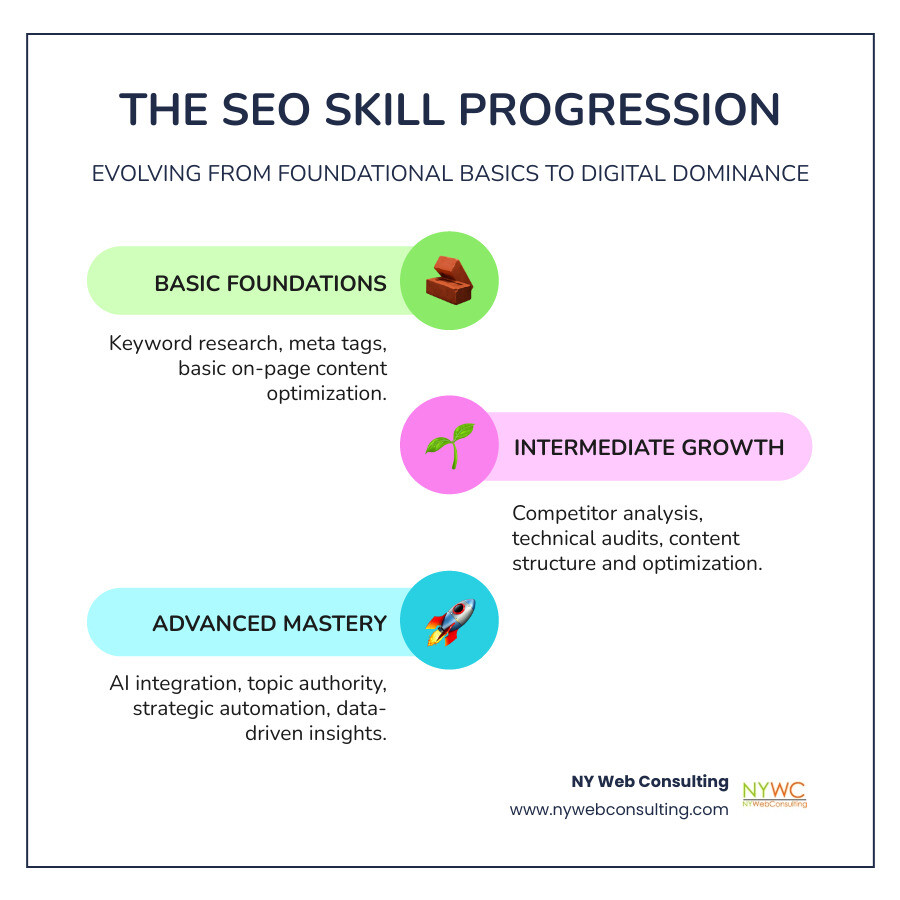
Think of SEO skills like learning to drive. Basic SEO is the learner’s permit: you know the fundamentals.
Basic SEO covers essentials like title tag optimization, fixing broken links, and ensuring mobile-friendliness. It’s about understanding keywords and basic analytics.
Intermediate SEO is more strategic, involving deeper keyword research, competitor analysis, understanding user intent, and implementing structured data. It’s about connecting different SEO tactics.
Advanced SEO strategies require a higher level of thinking to solve complex problems. This means mastering technical challenges like JavaScript SEO and Core Web Vitals, analyzing server log files, and building comprehensive content strategies that establish topical authority.
Advanced practitioners see the bigger picture. They connect SEO to business goals, troubleshoot complex issues, and adapt quickly to algorithm changes.
How can I stay updated on search engine algorithm changes?
Staying current with algorithm updates is essential for advanced SEO strategies. Google makes hundreds of unannounced changes annually, so the key is having a system to spot them and understand their impact.
Start by monitoring your own data closely. Sudden drops or spikes in traffic, ranking changes, or shifts in click-through rates can signal an algorithm update.
Follow trusted industry sources for accurate, actionable insights. Focus on experts who explain why a change matters for your situation, not just what changed.
Join communities where SEO professionals share real experiences. The collective wisdom of practitioners can reveal patterns and solutions you won’t find in official announcements.
Test and experiment regularly. Proactively trying new approaches builds the intuition needed to adapt quickly when the rules change.
The goal isn’t to chase every update. Focus on creating valuable content and excellent user experiences, as these fundamentals remain constant.
What role does user experience (UX) play in advanced SEO?
User experience is the secret weapon of advanced SEO strategies. It’s no longer enough to just focus on keywords.
Search engines are sophisticated at measuring user happiness. Signals like bounce rate and time on page directly influence your rankings.
Core Web Vitals represent the most direct connection between UX and SEO. These metrics measure page speed, interactivity, and stability. Poor scores can hurt your search visibility, regardless of your content quality.
Mobile experience is critical since Google uses your mobile site for ranking. A site that is difficult to use on a smartphone is fighting an uphill battle.
Focusing on user experience creates a virtuous cycle. Better UX leads to positive engagement signals, which search engines see as indicators of quality. This encourages more shares, links, and return visits.
At NY Web Consulting, we’ve seen that when we improve a website’s speed and usability, rankings often improve as a natural consequence. It’s about creating websites that people genuinely enjoy using.
Conclusion
Mastering advanced SEO strategies is a marathon, not a sprint. The constant evolution is what makes it both challenging and profitable for businesses willing to accept the challenge.
This guide has shown that advanced SEO strategies require a holistic approach combining technical excellence, content intelligence, authority building, and data analysis. It’s about strategic thinking, not just checking boxes.
The SEO landscape changes constantly. Google’s frequent updates and shifting user behavior reward businesses committed to continuous learning and adaptation.
At NY Web Consulting, we’ve built our reputation on staying ahead of these changes. From our base in Glendale, Queens, we help businesses across New York City transform their websites into powerful lead generation machines. Our approach combines a solid technical foundation with the strategic thinking that advanced SEO strategies demand.
We’ve seen how the right SEO strategy can attract the right traffic—the kind that converts into customers, builds brand authority, and creates sustainable growth.
Advanced SEO can feel like a constantly changing obstacle course. But with the right expertise and a commitment to strategic implementation, you can use these changes to your advantage.
Ready to build the foundation that makes advanced SEO possible? Learn how our Web Design Services can build your SEO foundation and start your journey toward digital dominance today.