

Why Most Businesses Struggle to Achieve Business Goals (And What to Do About It)
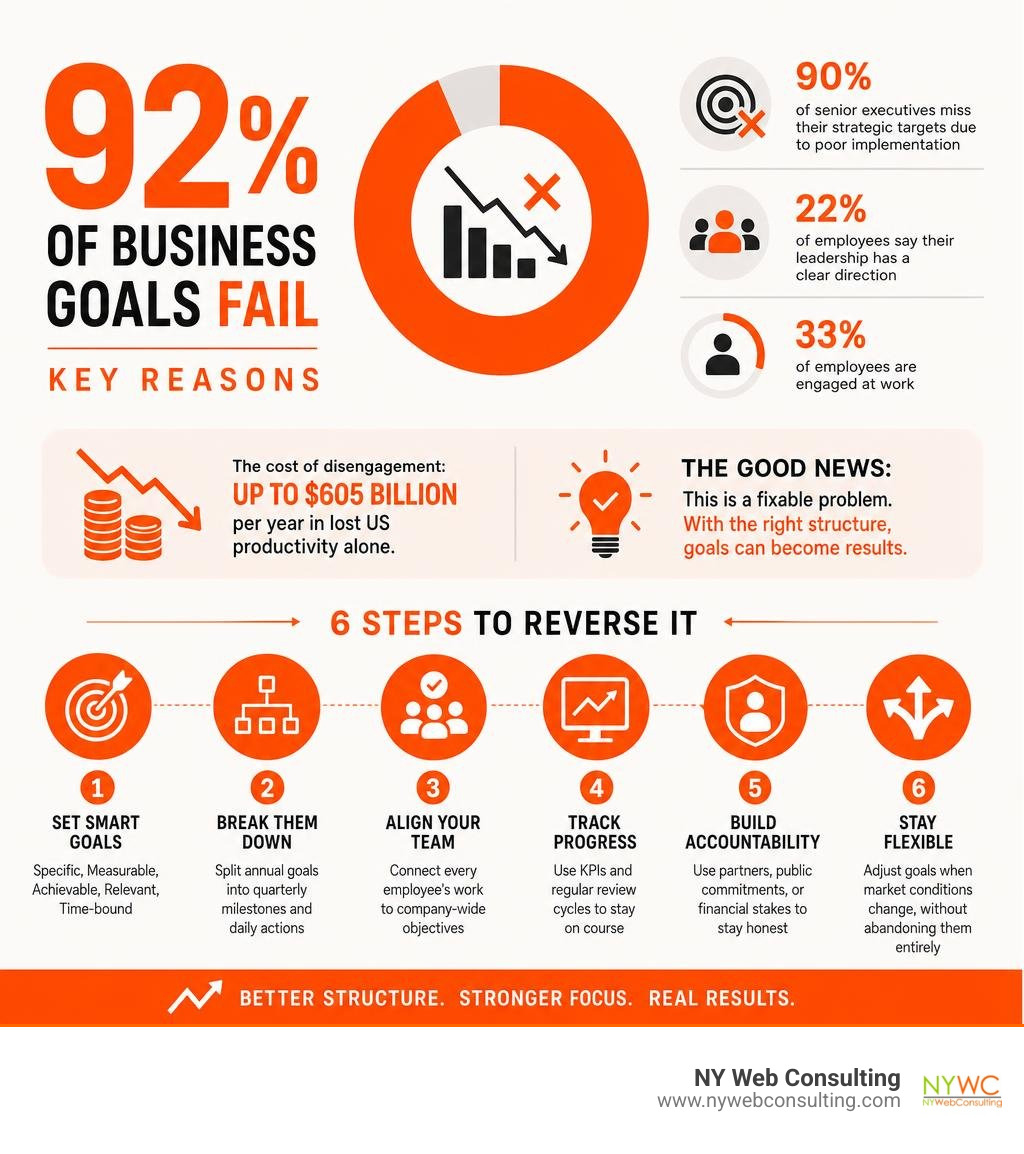
To achieve business goals consistently, follow these core steps:
- Set SMART goals — Specific, Measurable, Achievable, Relevant, Time-bound
- Break them down — Split annual goals into quarterly milestones and daily actions
- Align your team — Connect every employee’s work to company-wide objectives
- Track progress — Use KPIs and regular review cycles to stay on course
- Build accountability — Use partners, public commitments, or financial stakes to stay honest
- Stay flexible — Adjust goals when market conditions change, without abandoning them entirely
Here’s a number that should stop you cold: 92% of business goals fail.
Not because the goals were wrong. Not because the people were lazy. They fail because of how the goals were set and managed.
A separate study found that 90% of senior executives at companies earning over $1 billion admitted they missed their strategic targets — not from bad strategy, but from poor implementation. Meanwhile, only 22% of employees say their leadership has a clear direction. Only 33% are engaged at work. The cost of that disengagement? Up to $605 billion per year in lost US productivity alone.
The gap between setting goals and achieving them is where most businesses quietly fall apart.
The good news: this is a fixable problem. One business owner tracked 347 goals over 16 years, saw a 23% success rate for the first 8 years, then rebuilt their system from scratch — and hit a 71% success rate in year one, reaching 84% by 2024. The difference wasn’t motivation. It was structure.
This guide walks you through exactly how to build that structure.
I’m Brian Butrym, founder of NY Web Consulting — a results-driven web design and marketing firm based in Glendale, Queens, NY. Over the years, helping small businesses grow their online presence has taught me that the same principles used to achieve business goals in strategy apply directly to building websites that convert visitors into clients. Let’s get into it.
Explore more about achieve business goals:
Business Goals vs. Objectives: Why the Difference Matters
Many business owners use the words “goals” and “objectives” interchangeably, as if they are the exact same thing. This is a critical mistake that leads to strategic drift. If your team doesn’t know whether they are aiming for the ultimate destination or just looking at the next road sign, your projects will quickly lose alignment.
Think of it this way: your business goal is the destination on the map. Your business objectives are the precise GPS turn-by-turn directions that get you there.
To help visualize this, let’s look at how they stack up side-by-side:
| Feature | Business Goals | Business Objectives |
|---|---|---|
| Definition | Broad, long-term outcomes the company wants to achieve. | Specific, measurable actions that must be completed to reach the goal. |
| Timeframe | Usually 1 to 5 years (long-term). | Monthly, quarterly, or bi-annual (short-term). |
| Measurement | Qualitative or high-level quantitative targets. | Highly quantitative, precise KPIs with strict deadlines. |
| Stability | Relatively stable; only changes during major pivots. | Dynamic; updated frequently as tasks are completed. |
| Focus | Strategic direction and overall vision. | Tactical execution and daily/weekly progress. |
When you understand this difference, you can build a cohesive roadmap. Without this distinction, your strategic direction becomes muddy, and your organizational alignment suffers. Teams end up working on activities that feel productive but don’t actually move the needle toward your long-term destination.
By setting clear boundaries between the two, you give your team both a sense of purpose (the goal) and a clear to-do list (the objectives). This structure is essential to successfully measure success with clear business objectives.
Defining Long-Term Business Goals
Long-term business goals are rooted in your company’s core identity. They are shaped by your vision statement, your company values, and your Big Hairy Audacious Goals (BHAGs). A great long-term goal doesn’t just ask, “How much money can we make next month?” Instead, it asks, “What kind of impact will our organization have in three to five years?”
These goals act as a lighthouse. When market conditions shift, or when unexpected local disruptions occur here in New York City, your long-term goals keep you anchored. They prevent you from chasing every passing trend or short-term opportunity that doesn’t align with your core values.
When you set these broad outcomes, you establish the boundaries of what your company is—and, just as importantly, what it isn’t. To dive deeper into how to structure these long-term visions, check out this comprehensive guide to setting successful business goals.
Defining Short-Term Business Objectives
Once your long-term goals are set, you must immediately translate them into short-term business objectives. These are the bite-sized milestones that make the grand vision feel real to your team. Short-term objectives are built around tactical execution and tracked using Key Performance Indicators (KPIs).
For example, if your long-term goal is to become the leading local service provider in Queens, your short-term objective might be to secure 15 new local service contracts in the next 90 days. This gives your marketing and sales teams a concrete target to chase right now.
In the digital space, this tactical execution often starts with how you position your brand online. You can’t reach your sales targets if your digital presence isn’t built to capture attention. If you want to see how this works in practice, read our guide on how to build a winning internet marketing strategy to align your online tactics with your near-term objectives.
How to Set and Achieve Business Goals Using Proven Frameworks
Setting goals on a napkin during a lunch break in Glendale might feel inspiring, but it rarely leads to execution. To turn your ambitions into reality, you need structured frameworks that bridge the gap between planning and doing.

Two of the most powerful frameworks used by modern companies to achieve business goals are SMART goals and OKRs (Objectives and Key Results). While SMART goals focus on making individual targets highly actionable, OKRs help align large, cross-functional initiatives across an entire organization. When combined, these frameworks ensure that everyone from leadership to entry-level staff is pulling in the same direction.
To make these frameworks work, you must track your progress in a visible, centralized place rather than hiding them in a spreadsheet that nobody opens. When goals are highly visible, team members understand exactly how their daily work contributes to the larger picture. For a step-by-step breakdown of this process, explore these 6 steps to achieving your company goals.
Setting SMART Business Goals
The SMART framework is the gold standard for defining goals that actually get done. If your goals are vague—like “we want to grow our business”—your team will have no idea how to execute them. By running every goal through the SMART filter, you turn vague wishes into concrete action plans:
- Specific: Clearly define what you want to accomplish. (e.g., “Increase local organic website traffic.”)
- Measurable: Establish concrete criteria for tracking progress. (e.g., “By 30% using targeted SEO keywords.”)
- Achievable: Ensure the goal is realistic given your current resources and market conditions.
- Relevant: Align the goal with your broader business growth plans.
- Time-bound: Set a hard deadline. (e.g., “Within the next 6 months.”)
For local businesses, applying these criteria to your promotional efforts is incredibly powerful. Instead of running random ads, you can set a SMART goal to grow your local customer base by a specific percentage each quarter. To see how this applies to your local outreach, read our insights on marketing for small businesses.
Aligning Individual and Team Efforts to Achieve Business Goals
Even the most perfect SMART goal will fail if your team isn’t bought in. True alignment happens when individual employees can see a direct line between their daily tasks and the company’s highest-level goals. This connection is the secret to boosting employee engagement and workplace productivity.
To achieve this alignment, encourage collaborative decision-making and embrace cognitive diversity. When you involve team members with different backgrounds and perspectives in the planning process, you get better ideas and stronger buy-in. When employees understand the “why” behind their targets, they are far more likely to take ownership of their work.
If you are running a service business in New York City, this alignment often centers on lead acquisition. When your sales, marketing, and web development teams are fully aligned, they can work together to build a seamless customer journey. Discover how to create this synergy by learning how to turn your website into a lead generation machine.
Building Daily Systems to Achieve Business Goals Faster
Ambitious goals are won or lost in the quiet hours of the morning. If you only review your progress once a quarter, you will almost certainly fall short. You must break your massive annual goals down into daily systems and actionable habits.
A fantastic way to do this is through habit stacking—attaching a new, goal-supporting habit to an existing daily routine. For instance, before checking your email in the morning, spend 15 minutes reviewing your primary bottleneck. Is it a demand issue? A supply issue? Or a lack of clear tracking data?
To systematically demolish your targets, you must identify your primary business bottleneck, brainstorm solutions, rank them by impact and effort, and block dedicated time on your calendar to attack them. For a mathematical, systematic approach to breaking down your funnel and clearing operational bottlenecks, read this masterclass on how to systematically set and demolish goals in your business.
Additionally, you can accelerate your progress in 2026 by prioritizing high-impact, revenue-driving activities over simple busywork. For more practical execution tips, check out these 10 tips to achieve business goals faster.
The 4 Balanced Perspectives of Strategic Goal Setting
Many business owners make the mistake of setting goals that focus exclusively on financial metrics, like monthly revenue or net profit margins. While cash flow is the lifeblood of any business, focusing solely on money is like driving a car while only looking at the gas gauge. You might know how much fuel you have, but you have no idea if you’re about to run into a wall.
To build a sustainable, resilient company, you must take a balanced approach.
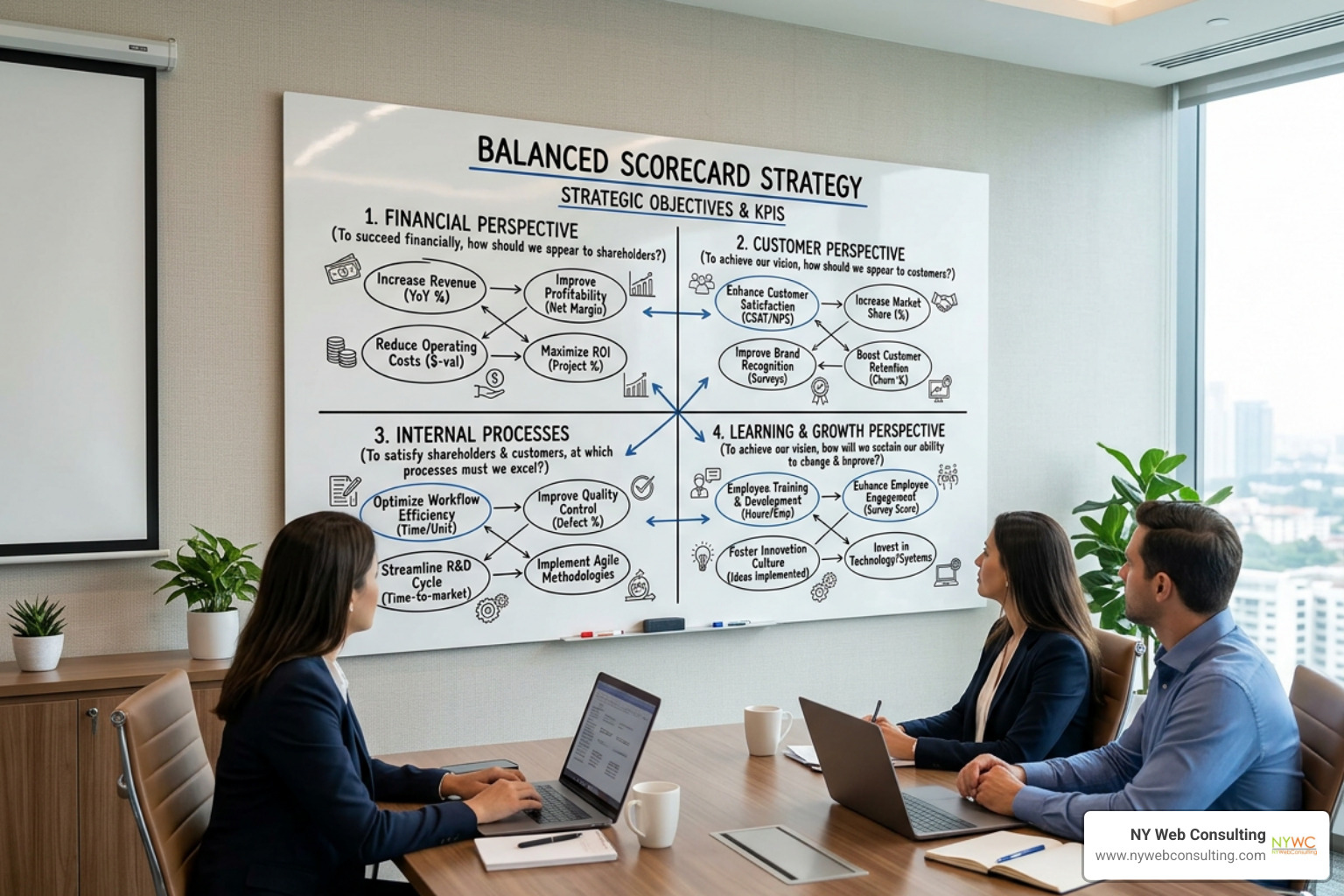
The Balanced Scorecard framework, developed by Dr. Robert Kaplan and Dr. David Norton, suggests that you should set and track goals across four distinct, interconnected perspectives:
- Financial: How do we look to our shareholders and investors?
- Customer: How do our customers see us, and how can we create more value for them?
- Internal Processes: What processes must we excel at to deliver that value?
- Learning & Growth: How can we continue to improve, innovate, and develop our people?
By using strategy maps, you can visualize the cause-and-effect relationships between these four areas. For example, if you invest in employee training (Learning & Growth), your team will improve your service delivery times (Internal Processes). This leads to happier clients (Customer), which ultimately drives higher referral rates and increased revenue (Financial).
Financial and Customer Perspectives
In profit planning, you must ask yourself three fundamental questions: Does our strategy generate enough profit? Does it generate enough cash to keep us solvent during slow seasons? And does it create sufficient returns for our investors?
However, those financial results are simply the lagging indicators of how well you serve your customers. To ensure your customer-focused goals are grounded in reality, you should conduct anonymous customer satisfaction surveys every quarter. Tracking metrics like repeat purchase rates and customer retention rates will tell you if you are building long-term loyalty or just chasing one-time transactions.
For local service businesses in Queens and Brooklyn, customer satisfaction is directly tied to how easily clients can find and engage with you online. If your digital pathways are confusing, you lose potential clients before they even speak to your team. To understand how to capture and nurture these relationships effectively, read our breakdown of lead generation meaning and why it is the secret sauce of sales.
Internal Processes and Learning & Growth
Your internal business processes are the quiet machinery that turns your strategy into reality. This perspective includes operations management, customer service systems, and quality control. If your internal processes are slow or disorganized, your customer satisfaction will plummet, no matter how great your marketing is.
To support these processes, you must foster a culture of continuous Learning & Growth. This means investing in human capital, information capital, and organizational alignment. Create a safe space where team members can make mistakes, learn from them, and share their knowledge openly. When your employees are growing, your business naturally scales with them.
In Glendale and the surrounding NYC neighborhoods, local businesses often find that their website is their most critical internal process tool—acting as a 24/7 digital storefront. If your site is slow, outdated, or hard to update, it creates a massive operational drag. Explore our business website solutions to see how a modern, secure platform can streamline your internal workflows and customer interactions.
Real-World Examples Across All Four Categories
To see how these four perspectives work together in a real business, let’s look at a set of balanced goals you could implement this quarter:
- Financial Goal: Increase monthly recurring revenue (MRR) by 15% by the end of Q4.
- Customer Goal: Achieve a 92% customer satisfaction score and reduce client churn from 8% to 5% within the next six months.
- Operational (Internal Process) Goal: Reduce project delivery times by 20% by automating client onboarding and streamlining internal communication channels.
- Employee (Learning & Growth) Goal: Provide advanced technical training to 100% of our customer support staff to improve first-contact resolution rates.
When you balance your goals this way, you protect your business from the dangers of short-sighted growth. For instance, chasing a massive financial goal at the expense of your employees’ well-being leads to burnout, high turnover, and a drop in service quality. By keeping these four areas in harmony, you build a healthier, more profitable company.
If you want to see how to align your marketing efforts with this balanced approach, check out our lead generation services to build a predictable sales pipeline.
Why 92% of Business Goals Fail (and How to Avoid It)
If setting goals was enough to guarantee success, every business in New York City would be a multi-million dollar enterprise. The reality is that the vast majority of business goals fail.
Understanding why this happens is the first step toward protecting your business from the same fate. Goals rarely fail because of a lack of ambition. Instead, they fail due to a few common, predictable traps:
- Vague Wishes: Setting goals like “improve sales” without specific metrics or deadlines.
- Goal Overload: Trying to pursue too many major initiatives at the same time. The data is clear: pursuing 1 goal yields a 91% success rate, while chasing 4 to 5 goals drops your success rate to 42%.
- Set-and-Forget Mentality: Writing down your goals in January, putting them in a drawer, and not looking at them again until December.
- Zero Accountability: Failing to share your commitments with anyone who can keep you honest.
By identifying these traps early, you can build systems to bypass them entirely.
Balancing Stretch Goals with Realistic Expectations
It is wonderful to be ambitious. “Stretch goals” are designed to push your team beyond their current comfort zones and inspire creative problem-solving. But if your stretch goals are completely untethered from reality, they will have the opposite effect—demoralizing your team and causing them to give up before they even start.
When setting ambitious targets, you must conduct thorough risk identification and assess your actual resource constraints. Do you have the staff, the budget, the tools, and the time required to hit this target? If you want to scale your revenue, you must be willing to invest in the systems that support that growth.
This balance is especially critical when designing your online customer experience. If you set a goal to double your online conversions, you must ensure your website is actually designed to guide visitors toward a decision. To learn how to optimize this pathway, read the ultimate guide to making your visitors say yes.
Establishing a Consistent Review Cadence
The secret to staying on track is to build a consistent, non-negotiable review cadence. You cannot manage what you do not measure, and you cannot measure what you do not look at.
We recommend a simple, tiered review schedule to keep your goals top-of-mind:
- Daily (2 Minutes): Review your primary daily action items first thing in the morning.
- Weekly (30 Minutes): Track your leading indicators, celebrate small wins, and adjust your weekly task list.
- Monthly (2 Hours): Analyze your lagging indicators, review budget allocations, and clear operational bottlenecks.
- Quarterly (Half-Day): Evaluate your high-level milestones, assess market shifts, and plan the next 90-day sprint.
This consistent rhythm allows you to make micro-adjustments throughout the year. If a particular marketing channel isn’t performing, you can catch it in week three instead of waiting until month nine. For businesses looking to optimize their digital revenue, this continuous tracking is essential. Learn how to keep your online strategies sharp with our guide on how to boost online sales.
Accountability Systems That Drive Results
Willpower and motivation are unreliable resources. When you are tired, busy, or stressed, it is incredibly easy to let your goals slide. To ensure long-term success, you must build robust accountability systems that keep you honest when the initial excitement fades.
There are three highly effective ways to build accountability into your business:
- Accountability Partners: Pair up with another business owner or mentor for a weekly 15-minute check-in to share progress and challenges.
- Public Commitments: Share your goals with your team, your board, or even your clients. Publicly committing to a target makes it much harder to quietly abandon it.
- Financial Stakes: Put real skin in the game by investing upfront in the tools, consulting, or resources required to reach your goal.
If you are a small business owner in New York, you don’t have to build these systems in isolation. There are incredible local networks designed to offer support, guidance, and community. Connecting with organizations like the New York Small Business Development Centers is a fantastic way to find mentors, access resources, and build the local accountability you need to succeed.
Frequently Asked Questions about Reaching Business Targets
What is the difference between a business goal and a KPI?
A business goal defines the ultimate outcome you want to achieve (e.g., “Become the most highly rated web design firm in Queens”). A Key Performance Indicator (KPI) is the specific metric you use to measure your progress toward that goal (e.g., “Maintain a 4.9-star rating on Google Reviews with at least 50 new reviews this year”).
In performance measurement, we look at both lagging indicators (which measure past results, like monthly revenue) and leading indicators (which predict future success, like the number of sales calls booked this week).
How often should a company review and adjust its goals?
While your high-level long-term goals should remain relatively stable, your short-term objectives and action plans should be reviewed weekly and adjusted quarterly. This flexibility is not a sign of weakness; it is a competitive advantage.
Including a “flexibility clause” in your strategic planning allows you to pivot when local market conditions, consumer tastes, or technologies change, ensuring your business stays responsive and resilient.
Where can small businesses in New York get help with strategic planning?
Small business owners in New York City have access to excellent local resources. If you are looking for local mentoring, business workshops, or strategic planning assistance, we highly recommend reaching out to the Queens Economic Development Corporation.
Additionally, you can explore funding opportunities, training programs, and operational support through the New York State Division of Small Business & Technology Development. These local organizations are dedicated to helping New York businesses build strong foundations for long-term growth.
Conclusion
At the end of the day, to achieve business goals consistently, you must transition from dreaming to doing. Strategic frameworks, balanced scorecards, and daily systems are the tools that make this transition possible.
Here at NY Web Consulting, based in Glendale, Queens, we believe that your digital presence should be the hardest-working asset in your business. We don’t just design beautiful, fast, and secure websites—we build custom digital growth engines designed to streamline your operations, capture high-quality leads, and help you reach your growth targets.
If you are ready to stop guessing, clear your digital bottlenecks, and build a web presence that actively works to grow your bottom line, we are here to help.
Transform your website into a lead generation machine with NY Web Consulting. Let’s work together to make your business goals a reality.