

What Lead Generation Meaning Really Is (And Why It Matters)
Lead generation meaning is straightforward: it is the process of attracting potential customers and capturing their interest so your business can guide them toward a sale.
Quick answer:
- Lead – a person who has shown interest in your product or service
- Lead generation – the actions you take to find and attract those people
- The goal – move strangers into your sales pipeline so your team can convert them into paying customers
Think of it like fishing. Your content, ads, and website are the bait. Lead generation is the whole system — the rod, the line, the hook, and knowing which pond to fish in.
Nearly 70% of B2B marketers are increasing their lead generation budgets right now, making it the single biggest investment area across marketing teams. That tells you how seriously businesses take this.
Without a steady flow of leads, even the best product or service can sit unsold. Lead generation is what keeps your sales pipeline full and your business growing.
I’m Brian Butrym, founder of NY Web Consulting, a results-driven web design and marketing firm based in Glendale, Queens — and helping small businesses understand lead generation meaning and build systems that actually convert is at the core of what we do. In the sections below, I’ll walk you through exactly how it works, step by step.
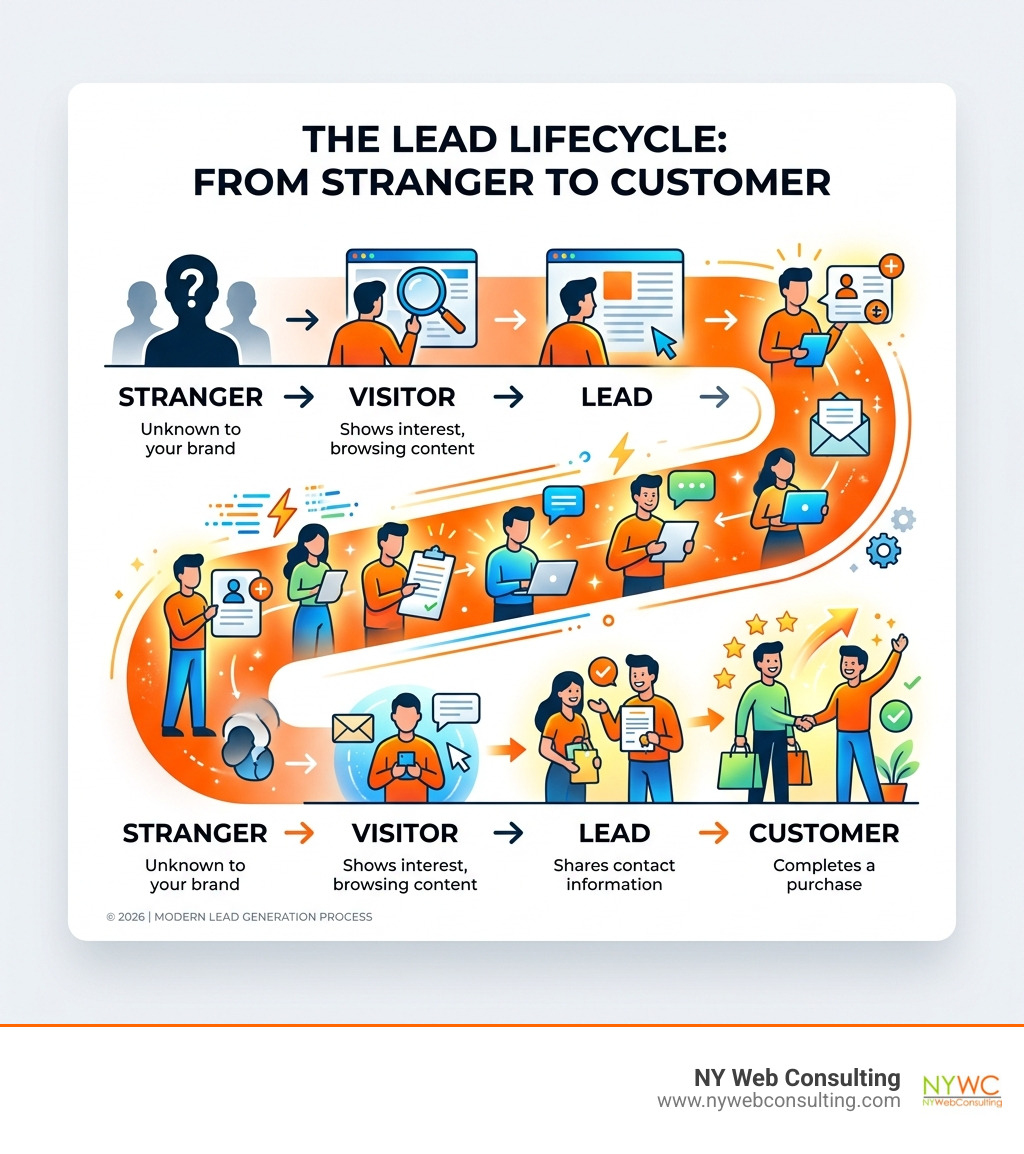
Lead generation meaning glossary:
Understanding the Lead Generation Meaning in Modern Business
In the old days, businesses relied on “spray and pray” tactics—think of those massive billboards on the Long Island Expressway or generic radio ads. Today, the lead generation meaning has evolved into a highly targeted, data-driven science. It’s no longer just about getting your name out there; it’s about finding the right people at the right time.

According to TechTarget, lead generation involves identifying and attracting potential customers, then nurturing and ultimately converting them into paying customers. This process is essential for revenue growth because it allows your sales team to stop cold calling and start talking to people who actually want to hear from them.
For businesses in New York City, the competition is fierce. Whether you are an attorney in Manhattan or an auto shop in Queens, your website needs to be more than a digital business card. As we discuss in The Anatomy of a Lead Generation Website, a high-performing site serves as your 24/7 salesperson, capturing market research and fueling customer acquisition while you sleep.
By focusing on lead generation, you achieve several key business objectives:
- Brand Awareness: You aren’t just selling; you’re educating your market.
- Efficiency: Your sales team spends time on high-quality prospects rather than dead ends.
- Predictable Growth: Instead of wondering where the next client will come from, you build a consistent pipeline.
The 5-Step Lead Generation Process
Generating a lead isn’t a single event; it’s a journey. At NY Web Consulting, we view this as a five-step cycle that turns a total stranger into a warm contact.
- Content Creation: You start by creating something of value—a blog post, a video, or an eBook. This addresses a specific pain point your audience is facing.
- Discovery: The prospect finds your content through channels like SEO, social media, or paid ads.
- Call-to-Action (CTA): Within that content, you provide a clear instruction, like “Download our free guide” or “Get a free quote.”
- Lead Capture: The prospect clicks the CTA and is taken to a landing page where they fill out a form, exchanging their contact info for your offer.
- Nurturing: Once you have their info, you don’t just let it sit there. You use email sequences or personal follow-ups to build trust.
As noted in this comprehensive guide to lead generation, this structured approach helps close deals more quickly by pre-qualifying buyers. If you want to see examples of how this looks in the real world, check out our list of the Ultimate Lead Generation Sites.
Decoding the Lead Generation Meaning for MQLs and SQLs
Not all leads are created equal. If someone downloads a “Top 10 Home Decor Tips” PDF, they might just be browsing. If they fill out a “Request a Kitchen Remodel Quote” form, they are ready to talk business. Understanding these distinctions is vital for your sales and marketing alignment.
| Lead Type | Meaning | Action Needed |
|---|---|---|
| MQL (Marketing Qualified Lead) | Someone who has engaged with your marketing but isn’t ready to buy yet. | Continue nurturing with helpful content. |
| SQL (Sales Qualified Lead) | Someone who has shown clear intent to purchase and fits your target profile. | Immediate follow-up from the sales team. |
| PQL (Product Qualified Lead) | Someone who has used a free version or trial of your product and shown interest in upgrading. | Offer a demo or a discount for the full version. |
| Service Qualified Lead | An existing customer who expresses interest in a higher tier of service. | Upsell or cross-sell by the account manager. |
Strategies to Enhance Your Lead Generation Meaning and Impact
To make your lead generation more effective, you need to diversify your tactics. Here are a few “secret sauce” strategies we recommend:
- Lead Magnets: Offer high-value items like checklists, webinars, or templates. In the legal world, a “Small Business Compliance Checklist” can be a goldmine for leads.
- LinkedIn Ads: For B2B companies, LinkedIn is a powerhouse. It delivers an average 113% return on ad spend. Using native Lead Gen Forms can reduce friction because the forms auto-populate with the user’s profile data.
- Personalization and AI: Modern tools can now personalize website experiences based on a visitor’s industry or location. AI chatbots can also qualify leads 24/7, ensuring you never miss a midnight inquiry from a busy New Yorker.
- Short Forms: Keep your capture forms simple. Asking for just a name and email often results in much higher conversion rates than asking for a life story.
For more inspiration on where to focus your efforts, take a look at our breakdown of Top Lead Generation Sites.
Inbound vs. Outbound: Choosing Your Strategy
One of the most common questions we get at our Glendale office is whether a business should focus on inbound or outbound marketing. The truth is, the best systems often use a hybrid approach.
Inbound Lead Generation: This is about “pulling” customers toward you. By creating valuable content and optimizing for SEO, you attract people who are already searching for solutions. SEO leads are incredibly valuable, boasting a nearly 15% close rate. This method builds long-term trust and is generally less intrusive.
Outbound Lead Generation: This is about “pushing” your message out to a specific audience. Think of PPC ads, cold email outreach, or trade shows. While some think outbound is “old school,” it is still highly effective for getting immediate results. For example, Google Local Services Ads are a great outbound tool for NYC contractors to get “Google Guaranteed” leads quickly.
Whether you prefer the steady growth of inbound or the quick wins of outbound, our Lead Generation Services can help you build a pipeline that never runs dry.
Qualifying and Measuring Success
You can’t manage what you don’t measure. To truly understand your lead generation meaning and its impact on your bottom line, you need to track specific Key Performance Indicators (KPIs).
Key Metrics to Watch:
- Cost Per Lead (CPL): How much are you spending to get one person’s contact info? This varies wildly by industry. For instance, attorneys might pay $144 per lead, while an auto shop might pay only $28.
- Conversion Rate: What percentage of website visitors are actually becoming leads? An average site might convert at 2%, but an optimized one can hit 5% or higher.
- Lead Scoring: This is a quantitative method of assigning a numerical value to a lead. You might give points for visiting your pricing page or opening three emails in a row.
- BANT Framework: A classic qualification method focusing on Budget, Authority, Need, and Timeline.
By analyzing these numbers, you can determine which channels are providing the best ROI. If you want to see what a high-converting site looks like under the hood, visit our guide on the Best Lead Gen Websites.
Frequently Asked Questions about Lead Generation
What is the difference between a lead and a prospect?
While the terms are often used interchangeably, there is a slight difference in engagement. A lead is anyone who has shared their contact info (like an email). A prospect is a lead that has been “qualified”—meaning they fit your target criteria and have a genuine need for what you sell. All prospects are leads, but not all leads are prospects.
How long does it take to see results from lead generation?
It depends on the channel. Paid ads (like Google or Meta) can generate leads within 24 to 48 hours. However, those campaigns usually need 4–6 weeks of data to be fully optimized. SEO and content marketing are long-term plays; they typically take 3 to 6 months to start producing a consistent flow of organic leads.
Why is lead scoring important?
Lead scoring prevents your sales team from wasting time. Instead of calling 100 people who just downloaded a free eBook, they can focus on the 10 people who have visited your “Book a Consultation” page and fit your ideal customer profile. It ensures your resources are allocated where they will have the most impact.
Conclusion
Understanding the lead generation meaning is the first step toward transforming your business from a reactive one into a proactive growth machine. In a city as as New York, you can’t afford to wait for the phone to ring. You need a system that identifies, attracts, and nurtures potential clients automatically.
At NY Web Consulting, we specialize in building these systems. From our home base in Glendale, Queens, we help businesses across NYC create fast, secure, and SEO-friendly websites that do more than just look pretty—they generate revenue. We believe that a beautiful website without conversion points is like an open house with locked doors.
Are you ready to stop “fishing” at random and start building a predictable sales pipeline? Transform your website into a lead generation tool with us today. Let’s make your website your most valuable employee.