
What Is Conversion Rate Optimization SEO (And Why It Matters for Your Business)
Conversion rate optimization SEO is the practice of combining two disciplines — driving organic traffic and turning that traffic into real business results — into one unified strategy.
Here’s a quick-reference summary:
| Term | What It Means |
|---|---|
| SEO | Getting more visitors to your site through search engines |
| CRO | Getting more of those visitors to take action (buy, sign up, contact you) |
| CRO + SEO | Using both together so your traffic actually grows your revenue |
| Conversion Rate | (Conversions ÷ Total Visitors) × 100 |
| Average Conversion Rate | ~1.7% across all industries |
Most businesses pour energy into SEO — climbing rankings, building backlinks, publishing content. But here’s the uncomfortable truth: if only 1.7% of your visitors are converting on average, the other 98.3% are leaving empty-handed.
Think of it this way. If you get 2,000 visitors a month and convert 10% of them, that’s 200 customers. Nudge that rate to 15% — with the same traffic — and you’ve got 300. A 50% jump in results without spending a single extra dollar on ads or content.
That’s the leverage CRO gives you.
The problem is that most small business owners treat SEO and CRO as separate projects. They’re not. When your pages load fast, match what users are searching for, and guide visitors toward a clear next step, both your rankings and your conversions improve together.
I’m Brian Butrym, founder of NY Web Consulting, and I’ve spent years helping small businesses build fast, high-ranking websites that are specifically designed to convert organic visitors into paying clients — which is exactly what conversion rate optimization SEO is all about. In this guide, I’ll walk you through everything you need to turn your existing traffic into real business growth.
The Strategic Impact of Conversion Rate Optimization SEO
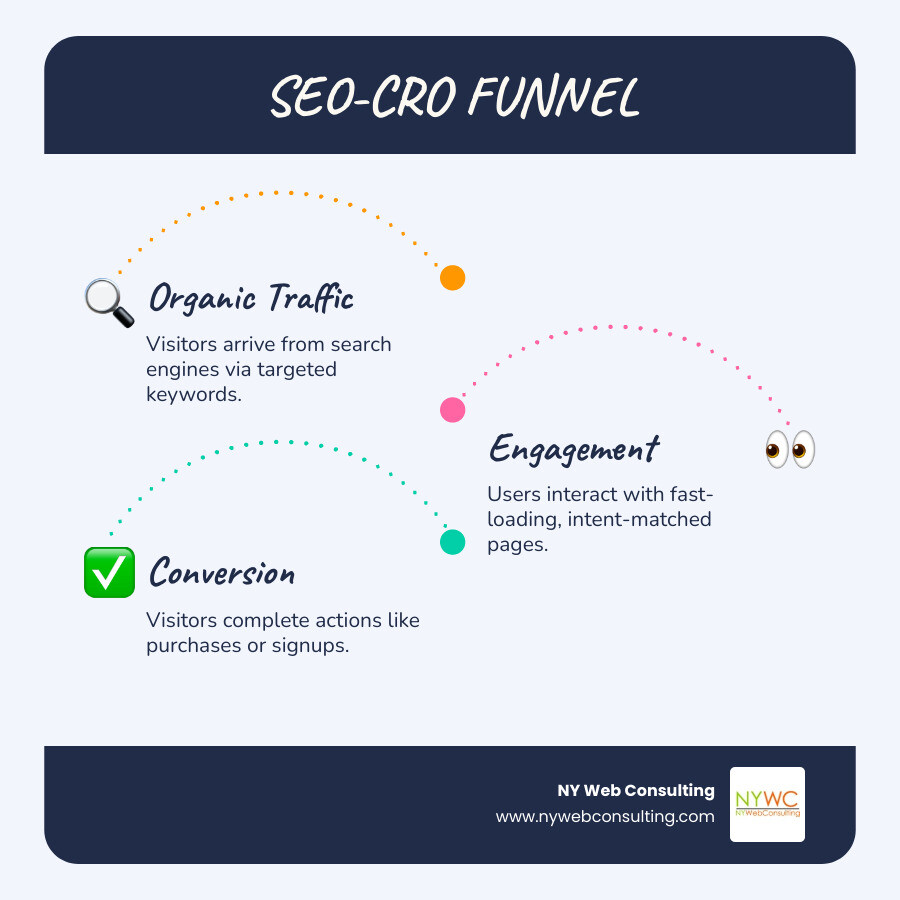
In the past, SEO was a volume game. You ranked for a keyword, got the click, and called it a day. But as we move through 2025 and into 2026, the landscape is shifting. Google’s AI Overviews (formerly SGE) are changing how users interact with search results. Often, the user gets their answer directly on the search results page without ever clicking through to a website. This “zero-click” reality means the traffic that does reach your site is more precious than ever.
When you implement conversion rate optimization SEO, you aren’t just chasing vanity metrics like “total sessions.” You are refining the quality of that traffic and ensuring that every person who lands on your page finds exactly what they need to take the next step. By using Advanced SEO Strategies, we ensure that your site doesn’t just attract “browsers,” but “buyers” who are ready to engage with your New York City business.
Why Conversion Rate Optimization SEO is Vital in 2026
The rise of Generative Engine Optimization (GEO) means that AI platforms like ChatGPT and Google’s Gemini are looking for structured, credible, and highly relevant content to cite. If your website is a confusing mess, AI won’t recommend it, and users won’t convert.
In 2026, traffic efficiency is the name of the game. With AI Overviews potentially reducing click-through rates for informational queries, we must maximize the value of every visitor. conversion rate optimization SEO bridges the gap by matching search intent with a seamless user experience. If a user in Queens searches for a local service, they shouldn’t just find a blog post; they should find a fast-loading, trust-building page that answers their question and offers a clear path to a solution.
Measuring the ROI of Conversion Rate Optimization SEO
One of the biggest benefits of this integrated approach is the drastic reduction in Customer Acquisition Costs (CAC). Think about it: if you double your conversion rate from 1% to 2%, you effectively cut your cost per lead in half.
By focusing on revenue per visitor rather than just total visitors, your business becomes more scalable. You stop being a slave to the “more traffic” treadmill and start building a high-efficiency revenue engine. This is why our Lead Generation Services Your Pipeline’s New Best Friend focus so heavily on the post-click experience. It’s about turning that hard-earned organic visibility into a predictable stream of income.
Calculating Benchmarks and Industry Standards
To improve your conversion rate, you first need to know where you stand. The formula is simple: (Conversions / Total Visitors) x 100. However, how you define a “visitor” matters. For repeatable actions like e-commerce purchases, we often use session-based tracking. For one-time actions like a newsletter subscription, tracking unique users provides a clearer picture.
Defining Macro and Micro Conversions
Not every “yes” from a visitor involves a credit card. To truly master conversion rate optimization SEO, we need to track the entire journey.
- Macro-Conversions: These are your primary goals. Think purchase orders, requested quotes, or completed lead forms.
- Micro-Conversions: These are the smaller steps that signal interest. This includes newsletter signups, watching a demo video, reaching a certain scroll depth, or clicking a “Features” link.
Tracking micro-conversions is essential for SEO pages because it tells us if our content is engaging enough to lead to a future sale. For more on building sites that capture these moments, check out our guide on the Best Lead Gen Websites.
Industry Benchmarks for 2026
While you should always strive to beat your own baseline, knowing the industry averages helps you identify if your site is underperforming.
| Industry | Average Conversion Rate |
|---|---|
| E-commerce | 2% – 4% |
| B2B Services | 1% – 2% |
| Lead Generation | 5% – 10% |
| Personal Care/Skincare | ~6.8% |
| Electronics | ~2.1% |
Mobile conversion rates typically lag behind desktop (roughly 2.9% vs 4.8%). This is why mobile-first design is no longer optional for businesses in Glendale or Queens—it’s a financial necessity. For a deeper dive, see our Lead Generation Sites Ultimate Guide.
Improving SEO Performance Through User Experience Signals
Google has stated clearly that user experience (UX) is a ranking factor. When a visitor lands on your site from a search result and immediately “pogo-sticks” back to the search page, it tells Google your page didn’t satisfy their intent.
By improving conversion rate optimization SEO, you naturally improve these SEO signals. Higher dwell time and lower bounce rates signal to search engines that your content is valuable, which can help maintain or even boost your rankings. This is the core of effective User Experience Design.
Technical Optimization for Conversions
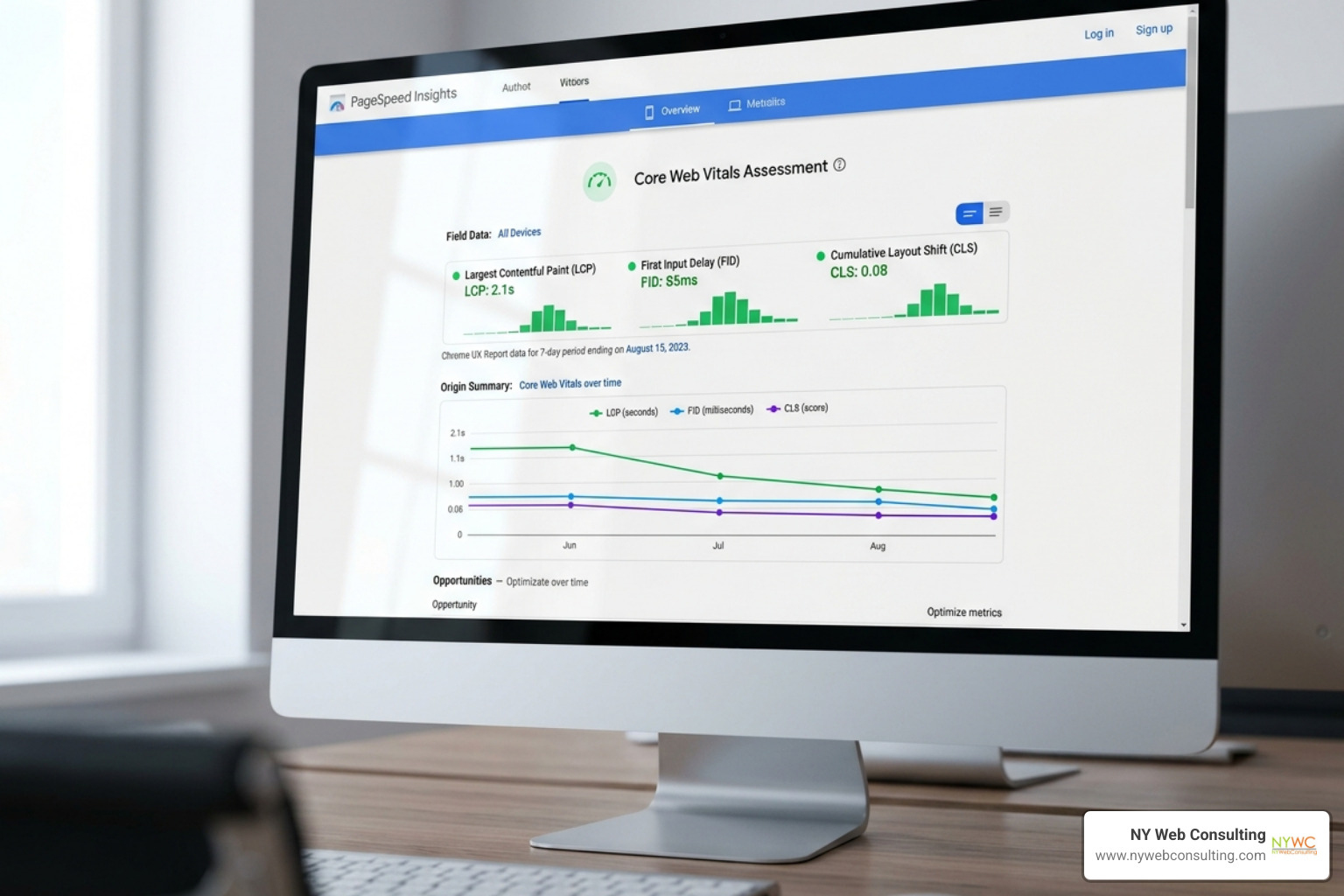
Speed is perhaps the most underrated sales tool in your arsenal. Research shows that a B2B site that loads in 1 second has a conversion rate 3x higher than a site that takes 5 seconds to load.
We focus heavily on Core Web Vitals, specifically:
- Largest Contentful Paint (LCP): How fast the main content loads.
- First Input Delay (FID): How fast the site responds to the first click.
- Cumulative Layout Shift (CLS): Ensuring elements don’t jump around while loading.
A stable, fast site builds trust. A slow, “jumpy” site makes visitors nervous and drives them into the arms of your competitors. Our From Slow to Go The Magic of Website Optimization Services is designed to eliminate these technical friction points.
Content Structure and Trust Signals
To convert search traffic, you must establish E-E-A-T (Experience, Expertise, Authoritativeness, and Trustworthiness). This is especially true for New York businesses where competition is fierce.
We recommend placing trust signals—like testimonials, security badges, and industry certifications—near your Call to Action (CTA). Your value proposition should be visible within three seconds of the page loading. If people have to hunt for what you do, they’ll leave. Mapping out a clear User Journey Design ensures that visitors are never more than a click away from the information they need to trust you.
A Step-by-Step CRO Framework for SEO Pages
Don’t guess—test. Conversion rate optimization SEO is a scientific process. We use a structured framework to ensure every change we make is backed by data.
- Research: Analyze GA4 data to find high-traffic pages with low conversion rates.
- Behavioral Analysis: Use heatmaps to see where people click (and where they don’t).
- Hypothesis: Create a “testable” statement: “If we change the CTA from ‘Submit’ to ‘Get My Free Quote’, then conversions will increase because it highlights the benefit.”
- Prioritization: Use the PIE framework (Potential, Importance, Ease) to decide which tests to run first.
- Testing: Run A/B or multivariate tests.
For a full breakdown of this process, see How to Optimize Your Website for Search Engines.
Behavioral Analytics and Testing
Traditional analytics tell you what happened; behavioral analytics tell you why. Heatmaps might reveal that visitors are clicking on an image that isn’t a link, suggesting they expect more information there. Session recordings might show users getting frustrated with a long form on mobile.
When A/B testing, it’s vital to reach statistical significance (usually 95%) before declaring a winner. Testing elements like headline copy, CTA colors, and form length can lead to massive lifts. For example, reducing a form from 10 fields to 4 can increase submissions by nearly 20%. Always look to Improve Website SEO by listening to what your users’ behavior is telling you.
Optimization Tactics for High-Traffic Pages
Your homepage, top blog posts, and service pages are your “money pages.” Here are a few quick wins we often implement for our NYC clients:
- CTA Design: Use high-contrast colors and action-oriented verbs (e.g., “Claim Your Discount” instead of “Click Here”).
- Headline Testing: Ensure your headline matches the search intent of the keyword that brought them there.
- Above-the-Fold Content: Place your most important offer and a CTA where users can see them without scrolling.
- Form Simplification: Use inline validation and “breadcrumb” (multi-step) forms to make complex tasks feel easy.
You can find more specific examples in our guide on The Anatomy of a Lead Generation Website Best Practices for Capturing Leads.
Frequently Asked Questions about CRO and SEO
What is the difference between CRO and SEO?
SEO is about the “invite”—getting people to show up to your “party” (website). CRO is about the “hosting”—making sure they have a great time and do what you want them to do once they arrive. SEO drives the quantity and quality of traffic; CRO drives the revenue from that traffic.
How long does it take to see results from CRO?
While SEO can take months to show significant ranking shifts, CRO results can often be seen much faster. A successful A/B test on a high-traffic page can show a “win” within 1 to 4 weeks, depending on your volume of visitors. However, CRO is a continuous process of iteration, not a one-time fix.
What are the most common CRO mistakes to avoid?
- Testing too many things at once: If you change the headline, the image, and the button color at the same time, you won’t know which one worked.
- Ignoring mobile users: With over 60% of searches happening on mobile, a “desktop-first” mindset will kill your conversion rate.
- Stopping after one “failed” test: Only about 12% of A/B tests produce a winning result. The goal is to learn from the 88% that don’t, so you can find the big wins later.
- Copying competitors blindly: What works for a giant corporation might not work for your local Queens business. Use your own data.
Conclusion
At the end of the day, traffic is a vanity metric; revenue is a sanity metric. By integrating conversion rate optimization SEO into your digital strategy, you ensure that your website isn’t just a digital brochure, but a high-performance sales tool.
Whether you are based in Glendale, Queens, or anywhere in New York City, the key to growth in 2026 is data-driven iteration. Don’t let your hard-earned organic traffic go to waste. Start small—optimize a headline, speed up a landing page, or simplify a form—and watch the cumulative impact on your bottom line.
If you’re ready to transform your website into a lead-generation machine, we’re here to help. At NY Web Consulting, we specialize in building fast, secure, and SEO-friendly websites that don’t just rank—they convert. Contact our Web Consulting Agency today to start making your visitors say “yes.”