
Why SEO Services Matter for Business Growth
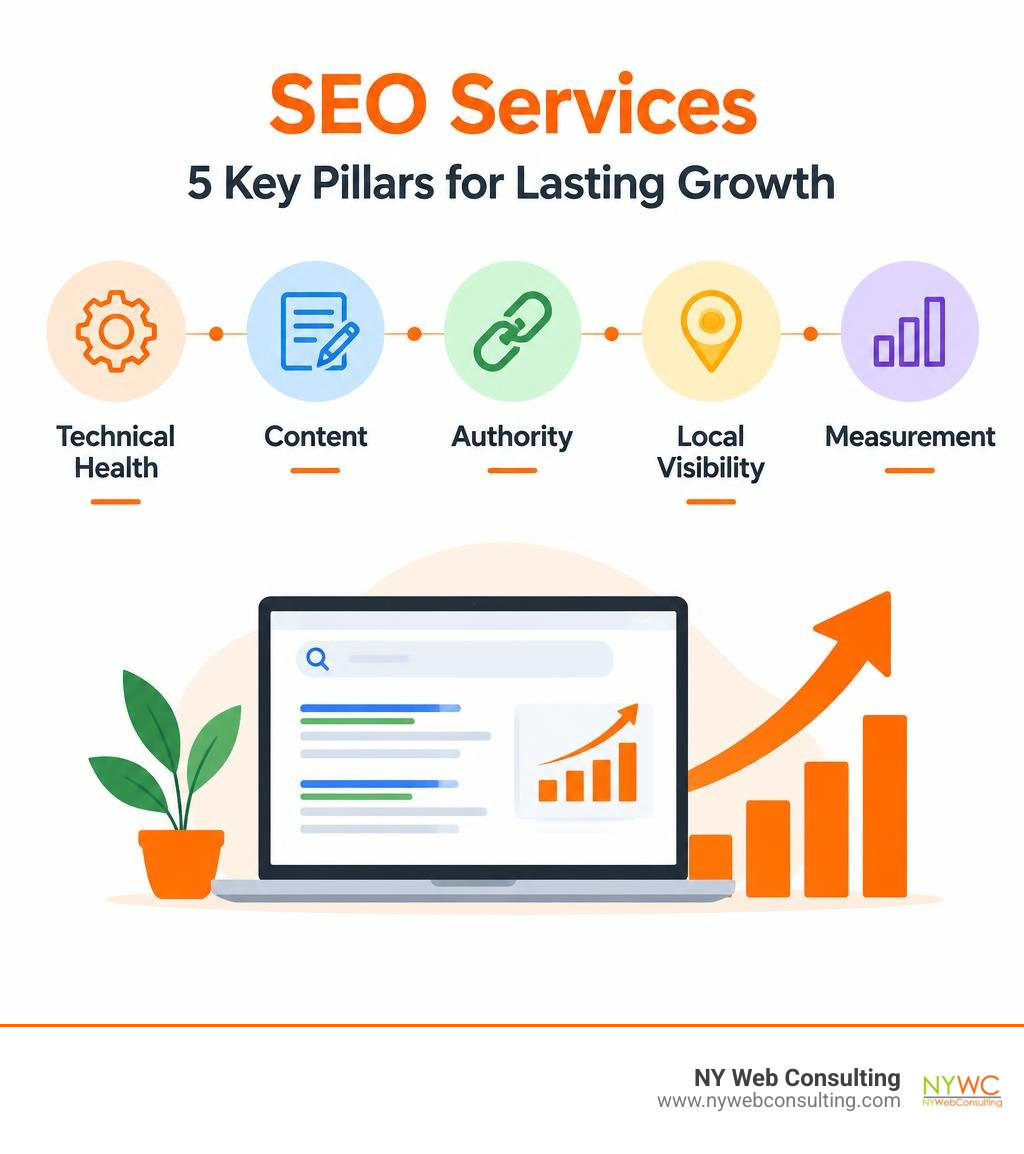
SEO services help your business appear when potential customers search for what you sell. A strong program improves the parts of your site that search engines and people rely on: technical performance, useful content, local visibility, and credible links from other websites.
When comparing providers, look for a clear plan that includes:
- A technical audit for speed, mobile usability, crawlability, and security issues.
- Keyword and competitor research tied to real customer intent.
- On-page improvements to pages, titles, internal links, and content.
- Ethical authority building, local optimization, and transparent reporting.
This work matters because visibility is concentrated near the top of search results. The first three organic listings receive an estimated 68.7% of available clicks. But SEO is not a quick switch: many businesses see early movement in 3 to 6 months, while meaningful gains often take 6 to 12 months or longer.
SEO can also help a site earn visibility in AI-assisted results, not just traditional blue-link rankings. The fundamentals remain the same: clear answers, fast pages, well-structured information, real expertise, and a trustworthy brand presence.
I’m Brian Butrym, and I work with NY Web Consulting, a Glendale, Queens web design and marketing firm focused on fast, reliable websites that perform well in search. Our approach to SEO services connects technical site health, search visibility, and conversion-focused design so your website can support real business goals.
What Are Professional SEO Services and How Do They Work?
At its heart, search engine optimization is the practice of aligning your digital presence with what your prospective clients need and what search engines require to index your pages accurately. When an agency or consultant delivers professional services, they are not waving a magic wand or trying to “trick” Google. Instead, they examine every layer of your website to ensure search engines can discover, understand, and trust your content.
An organic search rating reflects how relevant, authoritative, and technically sound your site appears compared to every other page targeting the exact same query. Modern search systems evaluate hundreds of ranking signals simultaneously. These algorithms monitor Core Web Vitals to assess page experience, measure mobile responsiveness, and check user engagement patterns. In an era where mobile browsing accounts for the vast majority of web traffic, mobile-first indexing is the standard. If your mobile site is slow or difficult to navigate, your rankings will suffer across every device.
Managing these signals requires specialized tooling and rigorous technical oversight. Professional specialists use Google Search Console and Bing Webmaster Tools to identify crawling errors, analyze indexing bottlenecks, and verify structured data. Learning how to optimize your website for search engines involves uniting web development, user experience design, and data analysis into one cohesive strategy.
How Search Engines Crawl, Index, and Rank Content
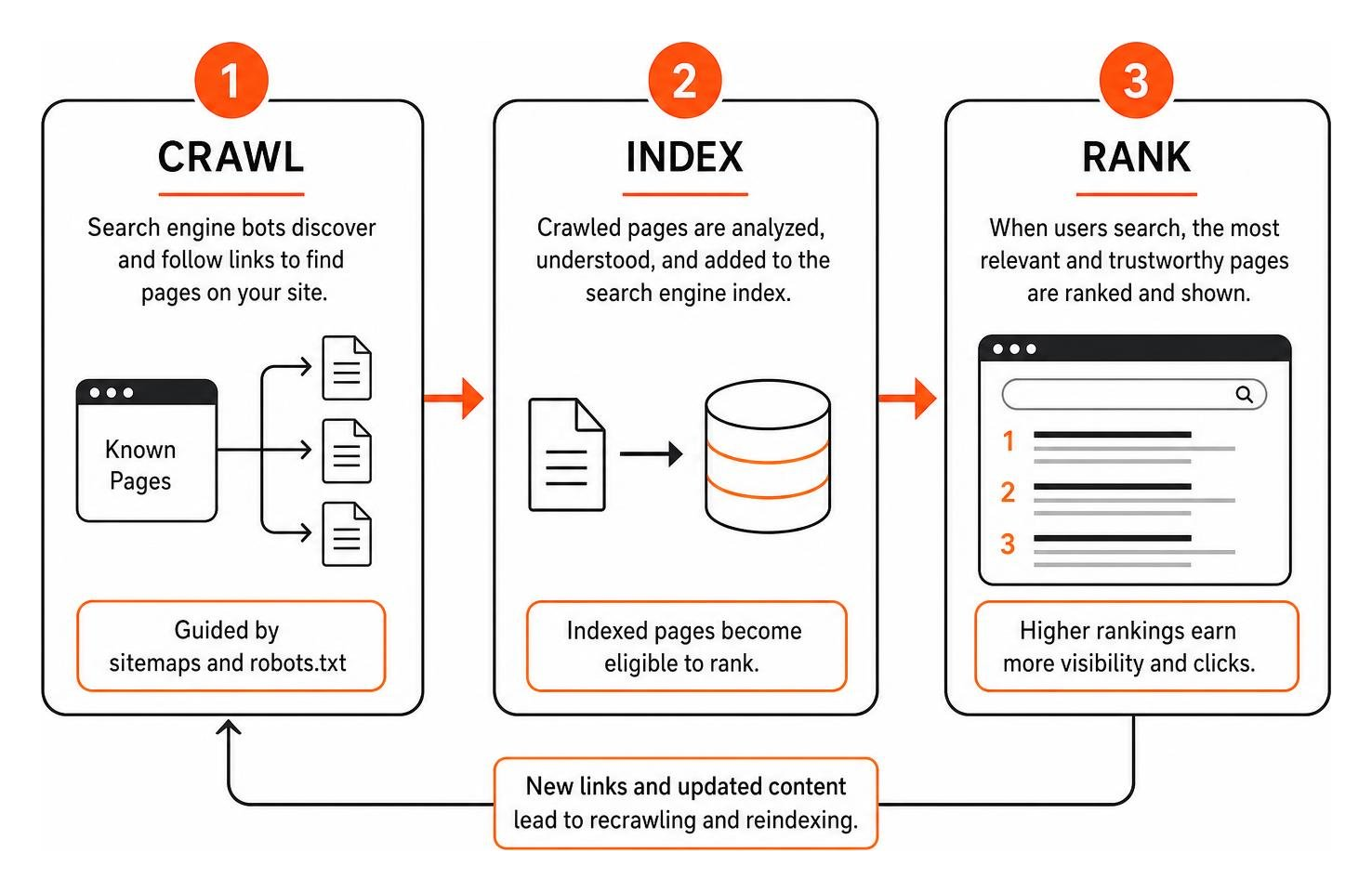
Understanding the path from an unranked URL to a top search result requires examining the search engine pipeline:
- Crawling: Search engine bots (like Googlebot) travel across the web by following links from known pages to newly discovered URLs. You guide these crawlers using XML sitemaps, which list your essential pages, and robots.txt directives, which instruct bots where they should and should not go.
- Indexing: Once a bot fetches a page, the search engine parses the code, processes text, analyzes media, and stores the extracted information in a massive database called the index. Proper canonicalization tags ensure that duplicate or parameterized URLs point to a single master page, preventing split authority.
- Ranking: When a user submits a query, algorithms query the index to retrieve the most helpful, topically relevant, and authoritative documents. The system calculates rank positions in milliseconds based on searcher intent, page speed, backlink authority, and contextual signals.
If technical blockers stop bots from crawling or indexing your website, even the most brilliantly written content will remain invisible to your audience.
Specialized SEO Services: Local, E-Commerce, and Technical
Not all websites require the exact same tactical roadmap. Optimization needs shift dramatically depending on your business model, target audience, and geographic focus:

- Local SEO: Essential for brick-and-mortar storefronts and regional service businesses. This work centers on claiming, verifying, and optimizing your Google Business Profile to capture positions in the coveted Google 3-Pack. Tailored local SEO solutions unify your Name, Address, and Phone number (NAP) across regional directories, earn localized citations, and secure map pack rankings that drive physical foot traffic and inbound calls.
- E-Commerce SEO: Designed specifically for online storefronts dealing with deep catalog structures, category hierarchies, and product variations. It includes implementing product schema, optimizing faceted navigation without generating thousands of duplicate URLs, managing out-of-stock items, and optimizing product descriptions for high-intent purchase searches.
- Technical SEO: Focuses on the foundation beneath your design. Technical specialists analyze crawl budgets, minify assets to accelerate page speed, resolve broken redirect chains, and configure structured data to ensure search engines understand every element of your site architecture.
On-Page Optimization vs. Off-Page Authority Building
A successful campaign balances two complementary disciplines: what happens on your website (on-page) and how the rest of the web views your brand (off-page).
| Area | Primary Focus | Key Tactics |
|---|---|---|
| On-Page SEO | Content, site structure, and user experience | Title tags, meta descriptions, header structure (H1-H3), internal linking, search intent alignment, and keyword placement. |
| Off-Page SEO | External reputation, authority, and brand trust | Contextual backlinks from industry publications, digital PR, brand mentions, social amplification, and local citations. |
On-page work gives you full editorial control. You can structure content logically, optimize metadata, and target long-tail SEO keywords that answer specific, high-intent questions asked by buyers. However, on-page optimization alone is rarely enough in competitive markets.
Off-page optimization acts as a digital voting system. When respected websites reference your research or link to your guides, search engines view those links as endorsements of your topical authority. The focus must always remain on earning contextual, high-quality links rather than accumulating thousands of spammy directory listings.
The Strategic Value: Organic Search ROI and Sustainable Growth
Many businesses view organic search as a long-term alternative to short-term advertising pushes. While paid promotions offer immediate visibility, that visibility disappears the moment spending stops. Organic search functions as an equity-building investment. The assets, optimizations, and technical improvements you make today continue driving qualified organic traffic for months and years to come.
Because organic listings carry strong inherent trust with searchers, high-ranking pages often yield higher conversion rates over time. In e-commerce, industry studies reveal that a healthy campaign can achieve an ROI of 275%—returning $2.75 for every dollar invested. Documented case studies show businesses growing from modest digital footprints into multi-million-dollar enterprises purely by resolving structural weaknesses and aligning content with real buyer intent.
Comparing SEO Approaches for Long-Term Lead Generation
To capture the highest return on your marketing spend, you must understand how different organic strategies operate across the buyer lifecycle:
| Approach | Setup Time | Time to Visible ROI | Sustainability | Best Suited For |
|---|---|---|---|---|
| Foundational SEO | Moderate (Weeks) | 3 to 6 Months | High (Compounds over time) | Establishing market presence, organic baseline, and steady inbound leads. |
| Enterprise & Advanced SEO | Intensive (Months) | 6 to 12+ Months | Exceptional (Defensible market moat) | Dominating competitive categories, capturing high lifetime value clients, and broad topical authority. |
Investing in advanced SEO strategies allows businesses to build an enduring digital moat. By systematically targeting commercial search intent, you attract prospects who are actively looking to make a purchasing decision, drastically lowering your blended customer acquisition costs.
AI Search Evolution: Generative Engine and Answer Engine Optimization
The search landscape is experiencing a significant shift with the rise of large language models (LLMs) and conversational search interfaces like Google AI Overviews. These tools do not just present links; they synthesize answers directly inside the search results using techniques like “query fan-out,” where a broad question is broken down into multiple sub-topics simultaneously.
To thrive in this environment, businesses must adopt Generative Engine Optimization (GEO) and Answer Engine Optimization (AEO). Modern AI SEO services and search optimization methods prioritize entity verification, clear structured data, and high E-E-A-T (Experience, Expertise, Authoritativeness, and Trustworthiness) signals. When your content provides unambiguous facts, clear data points, and direct solutions, AI systems are far more likely to cite your brand as the authoritative source in conversational summaries.
How to Evaluate, Compare, and Choose the Right Provider
Choosing an optimization partner is a major operational decision. A skilled team can turn your digital presence into a continuous lead generator, while an inexperienced or careless provider can harm your domain’s reputation with search engines.

When vetting potential providers, look closely at their operational methodology:
- Discovery and Auditing: Do they begin with an in-depth audit of your technical architecture and historical performance, or do they offer generic packages without looking at your code?
- Custom Deliverable Roadmaps: Will they provide a prioritized roadmap tailored to your specific market competition, or are they selling rigid, one-size-fits-all checklists?
- Attribution and Reporting: How do they measure progress? High-caliber partners connect search rankings and organic impressions to real business outcomes: conversions, phone inquiries, and revenue.
Agency vs. Freelancer vs. Dedicated Consultant
Every business has distinct operational requirements, internal bandwidth, and budgetary boundaries. Understanding the differences between provider types helps set realistic expectations:
- Agencies: Provide full cross-functional teams that include technical developers, content creators, digital PR specialists, and data analysts. They offer substantial resource bandwidth and broad strategic depth, making them ideal for scaling mid-market and enterprise businesses.
- Freelancers: Often cost-effective and specialized in specific tasks (such as writing blog posts or technical schema implementation). However, individual freelancers may lack the broad bandwidth required to run multifaceted campaigns across technical, content, and off-page areas simultaneously.
- Dedicated Consultants: High-level strategists who audit your architecture, identify core growth opportunities, and guide your internal team on execution. Learning how to find a local SEO consultant gives you access to senior-level expertise while maintaining tight communication and direct accountability.
If you are evaluating ways to improve website SEO, make sure the team you select aligns with your existing internal resources and development capabilities.
Identifying High-Quality Providers and Avoiding Black-Hat Red Flags
The search optimization industry has its share of questionable providers selling outdated or risky tactics. Protecting your business requires learning how to spot warning signs.
Reputable partners rely on transparent, research-backed methodologies that emphasize sustainable compliance with search engine guidelines. Black-hat tactics—such as buying mass link packages, hiding keyword text in page code, or publishing thin AI-generated content—can trigger severe manual penalties or algorithmic filters that remove your site from search results entirely.
Pricing Models and the True Cost of SEO Services
Search optimization pricing reflects the depth of work, team expertise, and market competition involved. In the current marketplace, common pricing models include:
- Monthly Retainers: Typically range from $700 to $3,000+ per month for small-to-midsize businesses, scaling higher for highly competitive enterprise or national campaigns. This model covers ongoing technical maintenance, content production, link acquisition, and monthly analysis.
- Project-Based Projects: Ranging from $1,500 to $10,000+ for specific deliverables, such as a comprehensive technical audit, a website migration, or an initial architectural overhaul.
- Hourly Consulting: Typically ranges from $100 to $300+ per hour for targeted strategic advice, code reviews, or executive training.
When budgeting, consider that cut-rate packages priced at a couple of hundred dollars a month rarely cover the manual effort needed to produce high-value content or build authentic relationships with industry publishers.
Frequently Asked Questions About SEO Services
How long does it take to see measurable results from SEO?
Most businesses see initial indicators of progress—such as improved keyword rankings for long-tail phrases and indexation health—within 3 to 6 months. Achieving substantial organic traffic growth and consistent lead generation generally requires 6 to 12 months of consistent execution.
This timeline depends on your domain’s historical authority, current technical health, content quality, and the competitive velocity of other sites in your industry. Unlike paid advertising, organic search optimization compounds over time, meaning gains made in the first year serve as the launchpad for greater growth in subsequent years.
Can an SEO agency guarantee a #1 ranking on Google?
No reputable agency, consultant, or marketing firm can guarantee a #1 ranking on Google for a specific keyword. Google’s algorithms are proprietary, highly complex, and constantly changing.
In fact, Google made over 500 algorithm modifications in 2010 alone (averaging 1.5 daily), and that pace of continuous testing has only accelerated. Legitimate optimization teams focus on probabilistic outcomes: establishing best-in-class technical health, providing top-tier content, and building genuine authority to maximize your likelihood of securing top spots across a wide range of commercially valuable queries.
How do major algorithm updates impact ongoing SEO campaigns?
Historic updates like Panda (targeting thin content), Penguin (penalizing unnatural links), and BERT (improving natural language processing), alongside regular Core Updates, are designed to reward helpful, authoritative content while filtering out manipulation.
When your campaign is built on clean technical architecture, genuine subject matter expertise, and honest authority building, algorithm updates often improve your rankings rather than hurt them. If an update does cause ranking volatility, a good provider will analyze the updated quality thresholds, evaluate search intent shifts, and refine your content accordingly.
Conclusion: Transforming Your Website Into a Growth Engine
A modern website should be more than an online brochure. When designed with clean architecture, fast loading speeds, and an intuitive user experience, your site becomes an active lead-generation engine that works around the clock.
Achieving sustainable organic visibility requires connecting technical web development, strategic content creation, local presence, and authoritative link building. At NY Web Consulting, we help businesses establish dependable, long-term search visibility through comprehensive professional SEO services that drive measurable business revenue. By focusing on technical site health, searcher intent, and conversion-centered UX, you can build a sustainable digital asset that grows your business year after year.