
Core Ranking Factors in Local Maps SEO
To achieve top rankings in local maps SEO, businesses must optimize their Google Business Profile categories, maintain consistent review velocity, ensure accurate geographic coordinates, publish hyperlocal website content, and build strong entity prominence across the web. Local search operates through a complex infrastructure known as Geostore, combined with Google’s entity-based Knowledge Graph. As revealed in the breakdown inside Google Maps: 72 ranking signals and the architecture behind local search, Google draws location data from nearly 800 data providers to establish a canonical entity for every single business before running it through its ranking layers.
Google processes these signals through three primary pillars:
- Relevance: How well your business entity matches the intent of the search query. This relies on category selection, website content depth, semantic concepts (GConcepts), and schema markup.
- Distance (Proximity): The physical distance between the user’s search location (or the centroid of the geographic query) and your business’s verified coordinates.
- Prominence: The authority and reputation of your business across the web, measured by review velocity, quality backlinks, listing impressions, user engagement, and mentions across trusted platforms.
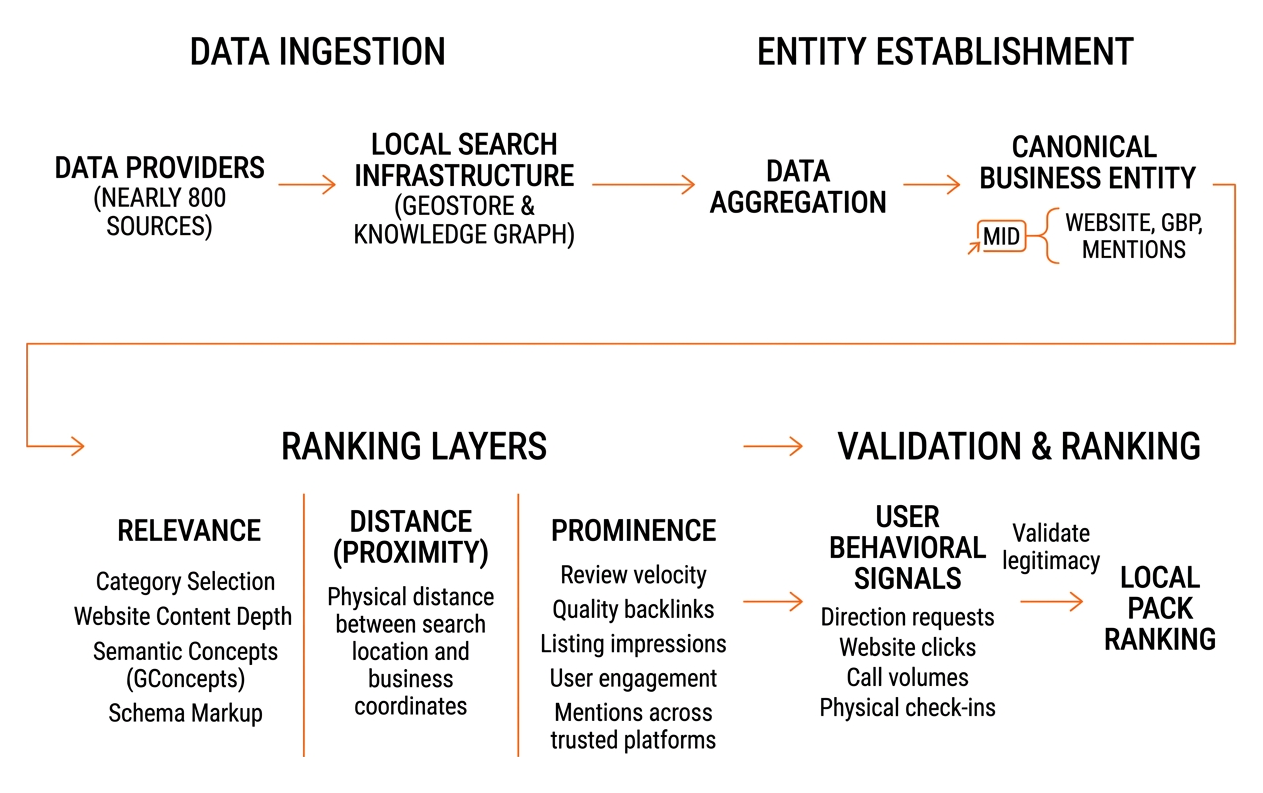
Google maps out entities using Machine IDs (MIDs) to link your website, Google Business Profile (GBP), and external mentions into a single, cohesive entity. User behavioral signals—such as direction requests, website clicks, call volumes, and physical check-ins—act as real-time validation that your business is active, legitimate, and trusted by actual locals.
Mastering Google Business Profile for Local Maps SEO
Your Google Business Profile accounts for roughly 32% of your local pack ranking signals. Setting up an effective profile requires precision and a focus on complete data entry.
- Primary and Secondary Categories: Your primary category carries the heaviest ranking weight. Choose the exact category that defines your primary revenue-generating service, and support it with relevant secondary categories without adding unrelated services.
- Profile Metadata and Attributes: Complete every single attribute field available, including payment methods, accessibility, appointment links, and specific amenities. Keeping accurate business hours and rich metadata can increase weekday call volume by up to 94%.
- Media and Local Imagery: Businesses that publish regular photos receive 42% more direction requests and 35% more click-throughs. Upload high-resolution images of your team, storefront, and completed projects. Real photos taken on-site contain natural camera metadata that helps search algorithms connect visual assets to your geographic location.
- Weekly Profile Activity: Treat your GBP like an active channel. Publish weekly updates featuring specific services, neighborhood mentions, and direct calls-to-action to provide consistent freshness signals to the ranking engine.
If you are setting up your listing from scratch or rebuilding after a suspension, implementing tailored local SEO solutions ensures your foundational profile settings align with current algorithm standards. You can also explore our step-by-step breakdown on Google Business Profile setup and optimization to refine every setting for maximum local visibility.
Review Velocity and Geolocation Trust Signals
Online reviews serve as both a conversion driver and a critical ranking factor. 97% of consumers read reviews for local service providers, with 41% stating they always check feedback before reaching out. A company with 200+ authentic reviews and a 4.7 rating will outrank competitors with minimal feedback in almost every competitive market.
To build an organic review engine:
- Maintain Consistent Review Velocity: Sudden spikes of reviews look unnatural. Aim for a steady acquisition rate of 2 to 4 verified customer reviews each week.
- Encourage Keyword-Rich and Hyperlocal Feedback: A review that says, “They fixed our roof leak near Myrtle Ave in Glendale” carries significantly more semantic weight than a generic “Great job!”
- Leverage Verified On-Site Signals: A review submitted by a customer who was physically located at your storefront carries up to three times the algorithmic trust of a remote submission.
- Engage High-Level Local Guides: Feedback left by active Google Local Guides provides stronger prominence signals due to their established account history within the map ecosystem.
- Respond to Every Review Promptly: Reply to all reviews within 24 hours. Acknowledge positive comments warmly and address negative feedback with professional, resolution-oriented answers.
Using printed QR-code cards at your physical checkout or job sites allows satisfied clients to open your direct review link instantly on their smartphones.
Optimizing On-Page Signals and Precision Geolocation
Winning top map rankings requires total harmony between your external profiles and your on-page technical foundation. Your website is the primary entity anchor that informs Google’s index about your geographic footprint and service scope.
Map positioning requires precision. A minor discrepancy between your website’s listed address and your map pin can cause cluster filter errors, where Google suppresses your listing because it cannot confidently resolve your true location. Ensure your latitude and longitude coordinates are accurate to five decimal places across your entire digital presence. For service-area setups, ensure your declared service boundaries mirror your real transactional zones rather than inflating your radius artificially.
To establish this level of authority, ensure your website adheres to foundational website search engine optimization, focusing on page speed, crawlability, and clear site architecture.
API-Driven Map Embeds and Schema Implementation
Embedding a map on your contact and location pages is a standard local SEO practice, but static iframe embeds generated through basic share links provide minimal semantic value. As outlined in the guide on the hidden link between map embeds and organic local traffic, using a dynamic Google Maps JavaScript API embed creates a direct programmatic bridge between your site and your Google Cloud project. In real-world tests, switching to an API-driven map centered precisely on a storefront improved “near me” visibility by 40% in two weeks.
To prevent interactive map scripts from dragging down your site performance, implement lazy loading on your map containers so they render only when a user scrolls near them.
Complement your map embed with complete LocalBusiness JSON-LD structured data. Your schema must match your profile data exactly:
Hyperlocal Content and Neighborhood Targeting
Templated, generic location pages fail to move the needle in competitive markets. Research shows that genuine, hyperlocal content delivers a 107% lift in local rankings compared to mass-produced city pages. In fact, case studies from how we used hyper-local content to win the next neighborhood over demonstrate that building true neighborhood authority allows service businesses to expand their reach well beyond their immediate zip code.
To win neighboring districts:
- Reference Specific Landmarks and Intersections: Mention local parks, major avenues, transit hubs, and recognizable community centers naturally within your case studies and project descriptions.
- Feature Authentic Hyperlocal Projects: Detail real customer jobs completed in specific neighborhoods, incorporating authentic customer testimonials and job photos.
- Target Neighborhood-Specific Search Queries: Expand your reach by targeting long-tail local keywords that combine your core services with specific sub-neighborhoods.
- Secure Hyperlocal Inbound Links: Build community authority by earning 5 to 10 local backlinks each month through neighborhood event sponsorships, local business associations, and community blogs.
Bridging Traditional Map Packs and AI Search Engines
Local discovery is experiencing a massive platform shift. 45% of consumers now use AI search platforms like ChatGPT, Perplexity, and Gemini for local service discovery, compared to just 6% a year ago. Furthermore, businesses recommended by AI engines see four to twenty-three times higher call conversion rates because the recommendations are delivered as direct, high-trust answers.
However, traditional local pack rankings do not automatically translate into AI visibility. As detailed in Local SEO in the AI Era: The Complete Guide for 2026, ChatGPT recommends only 1.2% of local business locations, Gemini highlights 11%, and Perplexity surfaces 7.4%, compared to 35.9% visibility in Google’s traditional 3-pack. In total, only 45% of leading brands in traditional map search maintain top positions within AI discovery engines.
| Ranking Dimension | Traditional Google Local Pack | AI Search Engines (ChatGPT, Gemini, Perplexity) |
|---|---|---|
| Primary Data Source | Google Maps Geostore & GBP | Multi-platform knowledge graphs, Mapbox, Bing, web text |
| Primary Driver | Proximity and direct category match | Entity consistency and citable unstructured web authority |
| Result Format | 3-Pack list with map pins | Synthesized natural-language answers and direct citations |
| Selection Breadth | Surfaces 32% more unique local businesses | Highly concentrated; surfaces fewer than 2-3 top recommendations |
| Content Evaluation | Keyword optimization and profile completion | Conversational Q&A relevance and authoritative third-party sentiment |
Adapting Local Maps SEO for AI Overviews and Recommendation Engines
AI engines evaluate local entities by synthesizing unstructured mentions across the wider web. To secure visibility across both traditional map packs and AI Overviews, businesses must implement advanced SEO execution strategies that make their local data easily citable:
- Implement Conversational FAQPage Schema: Structure frequently asked questions using
FAQPagemarkup to directly answer common buyer queries regarding pricing, service turnaround, and geographic availability. - Cultivate Unstructured Digital PR Mentions: AI models rely heavily on editorial mentions from local news outlets, neighborhood roundups, and verified directories to confirm that your business is an established authority.
- Maintain Multi-Platform NAP Consistency: Unlike Google, which relies primarily on its own ecosystem, generative AI cross-references Mapbox, Apple Maps, Bing Places, and Yelp to validate business details.
- Format Content for Answer Extraction: Use concise, factual summary paragraphs at the beginning of service pages that directly answer who you are, what you do, and the exact areas you cover.
Multi-Location Architecture and Scaled Governance
Managing multiple locations requires a clean architecture that prevents internal competition while delivering unique, localized value for every branch.
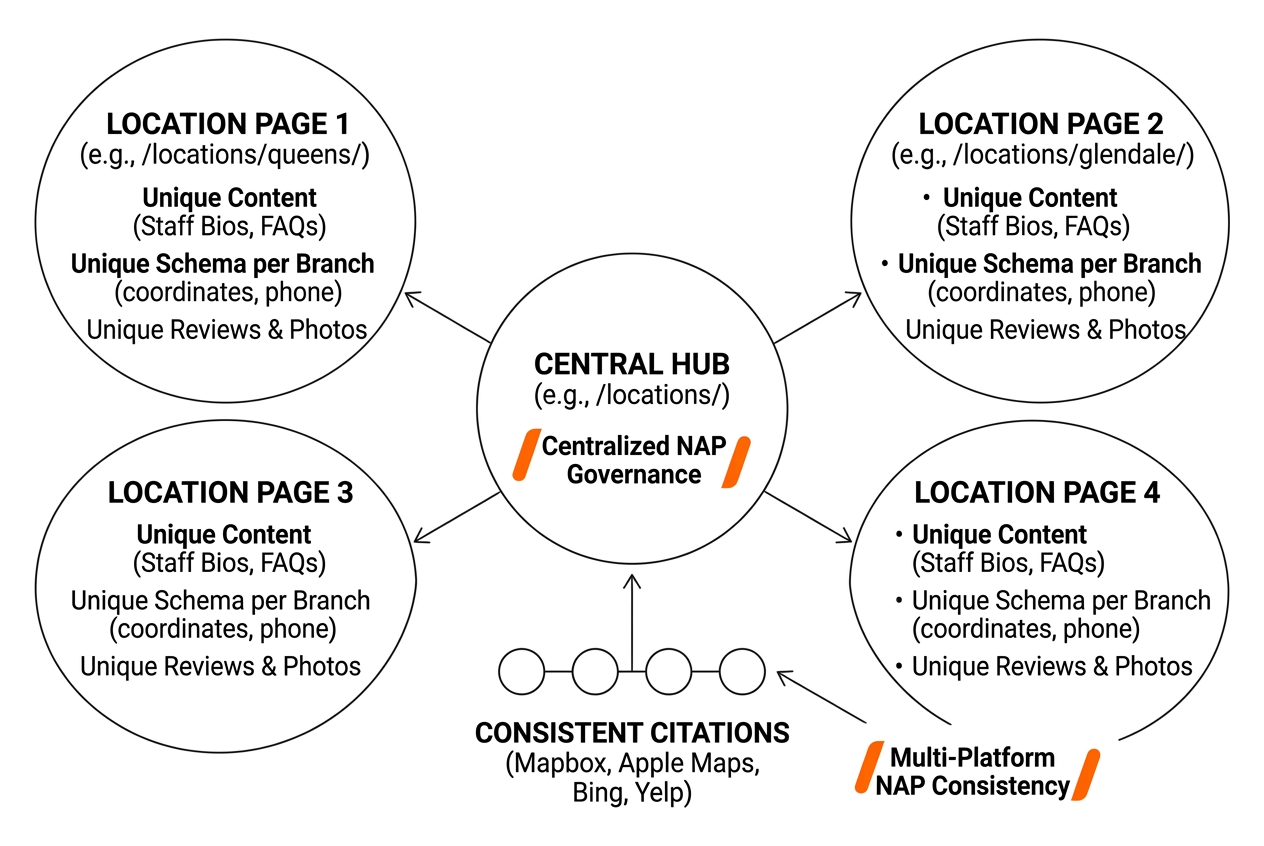
- Hub-and-Spoke URL Structure: Organize pages logically under a clear hierarchy (for example,
/locations/as the hub, linking to dedicated spokes like/locations/queens/and/locations/glendale/). - Unique Content per Location Page: Ensure that at least 60% to 70% of the content on each location page is completely unique. Include specific staff bios, neighborhood-specific FAQs, unique customer reviews, and actual storefront photography. For targeted borough-wide frameworks, review our dedicated Queens local SEO strategies.
- Unique Schema per Branch: Each location page must feature a distinct
LocalBusinessschema block containing the exact coordinates, phone number, and address for that specific location. - Centralized NAP Governance: Maintain a single, centralized database for all business details to prevent conflicting operating hours and addresses across directory networks.
Measuring Visibility and Eliminating Map Ranking Pitfalls
Tracking local rankings from a single physical spot produces misleading data because rank positions change from street to street. To get an accurate picture of your local footprint, use visual grid trackers (such as 5×5 or 13×13 coordinate heatmaps) to simulate searches across your entire target area.

By monitoring grid points across surrounding zip codes, you can instantly identify ranking dead zones where your proximity signals drop off. Use these insights to deploy targeted neighborhood pages and acquire localized backlinks to expand your coverage area.
Executing proven local visibility strategies allows you to track key performance metrics systematically:
- Grid Average Rank: Your average position across all simulated geographic points in your target area.
- Call and Direction Actions: Direct conversion actions generated through your Google Business Profile.
- AI Overview Citations: The frequency with which your brand is cited in conversational AI search responses.
- Website Organic Click-Throughs: Search visitors arriving via localized landing pages.
Common Local Maps SEO Mistakes to Avoid
Avoiding algorithmic penalties is just as important as executing proactive optimizations. Steer clear of these common local SEO pitfalls:
- Creating Thin Doorway Pages: Publishing near-identical city pages with only the town name swapped out triggers spam filters and dilutes your site’s authority.
- Keyword Stuffing the Business Name: Adding unbranded keywords or geographic locations into your official Google Business Profile title violates Google’s guidelines and risks an immediate listing suspension.
- Letting Coordinates Drift: Failing to verify that your schema coordinates match your physical map pin leads to algorithmic confusion and ranking loss.
- Allowing Stale NAP Discrepancies: Outdated phone numbers or addresses across third-party directories undermine entity confidence across search engines and AI models.
- Purchasing Artificial Review Bursts: Acquiring unnatural bursts of generic 5-star reviews from non-local accounts triggers Google’s spam algorithms and damages consumer trust.
Frequently Asked Questions About Local Maps SEO
What is the most important ranking factor for Google Maps in 2026?
Google Maps rankings are driven by a combination of primary category accuracy, physical proximity to the searcher, continuous review velocity, and overall entity prominence across the web. A complete Google Business Profile with active updates and accurate LocalBusiness schema provides the strongest base for high map pack placement.
How does AI search discovery differ from the Google 3-pack?
While Google’s local 3-pack relies primarily on proximity, category matches, and direct GBP signals, AI search engines (like ChatGPT, Perplexity, and Gemini) evaluate broad entity consistency, unstructured brand mentions, and conversational relevance across multiple web sources. AI search surfaces fewer total businesses but delivers significantly higher conversion rates per recommendation.
Can service-area businesses rank without a physical storefront?
Yes. Service-area businesses (SABs) can rank in local search results by defining accurate service-area polygons, adding complete LocalBusiness schema with clear geographic coverage attributes, generating authentic customer reviews that mention specific neighborhoods, and publishing hyper-targeted, unique service pages.
Conclusion
Dominating local search in 2026 requires an entity-first strategy that satisfies both Google’s map algorithms and emerging AI search engines. By combining a fully optimized Google Business Profile, steady review velocity, five-decimal coordinate accuracy, dynamic API map embeds, and genuine hyperlocal content, your business can build an unshakeable local search presence.
At NY Web Consulting, we help local businesses transform their online presence into scalable lead generation systems. Explore our expert search engine optimization services to see how we can help you capture the top spots in the local map pack and grow your market share.