
Why Most Businesses Are Targeting the Wrong Keywords
Long tail SEO keywords are specific, multi-word search phrases that individually attract lower search volumes but collectively make up the vast majority of all searches online.
Quick answer: Here’s what you need to know at a glance:
| Short-Tail | Mid-Tail | Long-Tail | |
|---|---|---|---|
| Example | “shoes” | “running shoes women” | “best running shoes for flat feet women” |
| Word count | 1-2 words | 2-3 words | 3+ words |
| Search volume | Very high | Medium | Low |
| Competition | Very high | Medium | Low |
| Conversion rate | Low | Medium | 2.5x higher |
| Best for | Brand awareness | Consideration | Ready-to-buy traffic |
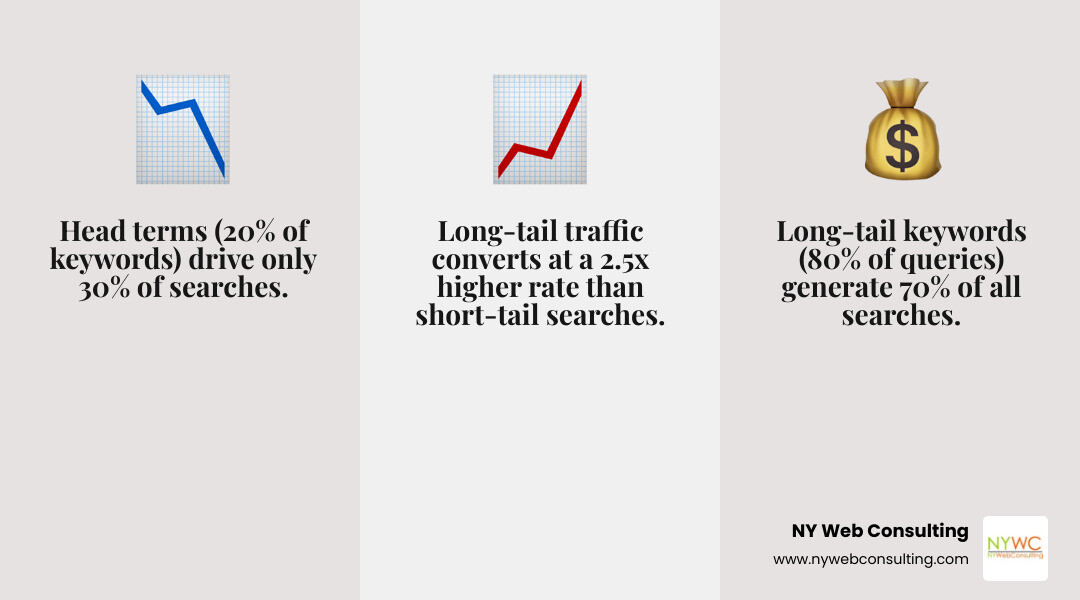
Most small business websites chase the same broad, high-volume keywords — and lose to bigger sites every time. Meanwhile, over 70% of all search queries are longer, more specific phrases that your competitors are quietly ignoring.
The math is simple: a handful of visitors who are ready to act are worth far more than thousands of casual browsers. Long-tail phrases attract the first group.
And in 2026, with AI-powered search changing how Google surfaces results, this strategy matters even more — not less.
I’m Brian Butrym, founder of NY Web Consulting, and I’ve spent years helping small businesses in Queens and beyond improve their search visibility through smart, targeted long tail SEO keywords strategies. In this guide, I’ll walk you through exactly how to find, target, and rank for the phrases that actually drive business.
Understanding Long Tail SEO Keywords in the Age of AI
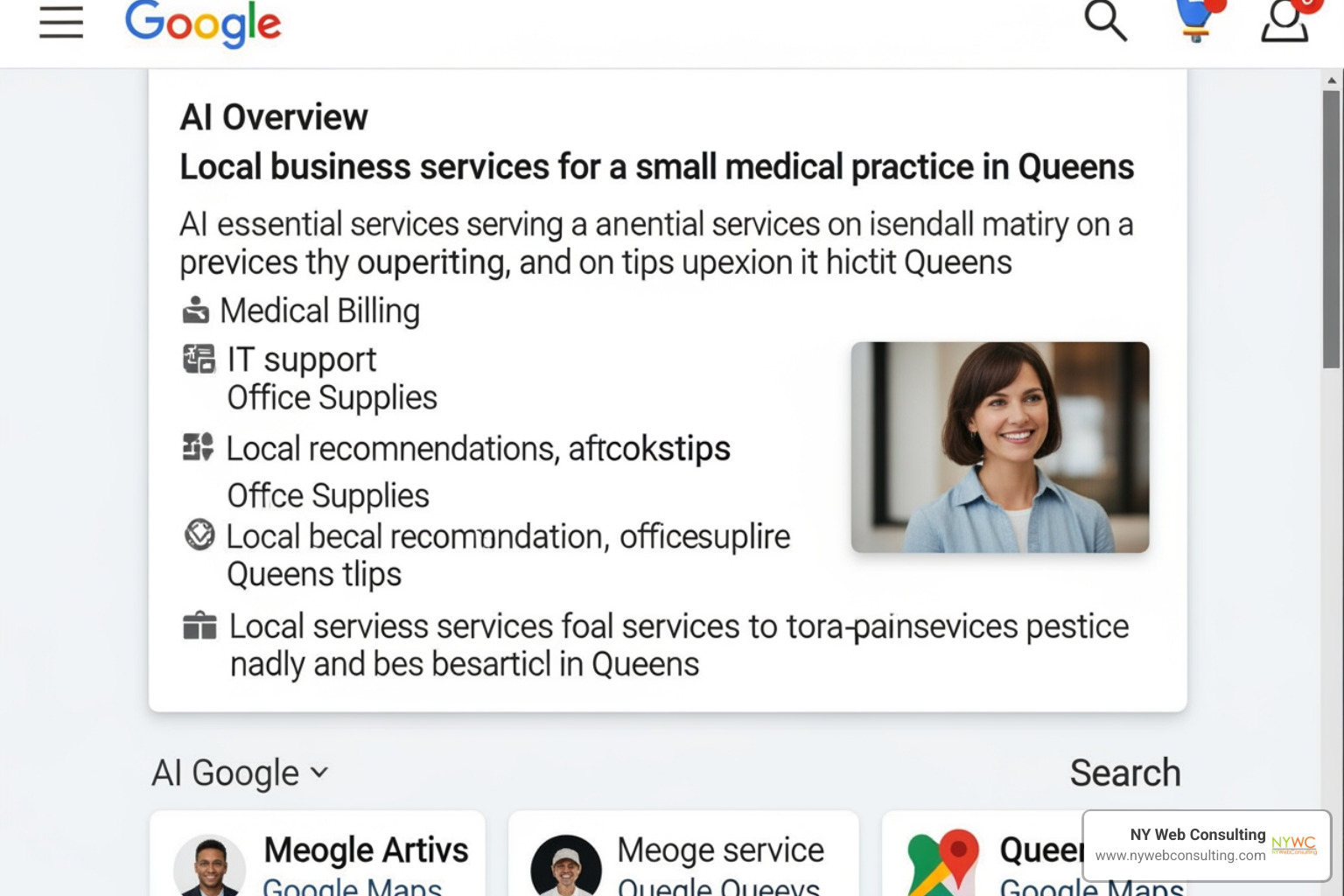
As we move through May 2026, the SEO landscape has shifted dramatically. If you’ve looked at a Google search result lately, you’ve likely seen an “AI Overview” at the top. These AI-generated summaries don’t just happen by accident; they are triggered by specific, conversational queries. This is the heart of why long tail keywords are the backbone of modern search.
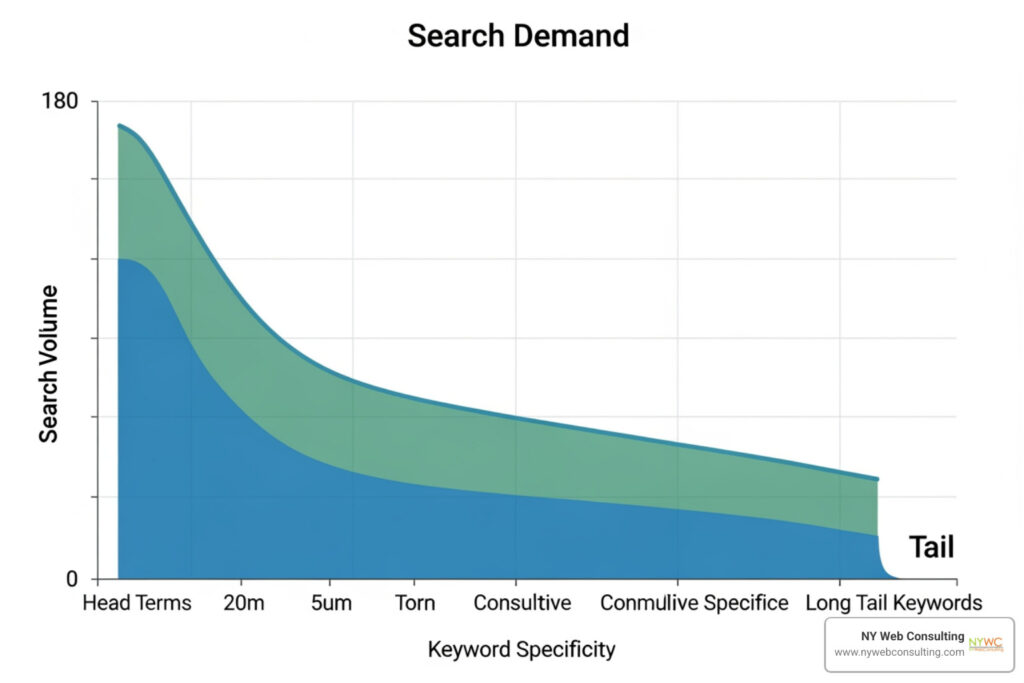
The “long tail” refers to the search demand curve. Think of a Chinese dragon: the “head” is the big, broad terms like “pizza” or “lawyer.” These have massive volume but are incredibly hard to rank for. The “tail” is the long, trailing body made up of billions of unique, low-volume queries. While one specific phrase might only get 10 searches a month, there are millions of these phrases. In fact, roughly 95% of keywords in major databases like Ahrefs have fewer than 10 searches per month.
In 2026, search has become more conversational. The average query length triggering AI Overviews grew to 4.2 words by the end of last year. People aren’t just typing “SEO”; they are asking, “How can I Improve Website SEO for a small medical practice in Queens?”
This shift toward “Concept Density” means search engines now look for content that covers specific niches deeply rather than broad topics shallowly. By targeting these phrases, we tap into a world where competition is lower and user intent is crystal clear.
The Difference Between Short-Tail, Mid-Tail, and Long-Tail
To master your strategy, we need to break down the anatomy of a search query. It isn’t just about word count—it’s about the “intent” behind the words.
- Short-Tail (Head Terms): Usually 1-2 words (e.g., “Web Design”). These are the “ego” keywords. They have massive volume but are almost impossible for small businesses to rank for because they are dominated by giant corporations. The intent is vague—is the user looking for a job, a definition, or a service?
- Mid-Tail: Usually 2-3 words (e.g., “Web Design Queens”). This adds a layer of specificity, often geographic or categorical. Competition is still high, but the intent is clearer.
- Long-Tail: 3+ words (e.g., “best responsive web design for local retail stores in Glendale”). These are highly specific. The searcher knows exactly what they want.
| Keyword Type | Volume | Competition | Intent | Conversion |
|---|---|---|---|---|
| Short-Tail | Massive | Extreme | Vague | Low |
| Mid-Tail | Moderate | High | Clearer | Moderate |
| Long-Tail | Low | Low | Specific | High |
How AI Overviews and Generative Search Impact Strategy
AI Overviews (SGE) have revolutionized how we think about ranking. As of early 2025, 35% of AI results handled multiple search intents at once, and that number is projected to hit 65% this year. What does this mean for you? It means Google is looking for “citations.”
Research shows that AI Overviews are pulling from up to 151% more unique websites for complex B2B queries compared to traditional search. By using Advanced SEO Strategies that target long-tail phrases, you increase your “surface area.” You aren’t just trying to be #1; you are trying to be the source the AI cites when answering a specific question.
Why Long-Tail Phrases Outperform Broad Head Terms
If we told you that you could have 1,000 visitors who might buy something or 50 visitors who definitely will buy something, which would you choose? If you like making money, you’ll take the 50.
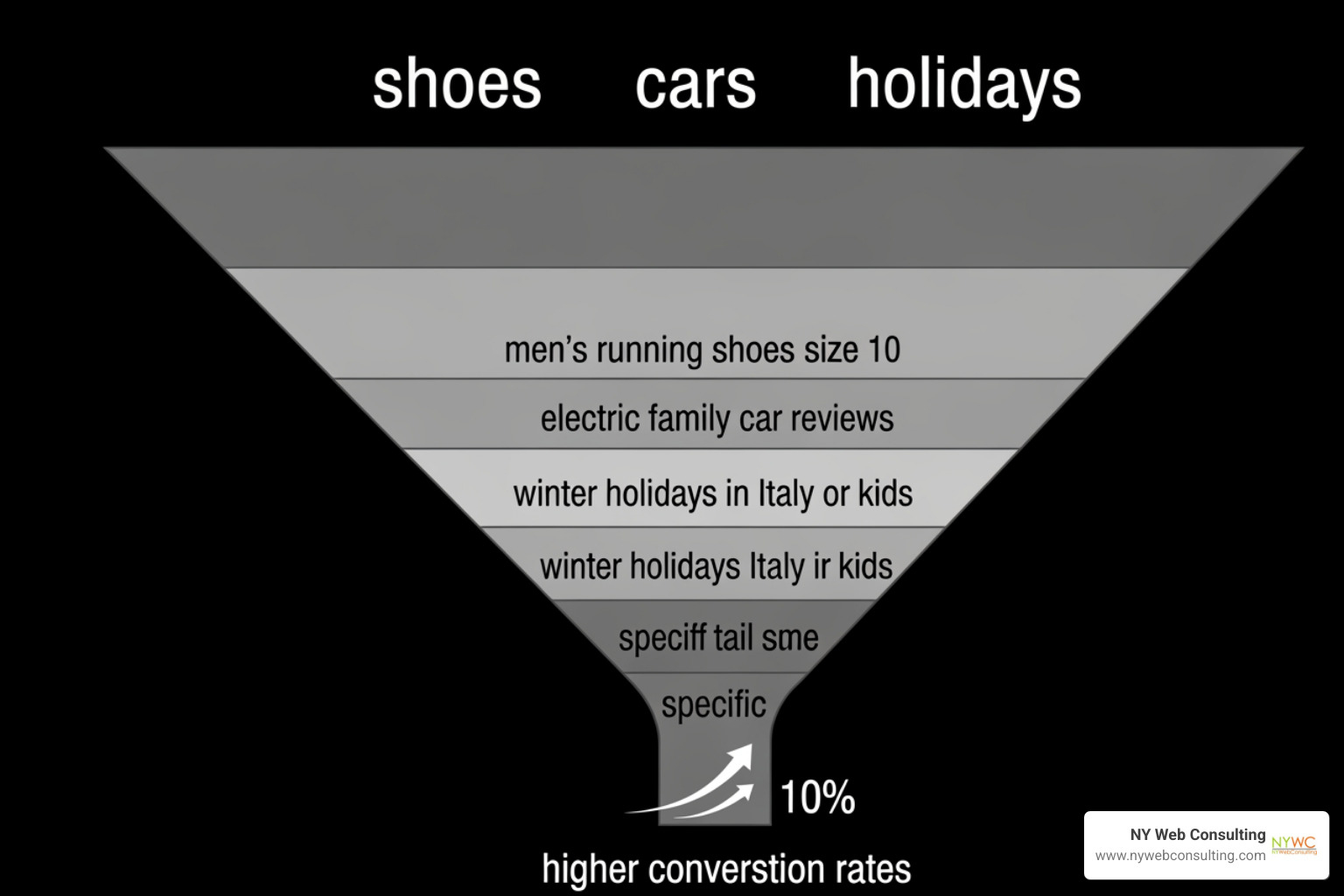
Long-tail keywords: Target lower-competition keywords because they represent users further along in the buying cycle. Someone searching for “laptop” is just looking. Someone searching for “best lightweight 14-inch laptop for graphic designers under $1500” has their credit card on the desk.
Beyond conversions, here is why we prioritize these phrases at NY Web Consulting:
- Lower CAC (Customer Acquisition Cost): Because the competition is lower, it takes less time and fewer backlinks to rank.
- E-E-A-T Authority: Writing deep-dive content on specific long-tail topics proves to Google that you have Experience, Expertise, Authoritativeness, and Trustworthiness.
- Reduced CPC: If you run Google Ads, long-tail phrases often have a much lower Cost-Per-Click. You get higher-quality traffic for a fraction of the price.
- Stability: A site that relies on one “head term” is vulnerable. A site that ranks for 500 long-tail terms has a “revenue moat” that is much harder to disrupt.
If you are looking for SEO Services NYC, you want a partner who understands that traffic is a vanity metric, but conversions are a sanity metric.
Topical vs. Supporting Long Tail SEO Keywords
Not all long-tails are created equal. Ahrefs and other experts distinguish between two types:
- Topical Long-Tail Keywords: These are unique topics. For example, “how to clean a vintage leather sofa” is a distinct topic. You need a dedicated page for this.
- Supporting Long-Tail Keywords: These are variations of a “Parent Topic.” For example, “cleaning old leather couch” is just a variation of the first one.
As a New York SEO Consultant, we help you cluster these together. You don’t want 50 tiny pages that all say the same thing (that’s called keyword cannibalization); you want one “Pillar Page” that answers the main question and covers all the semantic variations naturally.
How to Find High-Intent Long Tail SEO Keywords
Finding these gems requires looking where your competitors aren’t. While they are fighting over the same five keywords in a paid tool, we use “first-party data” and human behavior.
Here are our favorite methods:
- Google Autocomplete: Start typing your main service and see what Google suggests. These are real searches happening right now.
- People Also Ask (PAA): These boxes are a goldmine for long-tail questions. Each question is a potential H2 heading for your content.
- User-Generated Content (UGC): Browse Reddit, Quora, and niche forums. How do real people describe their problems? They don’t use marketing jargon; they use long-tail phrases.
- Competitor Gap Analysis: Look for the specific questions your competitors aren’t answering.
For more tips, check out this guide on How to Find Long-Tail Keywords to Grow Your Traffic – Nightwatch.io. We also specialize in Local SEO Solutions that find the specific neighborhood-based phrases your customers are using in Queens and Manhattan.
Mining Google Search Console for Long Tail SEO Keywords
Your best data is already in your hands. Open Google Search Console and look for “striking distance” keywords. These are queries where you are currently ranking in positions 8 through 20.
You already have “impressions” (people are seeing you), but your CTR (Click-Through Rate) is low because you’re on page two. By slightly optimizing your content to better target these specific long tail SEO keywords, you can jump to the first page and see an immediate traffic spike. As a New York Local SEO Company, we use this “low-hanging fruit” strategy to get our clients faster wins.
Strategic Implementation: Topic Clusters and Content Optimization
Once you have your list of long tail SEO keywords, you can’t just sprinkle them like salt on a bad meal. You need a structural approach.
We use the Topic Cluster Model:
- Pillar Page: A comprehensive guide on a broad topic (e.g., “The Ultimate Guide to Commercial SEO”).
- Cluster Content: Individual blog posts or pages targeting specific long-tails (e.g., “SEO for HVAC companies in Queens”).
- Internal Linking: Link the cluster pages back to the pillar page. This tells Google that you are a topical authority.
This approach is detailed further in Long-Tail Keywords: The Ultimate 2026 Guide. By organizing your site this way, you make it easy for search engines to crawl and understand your expertise. It’s a core part of How to Optimize Your Website for Search Engines.
Optimizing Content for Long Tail SEO Keywords and AI Overviews
To rank in 2026, your content must be “scannable” for both humans and AI. Here is our checklist for Local SEO Solutions to Make Your Business Famous Nearby:
- Direct Answers: Put a clear, 40-60 word answer to the primary long-tail question right at the top of the page. This is what AI Overviews love to grab.
- Heading Tags (H2/H3): Use your long-tail phrases as subheadings.
- Natural Integration: Don’t “keyword stuff.” If your keyword is “best vegan pizza Glendale Queens,” use it naturally in the first 100 words, but then use synonyms throughout the rest of the text.
- Schema Markup: Use FAQ schema to help search engines identify the questions and answers on your page.
- Bullet Points: AI engines prefer structured data. Use lists to break down complex steps.
Frequently Asked Questions about Long Tail SEO
What is the best way to track long-tail keyword performance?
We recommend using Google Search Console as your primary source of truth. Track your “Average Position” and “Total Impressions” for specific long-tail queries. If your impressions are going up but your clicks aren’t, it’s time to rewrite your Meta Description to be more enticing!
Can a single page rank for hundreds of long-tail keywords?
Absolutely! Thanks to Google’s semantic search capabilities (like BERT and MUM), a single, high-quality “comprehensive” page can rank for the main topic and hundreds of closely related long-tail variations. This is why we focus on “Topical Authority” rather than just individual keyword counts.
How do long-tail keywords benefit local businesses?
For a business in Glendale or Queens, long-tail keywords are your secret weapon. Instead of competing for “Plumber,” you compete for “emergency 24-hour drain cleaning in Glendale Queens.” These “near me” modifiers and hyperlocal phrases drive actual foot traffic and phone calls. Don’t forget The Power of Creating a Google Business Profile in 2023 to anchor these local searches.
Conclusion
Ranking in 2026 isn’t about outspending the giants; it’s about outsmarting them. By focusing on long tail SEO keywords, you are meeting your customers exactly where they are: at the moment of specific need.
At NY Web Consulting, based right here in Glendale, Queens, we specialize in this exact strategy. We don’t just build websites; we build lead-generation engines that focus on user experience and the latest SEO technology. Whether you need a faster site or a comprehensive content strategy, we are here to help you achieve sustainable, organic growth.
Ready to stop chasing “vanity” keywords and start driving real revenue? More info about our web consulting agency is just a click away. Let’s transform your website into your hardest-working employee.