
Why User Experience Design Matters for Your Business
User experience design is the process of creating products that provide meaningful and enjoyable experiences. At its core, UX design focuses on understanding user needs to craft solutions that are easy to use, accessible, and aligned with business goals.
Key aspects of user experience design:
- User-centered approach – Designing with real user needs in mind
- Holistic perspective – Considering every user touchpoint
- Business impact – Driving conversions and brand loyalty
- Iterative process – Continuous research, testing, and refinement
- Core disciplines – User research, information architecture, interaction design, and usability testing
The term “user experience” was coined by Don Norman at Apple in the 1990s to encompass “all aspects of the end-user’s interaction with the company, its services, and its products.”
For small business owners, good UX directly affects your bottom line. Since most visitors decide whether to stay or leave within seconds, a well-designed user experience is crucial for keeping them engaged, building trust, and converting them into customers. Poor UX, on the other hand, costs you money when frustrated users leave, likely never to return.
I’m Brian Butrym, and at NY Web Consulting, I’ve spent years helping businesses transform their websites into powerful lead generation tools through thoughtful user experience design. We create fast, secure, and user-friendly sites that convert visitors into loyal customers.
Foundations of User Experience (UX) Design
The concept of user experience design is built on a simple idea: design products for people. Don Norman, working at Apple in the 1990s, coined the term “user experience” to encompass every interaction a person has with a company and its products. This user-centered approach is the foundation of everything else.
Great user experience design ensures a product is:
- Usable: Intuitive and easy to steer.
- Equitable: Accessible to people of all backgrounds and abilities.
- Enjoyable: Creates a positive, delightful feeling.
- Useful: Solves a real-world problem for the user.
These principles are what separate a website that converts visitors into customers from one that sends them to your competitors. As the Nielsen Norman Group’s article on The Definition of User Experience (UX) states, UX includes “all aspects of the end-user’s interaction with the company, its services, and its products.”
What is user experience design and why is it crucial?
User experience design is the practice of shaping the entire journey a person takes with your product. It’s not just about aesthetics; it’s about how people perceive your brand and whether they can achieve their goals. A frustrating website experience costs businesses money.
Good UX, however, builds trust, guides users effortlessly, and simplifies complex tasks. This matters because user perception and emotions drive behavior. A positive experience fosters brand loyalty and improves conversion rates. When accessibility is prioritized, you open your doors to everyone. That’s why UX is a cornerstone of our Web Design Services.
Key Principles of Great UX
Peter Morville’s UX Honeycomb breaks down a valuable experience into seven key facets:
- Findable: Content is easy to locate.
- Credible: The site earns user trust.
- Desirable: The design creates an emotional connection.
- Accessible: It’s usable by people with diverse abilities. Learn more at What is Accessibility?.
- Valuable: It delivers value to the user and the business.
- Usable: The product is efficient and easy to use.
- Useful: It fulfills a genuine user need.
Understanding UX Design vs. UI Design
User experience design (UX) and User Interface design (UI) are often confused but are distinct disciplines. UX is the overall journey and feeling, while UI is the visual and interactive part. Think of UX as the architecture of a house and UI as the interior decor.
| Aspect | User Experience (UX) Design | User Interface (UI) Design |
|---|---|---|
| Focus | The overall journey and how it feels. Why people use something and how they accomplish their goals. | The visual and interactive elements. What people see and touch. |
| Goal | Make products useful, usable, and genuinely helpful. Create smooth, efficient experiences. | Make the interface beautiful, responsive, and easy to interact with. |
| Scope | Research, strategy, information architecture, user flows, wireframes, testing—the big picture. | Visual design, colors, typography, button styles, animations—the details that bring designs to life. |
| Deliverables | Research reports, personas, user flows, wireframes, prototypes, usability test results. | High-fidelity mockups, visual designs, design systems, interactive prototypes. |
| Timing | Usually happens first, laying the strategic foundation. | Follows UX, adding visual polish and interactive refinement. |
Both are essential. Great UX with poor UI is frustrating. Great UI with poor UX is a beautiful but useless product. Success requires both working in harmony.
The Role of a UX Designer: Responsibilities and Essential Skills
A UX designer is the user’s advocate, working to make digital products effortless and intuitive. They are problem-solvers who blend research, creativity, and psychology to champion the user’s needs. The role is dynamic, involving everything from brainstorming sessions to data analysis and stakeholder presentations.
A key challenge is balancing user needs with business goals and technical constraints. UX designers collaborate with developers, product managers, and marketers, using research and data to defend design decisions and create a cohesive, effective product.
Key Responsibilities and Tasks
The core of user experience design is translating user insights into better digital products. This involves several key activities:
- User Research: Uncovering user needs and pain points through interviews, surveys, and observation.
- Creating Personas: Developing semi-fictional characters based on research to represent key user groups and keep the team focused.
- Mapping User Journeys: Visualizing how a user moves through a product with user flows and journey maps to identify opportunities. Learn more in our guide on Mapping the User’s Mind: A Guide to Journey Mapping.
- Information Architecture: Organizing content and features logically so that the product is intuitive to steer.
- Wireframing & Prototyping: Creating basic structural layouts (wireframes) and then building interactive models (prototypes) to test concepts before development.
- User Testing: Observing real users interact with prototypes to identify usability issues and gather feedback for refinement.
- Collaboration & Presentation: Sharing findings and design rationale with stakeholders to advocate for the user.
Essential Skills for Success
Success in user experience design requires a mix of technical and human-centered skills.
Technical skills include proficiency in research methods, wireframing and prototyping tools (like Figma or Adobe XD), and understanding principles of information architecture and interaction design.
However, soft skills are what truly set great designers apart:
- Empathy: The ability to deeply understand and share the feelings of others is the foundation of user-centered design.
- Communication: Clearly explaining design decisions and research findings to non-designers is crucial.
- Collaboration: Working effectively across disciplines with developers, marketers, and stakeholders.
- Critical Thinking: Analyzing complex problems and finding neat, effective solutions.
- Adaptability: Staying curious, embracing feedback, and continuously learning in a field that is always evolving.
At NY Web Consulting, we’ve seen how these skills combine to create websites that work for real people, which is the power of thoughtful user experience design.
Building a Career in User Experience Design
The field of user experience design is growing rapidly, with roles like User Experience Researcher appearing on LinkedIn’s “Jobs on the Rise” lists. This reflects a major shift: businesses now understand that a great user experience is essential for success, creating strong demand for skilled designers.

For those starting out or transitioning from a field like graphic design, there has never been a better time to explore a career in user experience design.
How to Become a UX Designer
A traditional four-year degree isn’t the only path into UX. Here’s a roadmap to get started:
- Learn the Fundamentals: Start with online courses and bootcamps from platforms like Coursera, Udemy, or the Nielsen Norman Group. These offer practical, career-focused training and professional certificates. Traditional university degrees in Human-Computer Interaction (HCI) are also a great option for a deeper theoretical foundation.
- Gain Practical Experience: A portfolio is more important than a degree. Volunteer for non-profits, take on unsolicited redesigns of apps or websites you find frustrating, or seek out internships. Real-world projects demonstrate your problem-solving skills. You can find opportunities on sites like LinkedIn, The Muse, and AngelList.
- Build Your Portfolio: Your portfolio is your most critical career asset. It should tell the story of your process, showcasing not just final designs but also your research, wireframes, and prototypes. Explain your thinking behind each decision. Host it on a personal website or platforms like Behance or Dribble.
- Network: Connect with UX professionals on LinkedIn and attend industry meetups. Building a network can lead to mentorship and job opportunities.
UX Designer Salary and Career Paths
The financial prospects in UX are strong. According to Glassdoor, the average salary for a UX designer in the US is $110,000, often higher than in related UI design roles. This figure varies based on location, experience level, industry, and company size.
The career paths are diverse. You can start as a UX Generalist and later specialize as a:
- UX Researcher: Focuses on understanding user behaviors and needs.
- Interaction Designer: Designs the flow and interaction between a user and a product.
- Information Architect: Organizes complex information to be intuitive.
- Product Designer: Takes a broader, strategic view of the entire product.
- UX Writer: Crafts clear, concise copy for interfaces.
Graphic designers are well-positioned to transition into UX. Your skills in visual communication and creative thinking are a huge advantage. The main shift is moving from a purely aesthetic focus to a user-centered, research-driven approach that solves user problems.
At NY Web Consulting, we know that good user experience design drives business results. It’s a rewarding career that combines creativity with real-world impact.
The UX Design Process in Action
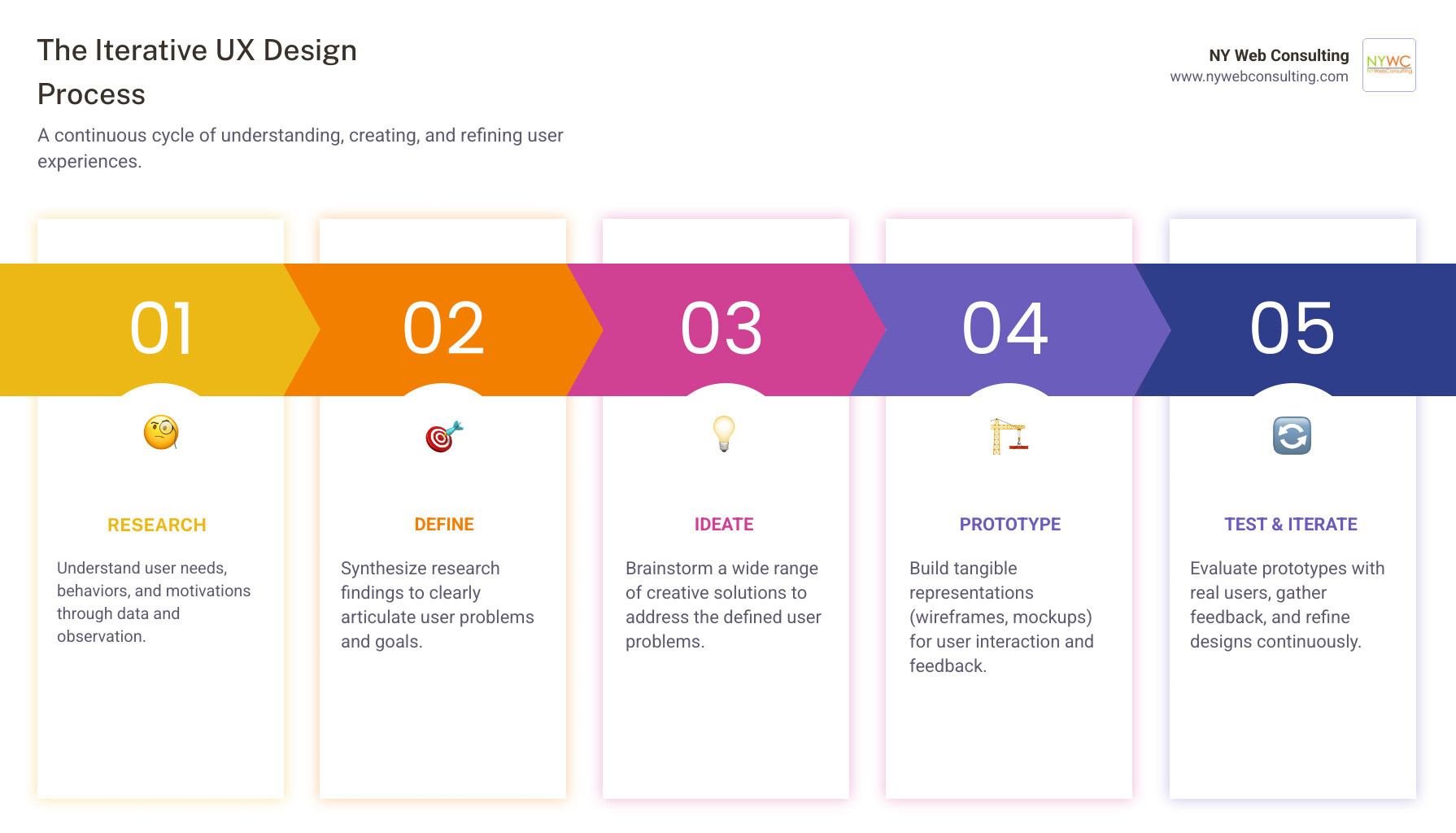
At NY Web Consulting, we know great user experience design is an iterative process, not a one-time task. We follow the design thinking framework, a human-centered approach to problem-solving that ensures we build products that truly connect with users.

The process involves five stages: empathize with users through research, define their core problem, ideate creative solutions, build tangible prototypes, and test them with real users to gather feedback. This cycle is vital for creating high-performing digital products, like those we detail in The Anatomy of a Lead Generation Website: Best Practices for Capturing Leads.
The Importance of User Research and Testing
User research is the foundation of user experience design, allowing us to make decisions based on evidence, not assumptions. Key methods include:
- Interviews: Deep one-on-one conversations to uncover motivations.
- Surveys: Collecting quantitative data from larger user groups.
- A/B testing: Comparing two design versions to see which performs better.
- Usability Testing: Watching users interact with a product to find pain points.
This research helps us identify roadblocks, validate assumptions, and measure how design changes impact user satisfaction and business goals. Testing throughout the process saves time and money by catching issues early.
Key considerations for user experience design
Several elements are critical to exceptional user experience design:
- Prototyping, wireframes, and mockups: We use these tools to visualize and test ideas before coding. Wireframes are the structural blueprints, mockups add the visual design, and prototypes are interactive models that simulate the user experience.
- Accessibility and inclusive design: We are committed to ensuring everyone can use your products. By following the Web Content Accessibility Guidelines (WCAG), we build sites that are perceivable, operable, understandable, and robust for all users, including those with disabilities.
- The impact of AI: Artificial intelligence is reshaping user experience design. AI tools can automate tasks, while conversational interfaces create new design challenges. As designers, we must also address the ethical considerations of AI, such as data privacy and bias, to ensure AI systems are trustworthy and human-centered.
Frequently Asked Questions about User Experience Design
We often hear common questions about user experience design, especially from those new to the field. Here are answers to the most frequent inquiries.
Do UX designers need to know how to code?
No, coding is not a primary requirement for a user experience design role. Your main job is to understand users and design solutions, not to build the final product. However, a basic understanding of HTML and CSS is highly beneficial. It helps you communicate more effectively with developers and design more realistic, implementable solutions. Your core tools remain empathy and research, not a code editor.
Is UX design a good career choice?
Yes, user experience design is an excellent career choice. The field has high demand, strong salary potential, and significant opportunities for growth. According to Glassdoor, the average salary for a UX designer in the US is $110,000. The work is a rewarding blend of creative design and analytical research, allowing you to solve meaningful problems and tangibly improve people’s interactions with technology.
What is the biggest difference between UX and UI design?
This is a common point of confusion. While they work together, user experience design (UX) and User Interface (UI) design have different focuses.
- UX Design is about the overall journey and experience. It focuses on the “why” and “how” of a product, ensuring it’s functional, usable, and solves a user’s problem. Think of it as the architecture and floor plan of a house.
- UI Design is about the visual and interactive elements. It focuses on the “what” and “look” of a product—the colors, fonts, and buttons. This is the interior decor and furniture of the house.
Great products need both: a solid structure (UX) and a beautiful, intuitive presentation (UI). At NY Web Consulting, we understand both are crucial for creating websites that convert.
Conclusion
If you’ve made it this far, you’ve journeyed through the entire landscape of user experience design – from its foundational principles rooted in empathy and user research to the day-to-day work of UX professionals and the promising career opportunities that await. The central message? Great UX isn’t just about making things pretty. It’s about understanding real people, solving their problems, and creating digital experiences that feel effortless and genuinely helpful.
Here’s what really matters: when you prioritize user experience design, you’re making a strategic investment in your business’s success. A website that’s easy to steer, accessible to everyone, and genuinely useful doesn’t just feel good to use – it drives real results. We’re talking about higher conversion rates, stronger customer retention, and the kind of brand loyalty that turns first-time visitors into long-term advocates.
At NY Web Consulting, this user-centric philosophy isn’t just something we talk about – it’s woven into every project we touch. Whether we’re working with a local business in Glendale, Queens, or partnering with companies across New York City, our goal remains the same: to transform websites from simple digital brochures into powerful lead generation tools. By integrating thoughtful user experience design, we create websites that not only look great but also perform exceptionally, turning visitors into loyal customers and driving meaningful business growth.
Your website should work as hard as you do. It should welcome visitors, guide them effortlessly toward what they need, and make it simple for them to take action. That’s the power of exceptional UX combined with smart SEO strategy.
Ready to see what a truly user-friendly website can do for your business? Learn how our SEO services can improve your site’s user experience and help you connect with more customers online. Let’s build something great together.