

Why Small Business Email and Website Hosting Can Make or Break Your Online Presence
Small business email and website hosting are two of the most important decisions you’ll make for your online presence – and getting them right from the start saves you time, money, and headaches down the road.
Here’s a quick breakdown of typical hosting bundle features to compare (pricing and inclusions vary by plan and term):
| Provider Type | Typical Starting Price | Email Included | Uptime Guarantee | Best For |
|---|---|---|---|---|
| Budget shared hosting bundle | ~$1-$5/mo intro | Often yes | Commonly 99.9% | Budget-conscious beginners |
| Standalone business email hosting | ~$1-$6/user/mo | Yes | Commonly 99.9% | Secure standalone email |
| Business email suite (team plans) | Free/low-cost tiers sometimes available | Yes | Commonly 99.9% | Teams of 25+ users |
| Premium web hosting bundle | ~$5-$15/mo intro | Often unlimited mailboxes | Commonly 99.9% | Bundled web + email hosting |
| Domain registrar + email add-on | Low-cost add-ons | Yes | Commonly 99.9% | Domain + email combo |
A few things to know before diving in:
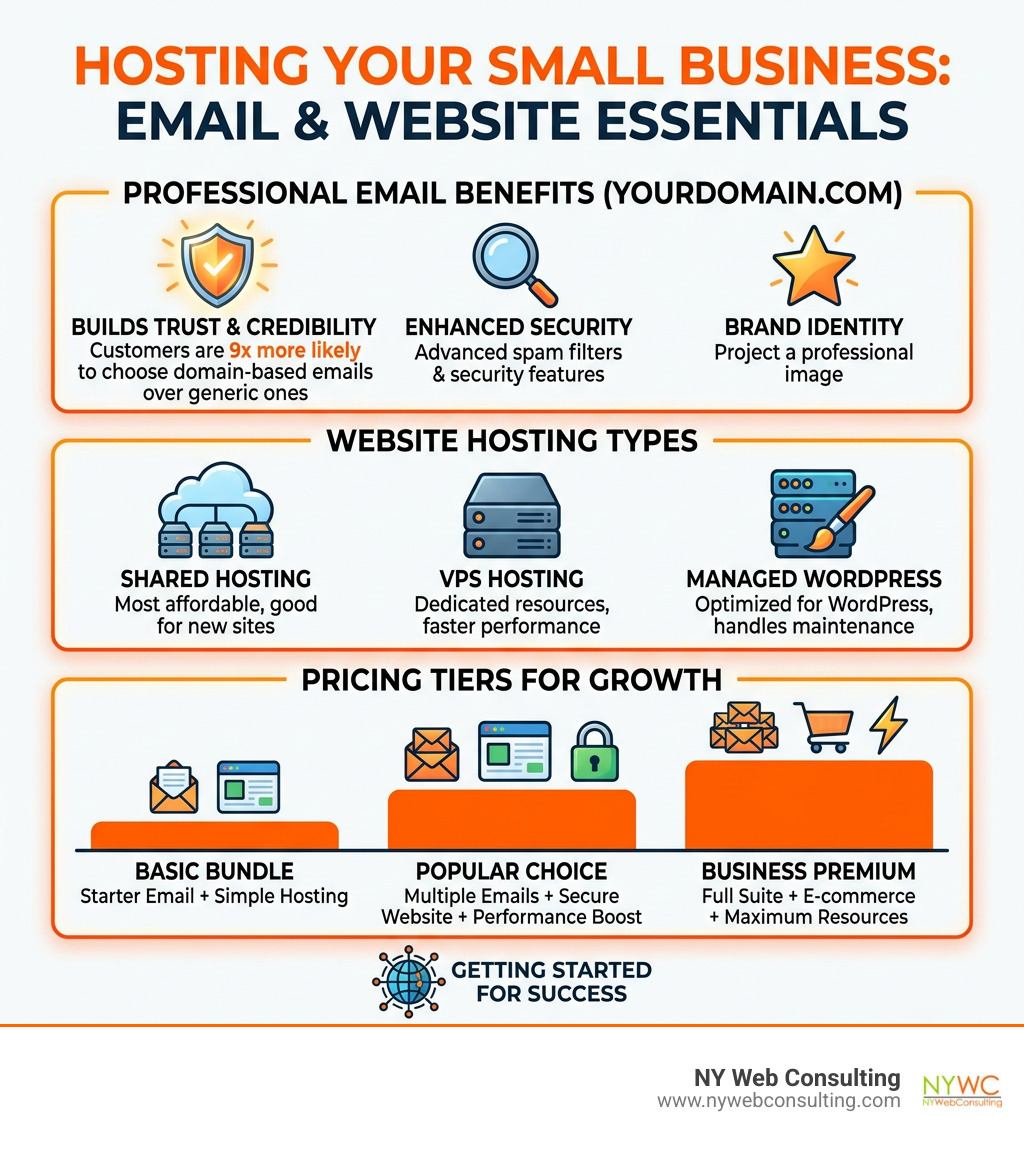
- Customers are 9 times more likely to choose a business with a professional, domain-based email address
- Shared hosting is cheapest but limited – VPS and managed WordPress offer more power as you grow
- Bundled plans (email + website hosting together) can simplify billing and cut costs
- Security basics like SSL, spam filtering, and two-factor authentication (2FA) are non-negotiable
I’m Brian Butrym, founder of NY Web Consulting – a results-driven web design and marketing firm based in Glendale, Queens, NY. I’ve helped dozens of small businesses navigate the often confusing world of small business email and website hosting, from choosing the right plan to migrating existing sites without losing a single email. Let’s break down exactly what you need to know.
The Essentials of Small Business Email and Website Hosting
When we talk about small business email and website hosting, we are talking about the two pillars of your digital identity. Your website hosting is the “land” where your digital office sits, and your email hosting is the “phone line” that carries your professional voice.
One of the most striking statistics in our industry is that customers are 9 times more likely to choose a company with a professional email address over one using a generic @gmail or @yahoo account. Why? Because a custom domain email (like [email protected]) signals that you are an established, credible entity.
For many of our clients in Glendale and Queens, the most efficient route is unified management. By combining your services, you get a single dashboard and one bill. However, you must keep an eye on storage limits and uptime guarantees. While many providers offer a 99.9% uptime guarantee, some specialized services advertise higher targets in their service-level agreements.
If you are just starting out, you can learn more info about website hosting with email to see how these bundles can simplify your workflow. As you grow, scalability becomes the name of the game. You don’t want to be stuck on a plan that crashes the moment your local marketing starts driving heavy traffic to your site.
Professionalism and Branding with Small Business Email and Website Hosting
Your brand identity starts the moment an email hits a lead’s inbox. Using small business email and website hosting allows you to move beyond the limitations of personal accounts.
One of the best ways to look like a larger, more organized operation is through the use of email aliases. Instead of just having [email protected], you can set up departmental addresses like billing@, support@, or sales@. The best part? Most providers allow these aliases to funnel into a single inbox, so you can manage your entire company’s “departments” without logging in and out of different accounts.
Every email you send with a custom domain also acts as a free advertisement for your website. If a customer sees an email from [email protected], they immediately know exactly where to go to see your portfolio. It’s a subtle but powerful first impression that builds trust before you’ve even said “hello.”
Key Security Features for Small Business Email and Website Hosting
In 2025, security isn’t just a “nice-to-have” – it’s a survival requirement. Small businesses in New York City are frequent targets for phishing and malware. When choosing your small business email and website hosting, look for these non-negotiables:
- Two-Factor Authentication (2FA): Whether it’s U2F (a physical key) or TOTP (an app like Google Authenticator), 2FA ensures that even if a hacker steals your password, they can’t get into your account.
- SSL Certificates: This is the “padlock” icon in the browser. It encrypts the data between your website and your visitors. Most quality hosts now include a free SSL certificate (like Let’s Encrypt) in their plans.
- Advanced Spam Protection: Look for modern spam and phishing filtering that can block the vast majority of malicious emails before they ever reach your inboxes.
- Malware Scanning and Data Encryption: Your host should proactively scan your website files for “backdoors” and ensure that your stored emails are encrypted to prevent data leaks.

Comparing Hosting Architectures: Shared, VPS, and Managed WordPress
Choosing the right structure for your small business email and website hosting depends on your technical comfort and your growth goals. We often see businesses start with shared hosting because it’s the most budget-friendly, but as traffic increases, the limitations become clear.
| Feature | Shared Hosting | VPS (Virtual Private Server) | Managed WordPress |
|---|---|---|---|
| Cost | Lowest ($3-$10/mo) | Moderate ($20-$60/mo) | Moderate ($15-$50/mo) |
| Performance | Basic (Shared resources) | High (Dedicated resources) | Optimized for WP speed |
| Control | Limited | Full (Root access) | Specialized for CMS |
| Maintenance | Handled by host | Mostly your responsibility | Fully automated updates |
| Security | Standard | Enhanced (Isolated) | Hardened for WordPress |
For businesses that want to focus on their craft rather than server settings, we often recommend business website solutions for growth that lean toward managed options. Managed WordPress hosting, for instance, handles all your plugin updates and security patches automatically. If you need total control over your server environment for custom software, a VPS is the way to go.
Choosing the Best Small Business Email and Website Hosting Features
When comparing providers, look beyond the price tag. You need to ensure the “plumbing” of your email is modern. This means support for IMAP, SMTP, and POP3 protocols. These are what allow you to sync your email across your iPhone, your office desktop, and your webmail seamlessly.
Another key feature is Auto-discovery. Modern hosting providers are rolling out tools that allow Outlook or Thunderbird to configure themselves just by entering your email and password. No more hunting for port numbers and server addresses! Finally, ensure your provider offers a 99.9% uptime commitment and 24/7 technical support. If your email goes down at 2:00 PM on a Tuesday, you need a human to talk to immediately.
Cost Analysis: Budgeting for Your Digital Presence in 2025
One of the most common questions we get at our Glendale office is: “What does a website really cost?”
For a professional, lead-generating small business website in 2025, the upfront investment typically ranges from $2,000 to $10,000. While you can certainly find “DIY” builders for a few hundred dollars, these often lack the SEO power and professional polish needed to compete in a crowded market like New York City.
Here is a breakdown of the typical recurring costs:
- Domain Registration: $10–$20 per year.
- Hosting (Shared/Basic): $5–$15 per month.
- Professional Email: Often bundled, or $1–$6 per user/month.
- Maintenance Plans: $50–$200 per month (this covers security scans, backups, and small updates).
Beware of “hidden” renewal rates. Many providers offer a “teaser” rate of $0.99 for the first year, only to jump to $15.99 or more the following year. Always read the fine print regarding SSL costs as well; some hosts charge $100/year for something that others provide for free.
Migration and Setup: Moving to a Unified Hosting Provider
If you already have a website or email address and are unhappy with your current provider due to rising prices and declining support, moving doesn’t have to be painful.
Modern small business email and website hosting services offer automated Email Import tools. These tools use IMAP to “copy and paste” your entire inbox history from your old provider to the new one with zero data loss.
For the website side, the process involves:
- Website Staging: Building a copy of your site on the new server to test it before going live.
- Database Transfer: Moving your content, products, and user data.
- DNS Record Updates: Changing your MX (Mail Exchange) records to point to the new email server.
If this sounds like “tech-speak,” don’t worry. A web hosting services complete guide can help you understand the step-by-step process of making the switch without your site going dark.
Frequently Asked Questions about Small Business Hosting
What is the difference between business email and free personal email accounts?
The primary difference is the domain. A personal account is [email protected], while a business account is [email protected]. Beyond branding, business accounts offer significantly higher security (like audit logs), administrative control (you can reset an employee’s password if they leave), and much higher storage limits (often 10GB to 50GB per user).
Can I get free email hosting bundled with my website plan?
Yes, many hosting providers include “free” email with their web hosting plans. However, these often have limitations on the number of mailboxes or the total storage shared with your website files. For a growing team, you may eventually need to upgrade to a dedicated email hosting plan for better performance.
How easy is it to migrate my existing website and emails?
It is easier than ever. Most reputable hosts offer free migration services or intuitive automated tools. For email, as long as you have your current login credentials, an IMAP transfer can move thousands of emails in minutes. For websites, “one-click” migration plugins for WordPress make the transition nearly seamless with minimal downtime.
Conclusion
Navigating small business email and website hosting is about finding the balance between affordability and reliability. Whether you are a local contractor in Glendale, a boutique in Queens, or a service provider in Manhattan, your digital foundation determines how customers perceive you.
At NY Web Consulting, we specialize in more than just “hosting.” We focus on transforming websites into lead generation tools using industry-leading technology and a deep understanding of the New York market. From fast, secure servers to SEO-friendly designs, we ensure your business doesn’t just exist online — it thrives.
If you’re ready to stop juggling multiple providers and start building a professional presence, start your journey with website hosting and email today. We’re here to help you every step of the way, right here from our home base in Queens.