

What Is a Web Consultant Job Description?
A web consultant job description outlines the skills, responsibilities, and qualifications businesses look for when hiring someone to guide their online strategy — from website performance and SEO to user experience and digital growth.
Here’s a quick summary of what the role typically involves:
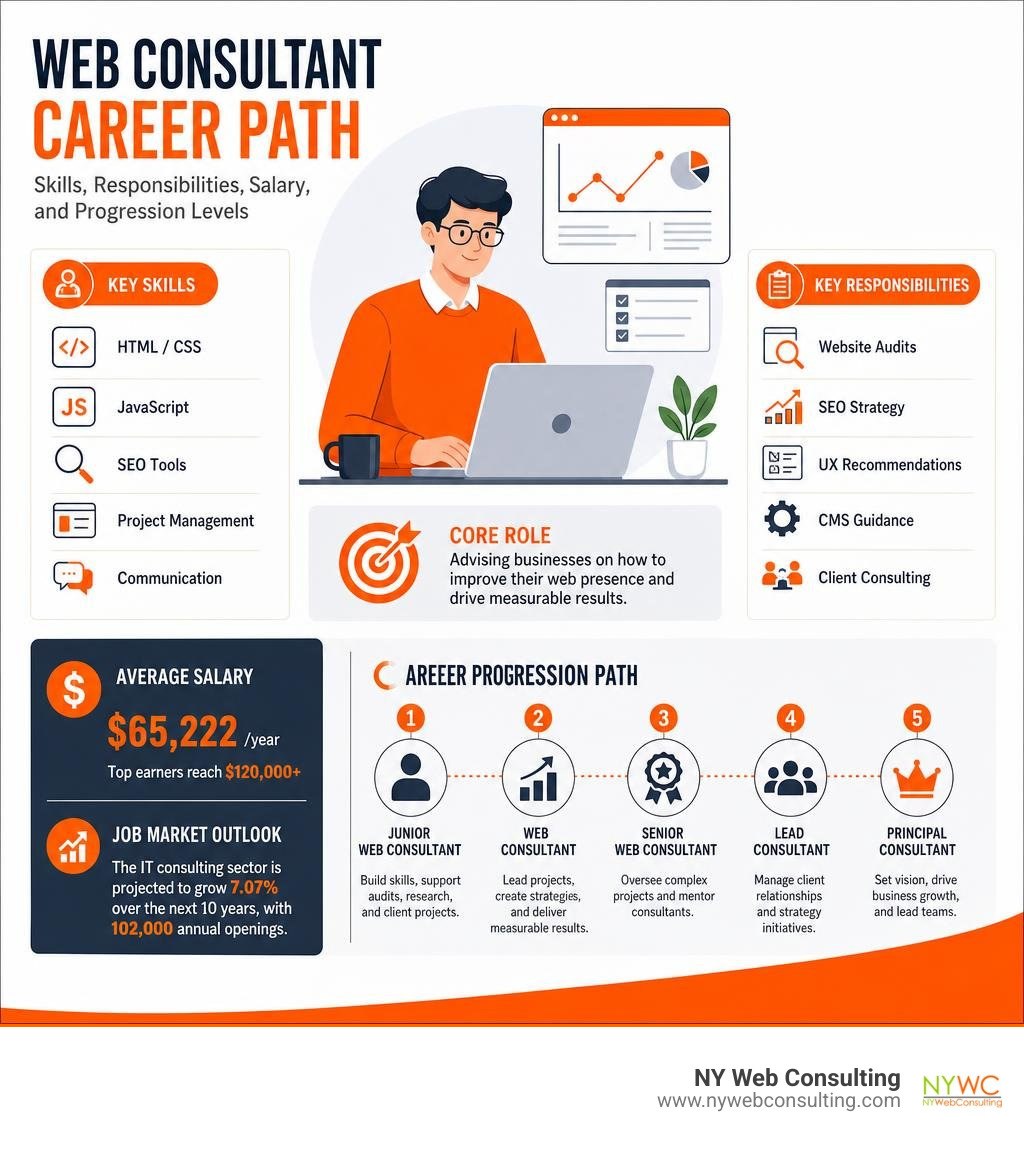
- Core role: Advising businesses on how to improve their web presence, not just building websites
- Key responsibilities: Website audits, SEO strategy, UX recommendations, CMS guidance, and client consulting
- Required skills: HTML/CSS, JavaScript, SEO tools, project management, and strong communication
- Typical education: Bachelor’s degree in computer science or related field (a strong portfolio can substitute)
- Average salary: $65,222/year, with top earners reaching $120,000+
- Job market: The IT consulting sector is projected to grow 7.07% over the next 10 years, with 102,000 annual openings
Whether you’re job hunting or hiring, understanding exactly what this role demands is the first step to getting it right.
The demand for web consultants is growing fast. Businesses of every size now realize that having a website isn’t enough — they need someone who can make it work. That means driving traffic, converting visitors, and keeping the site fast, secure, and accessible. A web consultant fills that gap between raw technical work and real business results.
As someone searching for clarity on this role, you’re in the right place. I’m Brian Butrym, founder of NY Web Consulting, a results-driven web design and marketing firm based in Glendale, Queens. My hands-on experience helping small businesses optimize their online presence gives me a practical, ground-level view of what a strong web consultant job description actually looks like in practice. In the sections below, I’ll break down everything you need to know to write a resume that gets you hired.
Understanding the Web Consultant Job Description
To build a resume that stands out to hiring managers in New York City, you must first understand what a web consultant actually does. Unlike a traditional developer who focuses solely on writing code, or a designer who focuses strictly on visuals, a web consultant is primarily an advisor.
According to the Web Consultant | Career Guide & Salary Info, web consulting is highly strategic. Your job is to analyze a client’s existing web presence, understand their core business objectives, identify technical or strategic gaps, and deliver clear, actionable recommendations.

When businesses partner with a Web Consulting Agency, they aren’t just looking for someone to change a font or swap an image. They are looking for digital transformation. They want to know:
- Why is our bounce rate so high?
- Which Content Management System (CMS) will scale with our business over the next five years?
- How do we structure our site architecture to maximize organic search traffic?
As a consultant, you must translate complex technical jargon into plain business language. You need to be as comfortable presenting in a corporate boardroom in Manhattan as you are troubleshooting a database issue or reviewing a JavaScript codebase.
Key Responsibilities of a Web Consultant
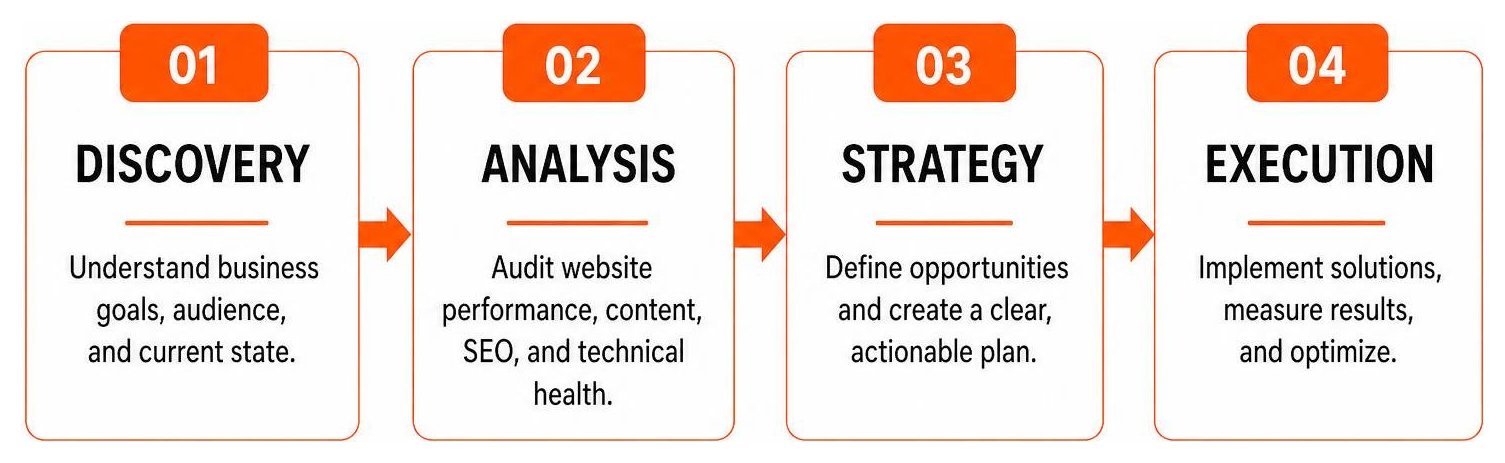
When you look at a modern web consultant job description, the responsibilities span several disciplines. Employers want a multi-faceted professional who can guide a project from initial discovery through to post-launch optimization.
If you are drafting your resume, your work experience section should directly reflect these core responsibilities:
- Comprehensive Website Audits: Evaluating existing sites for speed, mobile responsiveness, security, and search engine visibility.
- Conversion Rate Optimization (CRO): Analyzing user behavior to turn passive visitors into active leads or customers.
- Accessibility and Compliance: Ensuring digital assets adhere to modern ADA standards and WCAG guidelines.
- Platform Migration and Selection: Helping clients choose and transition between platforms like WordPress, Shopify, or headless setups.
- Collaboration and Project Management: Bridging the gap between the client’s stakeholders and the technical execution team, which may include a Web Development Agency or freelance designers.
To stand out, you should highlight your ability to map out the user’s journey. Demonstrating expertise in User Journey Mapping shows employers that you design web strategies around human behavior, which is exactly what drives real business results.
How to Align Your Resume with a Web Consultant Job Description
Hiring managers in 2026 scan resumes in seconds. If your resume looks like a generic list of coding languages, it will likely end up in the rejection pile. To get noticed, you must tailor your resume to mirror the specific consulting role you want.
When applying for the Best Consulting Jobs in New York City, NY 2026 | Built In NYC, focus your bullet points on outcomes rather than just tasks.
For example, instead of writing:
- “Responsible for updating client websites and writing HTML.”
Try framing it with a consulting and strategic focus:
- “Collaborated with executive stakeholders to audit and redesign legacy web platforms, resulting in a 25% increase in conversion rates and improved site speed across mobile devices.”
Highlight your client-facing experience. Mention your history of managing project scopes, handling client feedback, and delivering projects on time and within budget. This proves you have the professional maturity required to consult, not just execute.
Essential Skills and Qualifications for Web Consultants
To successfully land a role, your resume must showcase a balanced mix of technical expertise, business acumen, and soft skills.
A great consultant understands how to leverage modern platforms. For instance, knowing how to explain the benefits of a custom CMS setup versus a standard template is highly valuable. You can learn more about these strategic decisions in our guide on Building Brilliance: How to Use a CMS for Web Design Development.
Here is a breakdown of the essential skills that should appear on your resume:
- CMS Mastery: Deep familiarity with platforms like WordPress, Drupal, or modern headless architectures.
- Core Web Technologies: Strong foundational knowledge of HTML5, CSS3, and JavaScript.
- Analytical Tools: Proficiency in Google Analytics, Google Search Console, and heat-mapping software to back up your recommendations with hard data.
- SEO & Digital Marketing: Understanding clean URL structures, schema markup, and content strategy.
- Soft Skills: Active listening, complex problem-solving, and the ability to present technical recommendations clearly to non-technical business owners.
Technical Skills Required in a Web Consultant Job Description
While consulting is highly strategic, you still need a solid technical foundation. If a client’s website has “shoddy plumbing,” you must be able to diagnose it.
When applying for technical roles, such as a Developer (Web Application) | City of New York Jobs, employers look for specific technical competencies:
- Full-Stack Familiarity: You don’t need to be a daily backend developer, but you must understand database structures, API design, and integration.
- Performance Optimization: Knowledge of Core Web Vitals, browser caching, and content delivery networks (CDNs).
- Accessibility Compliance: A minimum of 2 years of experience in professional digital accessibility testing is highly valued, particularly for public sector and enterprise consulting roles. You should be well-versed in WCAG 2.1 AA standards.
- Version Control & CI/CD: Familiarity with Git workflows and modern deployment pipelines.
By listing these technical skills alongside your strategic consulting experience, you position yourself as a highly versatile asset who can both plan and oversee complex web projects.
Web Consultant Salary and Career Outlook in 2026
The career outlook for web consultants in 2026 is incredibly bright. As digital transformation continues to sweep through traditional industries, the IT consulting sector is projected to grow by 7.07% over the next 10 years, creating roughly 102,000 annual job openings across the United States.
Earning potential varies based on your experience level, location, and whether you work for an agency, a corporate firm, or as an independent freelancer.
| Experience Level | Typical Salary Range (USD) | Key Focus Areas |
|---|---|---|
| Entry-Level (1-2 Years) | $22,000 – $31,000 | Basic website audits, content updates, CMS management, and client onboarding support. |
| Mid-Level (3-5 Years) | $47,000 – $75,000 | Independent project management, UX/UI strategy, SEO audits, and platform migrations. |
| Senior / Remote Specialist (5+ Years) | $75,000 – $120,000+ | Enterprise architecture, custom API integrations, accessibility compliance, and high-level digital strategy. |
Across the United States, the overall average salary for a web consultant sits at $65,222 per year, with top-tier consultants and remote specialists easily commanding $101,000 to $120,000+ annually.
Frequently Asked Questions About Web Consulting Careers
What is the difference between a web consultant, web developer, and web designer?
This is one of the most common points of confusion in the industry. Think of building a website like building a commercial property:
- Web Designer: The architect. They design the layout, visual branding, and user interface.
- Web Developer: The construction crew. They write the code, set up the databases, and build the physical structure.
- Web Consultant: The real estate strategist and project supervisor. They analyze whether the building meets business goals, ensure it is accessible, verify that search engines can find it, and guide the overall digital strategy.
While many consultants have a background in design or development, their primary job is to advise and align these technical elements with the client’s business growth. You can see how these roles collaborate by exploring our professional Web Design Services.
Do I need a degree to become a web consultant?
While a Bachelor’s degree in Computer Science, Marketing, or Business is preferred by 62% of corporate employers, it is not a strict requirement. In the digital space, a strong portfolio of successful projects, real-world case studies demonstrating business ROI, and specialized certifications (such as Google Analytics, HubSpot, or IAAP WAS for accessibility) often carry far more weight than a degree.
What industries hire web consultants the most?
Web consultants are needed across almost every sector, but the highest demand comes from:
- Professional Services (28% of hires): Law firms, medical practices, and local service businesses.
- Technology & Information (10% of hires): Software companies and digital startups.
- Financial Services (10% of hires): Banks, insurance firms, and investment agencies.
- Local Commerce: Local businesses in Queens and across NYC looking to build high-converting lead generation tools.
Conclusion
Writing a resume that stands out in 2026 requires shifting your focus from “what I can build” to “how I can help a business grow.” By structuring your resume to match the strategic, analytical, and communicative demands of a modern web consultant job description, you will position yourself as a highly valuable partner for any organization.
At NY Web Consulting, based in Glendale, Queens, we live and breathe this strategic approach every day. We don’t just design websites; we build fast, secure, and SEO-friendly digital platforms that act as active lead generation engines for our clients.
If you are a business owner looking to transform your online presence, or a professional looking to understand how high-performing websites are built, we are here to help. Discover how we can accelerate your digital growth by visiting our Web Consulting Agency page today.