
Why Improving Your Website’s SEO Matters More Than Ever
To improve website SEO is to build a powerful engine for sustainable business growth. Success hinges on a few core principles:
- Create high-quality, people-first content that shows real expertise.
- Optimize your site’s technical foundation for speed and mobile-friendliness.
- Build authority with quality backlinks from reputable sites.
- Target the right keywords with clear search intent.
- Monitor progress with tools like Google Search Console to refine your strategy.
SEO is a marathon, not a sprint. Results take time—often several months—but the effort is worthwhile. Search engines and businesses share a common goal: connecting people with helpful, relevant content that solves their problems.
Google finds most sites automatically. Your job is to make your site easy for search engines and people to find, understand, and trust. A genuinely useful user experience is the foundation of good rankings.
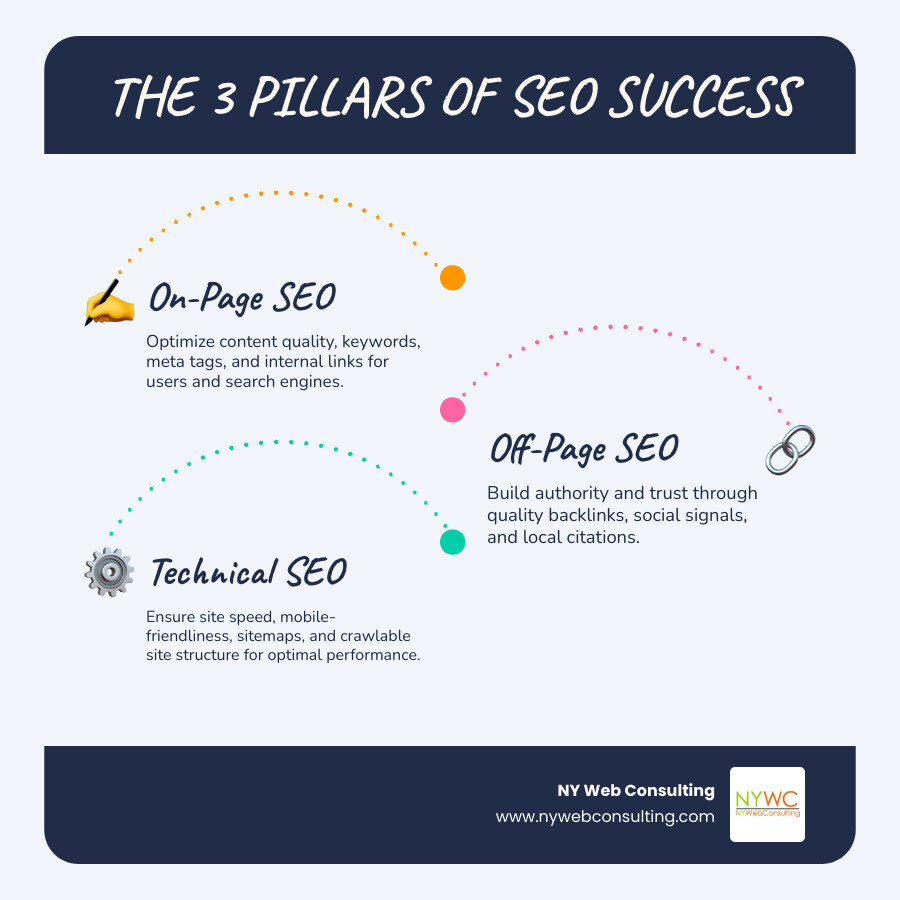
SEO rests on three pillars: great content (on-page SEO), endorsements from other sites (off-page SEO), and a fast, smooth website (technical SEO). Neglecting one weakens the others.
I’m Brian Butrym, and I help small businesses improve website SEO with fast, reliable websites that rank well. This guide offers practical, no-fluff strategies you can use today.
Simple guide to Improve website SEO terms:
The Foundation: Content and Keyword Strategy
A technically perfect site is useless if the content doesn’t connect with people. Content isn’t just a part of SEO—it is SEO. Google’s business relies on providing helpful results, so creating high-quality content is the most important ranking factor.
How to Improve Website SEO with High-Quality Content
In 2022, Google updated its E-A-T framework to E-E-A-T: Experience, Expertise, Authoritativeness, and Trustworthiness. The new “E” for Experience is crucial. Google now asks if your content shows it was produced with real-world experience, like using a product or visiting a place.
This is called people-first content. At NY Web Consulting, we encourage clients to share their real experiences—projects completed, problems solved, and lessons learned. This demonstrates authenticity that keyword-stuffed articles lack.
One powerful way to improve website SEO is through information gain. Instead of rehashing existing information, offer a new perspective, share proprietary data, or create unique visuals. When you provide information that can’t be found elsewhere, other sites are more likely to link to you.
Your content must also be helpful and readable. Use headings, short paragraphs, and visuals to break up text. Proofread carefully, as sloppy writing kills credibility.
Keeping content up-to-date is as important as creating new content. Outdated information can hurt your rankings. Regularly review and refresh existing pages. This is often easier than creating content from scratch and signals to search engines that your site is actively maintained. Updating builds on existing authority, while new content captures emerging keywords.
See examples of effective content on our blog.
Mastering Keyword Research and Search Intent
Keywords are the phrases customers use on Google. However, not all searches are equal. Understanding search intent—the user’s goal—is critical. Someone searching “leaking tap” has different needs than someone searching for “plumber in Queens.”
We start by identifying “money” keywords with commercial intent that drive leads and sales. Tools like Google Keyword Planner, Semrush, or Ahrefs help find terms with a good balance of search volume and competition.
Long-tail keywords are often more effective. Instead of the highly competitive “web design,” we might target “fast website design for small businesses in Glendale NY.” The search volume is lower, but the conversion rate is much higher.
We also use tools like Exploding Topics to find trending keywords and AlsoAsked to find the questions people are asking, which makes for great content ideas.
For each page, focus on one primary keyword and a few related terms. Analyze the top-ranking results for that keyword to understand what type of content Google prefers. The key is natural implementation. Include keywords in your title, URL, headings, and opening paragraph, but always write for humans first. Keyword stuffing is against Google’s spam policies.
Optimizing Meta Tags for Higher Click-Through Rates
Meta tags are your first impression in search results. They are crucial for earning clicks.
Your title tag, the headline in search results, is your most important on-page element. It should be unique, under 60 characters, and include your main keyword near the start.
The meta description is the short paragraph below the title. While Google may rewrite it, a well-crafted description can significantly improve website SEO by boosting your click-through rate. Keep it under 155 characters, include keywords naturally, and end with a clear reason to click. Write for people, not robots, and highlight the specific benefit your page offers.
On-Page and Technical SEO: Building a Search-Friendly Site
Great content and keywords need a solid technical foundation. On-page and technical SEO ensure your site is accessible to search engines and provides a good user experience.
Essential On-Page Optimization Techniques
On-page SEO involves optimizing visible elements to clarify a page’s topic for users and search engines.
- Header tags (H1, H2, H3) create a content roadmap. Each page needs one H1 tag with the primary keyword. Use H2s and H3s to organize subtopics, making content scannable.
- Internal linking is a powerful way to improve website SEO. Linking between pages on your site helps users find content and shows search engines which pages are important. Use descriptive anchor text to provide context.
- URL structure should be clean and descriptive (e.g.,
nywebconsulting.com/services/seo/). Keep URLs short, use hyphens to separate words, and include the primary keyword where it makes sense. - Images need optimization. Large images slow down websites. Compress them before uploading. For guidance, see How to Reduce Your Image File Size to Increase Website Speed.
- Alt text is a short description for each image. It aids visually impaired users and tells search engines what an image represents. Describe the image’s context. Check the W3 decision tree and Siteimprove’s best practices for more details.
Technical Fixes to Improve Website SEO Performance
Technical SEO works behind the scenes to help search engines crawl and index your site.
- Website speed is essential for ranking. Slow sites lose visitors. Use Google’s PageSpeed tool to test your site and measure Core Web Vitals—metrics for user experience like loading speed (LCP), interactivity (INP), and visual stability (CLS). Google’s Lighthouse tool offers more detail. Quick wins include image compression and minimizing code.
- Mobile responsiveness is mandatory. Google uses mobile-only indexing, so your site must work perfectly on smartphones. Test it with Google’s Mobile-Friendly Test.
- An XML sitemap is a map of your site for search engines. Submit it via Google Search Console. A robots.txt file tells crawlers which pages to ignore, like admin areas.
The Impact of User Experience (UX) on Rankings
Google observes how users interact with your site. While not direct ranking factors, user signals like a low bounce rate (users not leaving immediately) and high dwell time (users staying longer) indicate relevance and quality. The only way to improve these is to improve the user experience.
- Site navigation must be intuitive. Users should find what they need in a few clicks. Use clear headings, short paragraphs, and bullet points to make content scannable.
- Readability is also key. Use simple language (the Hemingway Editor can help) to make your content accessible. A great user experience turns visitors into customers. Learn more about User Experience Design.
Off-Page SEO: Building Authority and Trust
Off-page SEO is about building your reputation beyond your own website, like digital word-of-mouth. To improve website SEO, you need other sites to vouch for you. The most powerful form of this is link building.
The Importance of Authoritative Backlinks
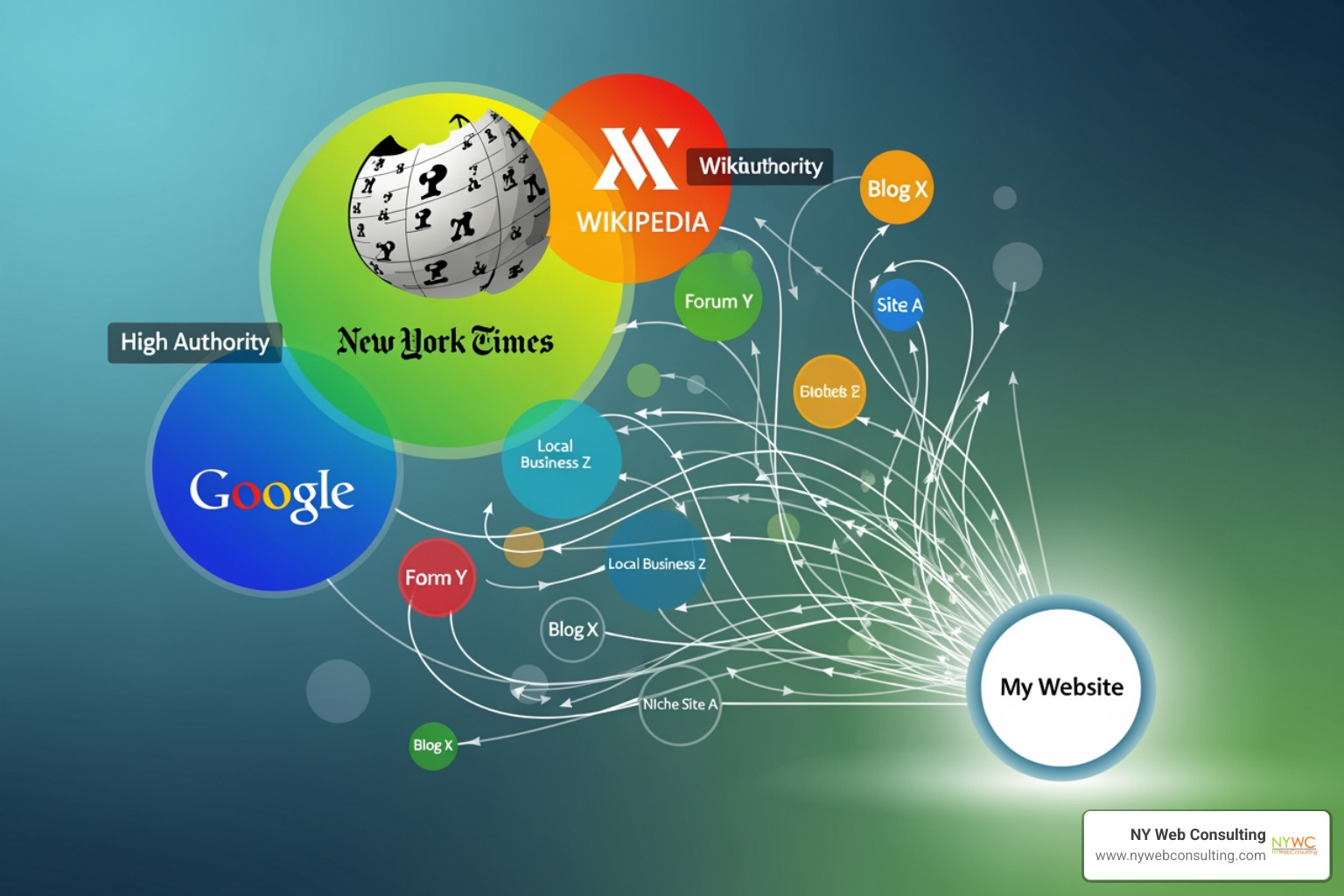
Backlinks are recommendations. A link from a respected source like The New York Times carries more weight than one from a random blog. Each backlink is a vote of confidence that search engines use to gauge your site’s trustworthiness. Google finds many pages through links, making them vital for being found.
Quality trumps quantity every time. A few links from authoritative sources are better than hundreds of spammy ones. We evaluate potential backlinks for relevance and domain authority. A link placed naturally within quality content is far more valuable than one buried in a footer.
Proven Strategies for Earning Quality Backlinks
The best backlinks are earned, not bought, as buying links violates Google’s guidelines.
- Create linkable assets: Produce content so valuable that others want to reference it. This includes original research, comprehensive guides, useful tools, or compelling infographics.
- Broken link building: Find broken links on relevant industry sites. Notify the site owner and suggest your content as a replacement. It’s a win-win: you help them fix their site and earn a quality backlink.
- Guest blogging and digital PR: Contribute content to reputable industry publications. This earns you a backlink and exposure to a new audience. Focus on publications your target audience reads.
Leveraging Local SEO for Community Presence
For businesses serving a specific area like Queens or New York City, local SEO is critical for appearing in “near me” searches.
- Google Business Profile: This free listing is the foundation of local SEO. Ensure your Name, Address, and Phone number (NAP) are complete and accurate. NAP consistency across the web is crucial.
- Local citations: These are mentions of your NAP on sites like Yelp or local directories. Even without a link, they help search engines verify your business information and improve local rankings.
- Online reviews: Reviews are a significant local ranking factor and build trust with potential customers. Encourage satisfied customers to share their experiences online.
Dominating local search can connect you with customers at the exact moment they’re ready to buy. Learn more in The Power of Creating a Google Business Profile in 2023.
Measuring Success and Adapting to the Future of SEO
SEO is never truly “done.” The digital landscape is always changing, so tracking progress and adapting your strategy is essential to improve website SEO for the long term.
Essential Tools for Monitoring SEO Progress
SEO tools are your dashboard for making smart decisions. Two free tools from Google are indispensable.
- Google Search Console shows how your site performs in search results. We use it to monitor impressions, clicks, and average position. It also alerts you to technical issues or penalties. A key strategy is finding queries with high impressions but low clicks—these are prime opportunities for content optimization. Get started with Google Search Console if you haven’t already.
- Google Analytics 4 shows what happens after users click to your site. It reveals visitor behavior, such as which pages are engaging, how long people stay, and whether they convert into leads. Setting up a free Google Analytics 4 account provides invaluable audience insights.
Review these reports at least monthly, focusing on long-term trends rather than daily fluctuations. The patterns that emerge over time tell the real story of your SEO performance.
Common SEO Mistakes to Avoid
Many well-intentioned site owners make avoidable SEO mistakes. Here are the most common pitfalls:
- Keyword stuffing: Awkwardly repeating the same phrase violates Google’s spam policies and reads poorly. Write naturally.
- Buying backlinks: This is a fast way to get penalized by Google. Earn links through high-quality content instead.
- Thin content: Pages with very little text offer no value. Comprehensive, helpful content almost always performs better.
- Ignoring mobile users: Google uses mobile-only indexing. If your site doesn’t work well on smartphones, it won’t be indexed.
- Forgetting alt text: These short image descriptions help with accessibility and search engine understanding. It’s a quick and easy fix.
Other issues include duplicate content, slow page speeds, and broken links. Regular site audits can catch these problems before they escalate.
The Evolving Role of AI in Search
AI is changing search, with AI Overviews summarizing results at the top of the page. This shift makes genuine human experience more valuable than ever. This is why Google added “Experience” to its E-E-A-T guidelines. They are actively seeking content that demonstrates real-world knowledge.
Information gain is your secret weapon. When AI can summarize generic information, content that offers something new—proprietary data, unique perspectives, or custom visuals—becomes far more valuable. Ask yourself: “Could an AI have written this, or does it reflect genuine insight?”
Lean into what makes your business unique. This authentic, experience-based content builds the trust and authority that turns visitors into customers. Your human insight is your most valuable asset. For more, review Google’s explanation of E-E-A-T.
Frequently Asked Questions about Website SEO
Business owners in Queens and across New York City often ask the same questions about how to improve website SEO. Here are the answers to the most common concerns.
How long does it take to see SEO results?
There’s no magic number. SEO is a marathon, not a sprint. While some minor changes can show results in days, the full impact of a strategy often takes 4-6 months to become clear. SEO is a long-term investment with cumulative effects. Each improvement builds on the last, creating momentum over time. Patience is key, but the lasting benefits of organic rankings are worth the wait.
What is the difference between on-page and off-page SEO?
Think of your website as a house.
- On-page SEO is everything you do inside your house to make it functional and inviting. This includes your content, site structure, technical performance (like speed), and clear labeling (like meta tags).
- Off-page SEO is everything you do outside your house to build its reputation. This is primarily about earning recommendations (backlinks) from other respected websites to establish your authority and trustworthiness.
Both are essential. A great house that no one knows about won’t get visitors, and a famous house that’s falling apart won’t keep them.
Is SEO better than PPC advertising?
This isn’t an “either/or” choice; they work best together.
- SEO (organic search) is like owning your property. It takes time to build, but once you rank, you receive consistent, free traffic that builds brand authority. The investment pays dividends for years.
- PPC (paid advertising) is like renting. You pay for immediate visibility and traffic. It’s great for short-term campaigns or getting leads while your SEO matures. When you stop paying, the traffic stops.
A balanced approach often yields the best results. PPC can provide immediate leads and data, while SEO builds a sustainable growth engine. Learn more about how paid ads can complement your strategy with More info about PPC Advertising.
Conclusion: Your Path to Sustainable SEO Success
To improve website SEO, you must integrate three pillars: high-quality, experience-driven content; a technically sound, fast website; and authoritative backlinks that signal trust.
SEO is not a one-time task but an ongoing journey. It requires patience, consistency, and a commitment to providing value. As search engines evolve and user expectations rise, one thing remains constant: websites that genuinely help people will always win.
At NY Web Consulting, we help businesses in Glendale, Queens, and across New York City turn their websites into powerful lead generation engines. We understand the local market and combine leading technology with a focus on user experience to build websites that don’t just look good—they perform.
Your website should be working for you every day, bringing in qualified leads. Whether you’re just starting or looking to advance your efforts, we can help you achieve the sustainable, organic growth your business deserves.
Ready to open up your website’s full potential? Start improving your website’s SEO today and let’s build something remarkable together.